Opening The Rift
therift
© 2026 The Rift. All Rights Reserved.
Subcontinental Sworn Enemies, Tyrannical Twins: Pakistan and India’s War on Democracy
The ruling establishments of Islamabad and New Delhi increasingly resemble the very tyranny they claim to oppose.

Key Takeaways
1 of 3
Automatically generated. Read full article for complete context.
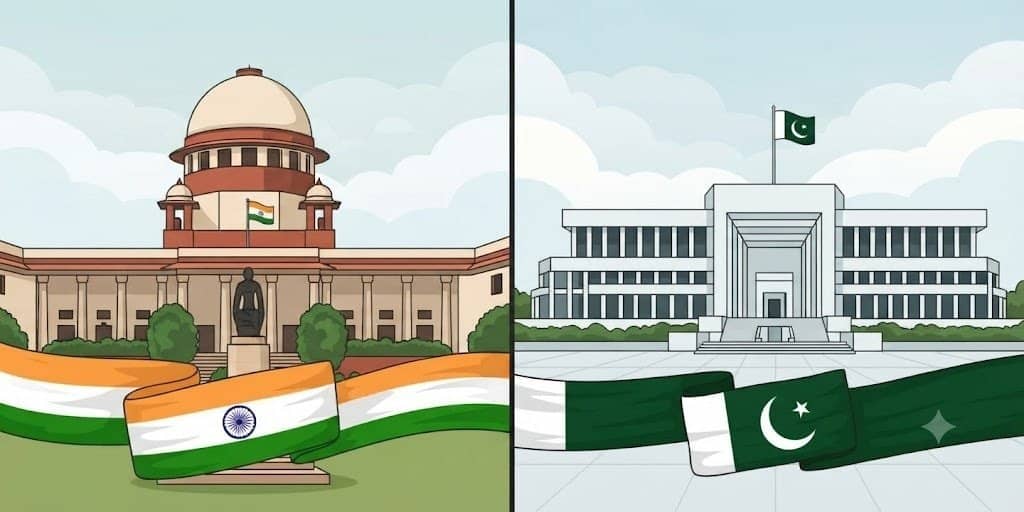
Two consecutive days, two brutal assaults on democracy, and one unmistakable truth: the ruling establishments of Islamabad and New Delhi increasingly resemble the very tyranny they claim to oppose.
India and Pakistan have spent eight decades manufacturing hatred across their borders. Yet behind the theatrical nationalism, their rulers have discovered a remarkable fraternity in repression. Different flags, different ideologies, different masters — but the same authoritarian playbook: crush dissent, criminalize opposition, weaponize state institutions, and dignify political persecution as national security.
On October 10, Narendra Modi’s government turned Delhi into a militarized fortress to suppress protests against the staggering deletion of approximately 130 million names from electoral rolls. The following day, Pakistan’s military-dynastic regime imposed emergency rule in Khyber Pakhtunkhwa, overthrowing Imran Khan’s elected provincial government.
The sworn enemies cannot agree on Kashmir. But when it comes to terrorizing political opponents and strangling democracy, their ideological differences evaporate.
In Pakistan, Field Marshal Asim Munir — Washington’s favored generalissimo of Rawalpindi — presides over a system of military supremacy masquerading as civilian government. The House of Sharif and House of Bhutto-Zardari function as its indispensable political accomplices: hereditary beneficiaries of a rotten arrangement in which generals wield power, dynasties enjoy its privileges, and ordinary Pakistanis pay the price.
President Zardari, acting on Shehbaz Sharif’s recommendation, extinguished the elected government of Khyber Pakhtunkhwa and handed authority to a federally appointed governor. Chief Minister Sohail Afridi was arrested amid an escalating campaign against Khan’s relatives, supporters, and elected representatives.
Their unforgivable crime? Refusing political surrender. Demanding Khan’s freedom. Challenging the generals’ assumed divine right to rule.
The pretext was terrorism — an obscenity of political hypocrisy from a military establishment that spent decades cultivating militant proxies, nurturing the distinction between “good” and “bad” Taliban, and turning Afghanistan into a graveyard of strategic delusions. Having helped incubate the very militancy now ravaging Pakistan, the generals invoke its horrors to justify crushing democratic opposition.
Spectacularly incompetent at ending terrorism, Pakistan’s military establishment displays ruthless proficiency at persecuting its political adversaries.
At the center of this machinery of persecution stands Imran Khan, imprisoned since 2023 yet politically unconquered. His continued influence exposes the establishment’s greatest humiliation: an incarcerated opponent can still command the loyalty that an entire coercive apparatus cannot purchase.
One prisoner confronts the generals, intelligence agencies, dynastic oligarchs, and their formidable machinery of intimidation. They can confiscate his freedom, but not his political significance.
The Sharifs and Bhutto-Zardaris, meanwhile, treat democracy as a family heirloom and constitutional principles as disposable conveniences. They denounce dictatorship when excluded from power and embrace its perpetrators when restored to office. Their supposed democratic convictions amount to little more than a cynical strategy for preserving dynastic privilege.
This is not some “constitutional crisis.” It is an authoritarian assault on popular sovereignty, conducted through arrests, intimidation, institutional subservience, and the calculated destruction of political competition. The constitution survives as ceremonial wallpaper while coercion governs.
Across the border, Modi’s Hindu-nationalist establishment reveals its own chilling appetite for authoritarian domination. The Special Intensive Revision has removed approximately 130 million names from electoral rolls, prompting allegations of disproportionate disenfranchisement of Muslims, Dalits, and other vulnerable citizens. Election authorities deny wrongdoing, but the extraordinary scale of the deletions demands independent scrutiny, not official self-exoneration.
Delhi’s response to protesters demanding accountability was a grotesque exhibition of state muscle: barricades, paramilitary deployments, transport shutdowns, internet restrictions, and thousands detained. The youth-led Cockroach Janta Party punctured the regime’s carefully cultivated image of invincibility by refusing to disappear quietly.
First put the vote in jeopardy. Then punish those who protest. Such is the perverse genius of authoritarian rule dressed in democratic clothing.
Modi’s majoritarian politics and Munir’s military-dynastic order differ in structure, but their methods increasingly converge: intimidate the opposition, bend institutions to executive power, and treat independent political mobilization as an existential threat. Their conduct exhibits the unmistakable logic of fascistic politics — the exaltation of state power over citizens’ rights and the attempted destruction of meaningful dissent.
Neither elections emptied of genuine competition nor constitutions stripped of practical authority can confer legitimacy. A captive media, compliant judiciary, militarized streets, and overflowing detention centers are not evidence of political strength. They are the instruments of rulers terrified of their own people.
The subcontinent’s greatest democratic enemies are not across its borders. They sit in each country’s corridors of power.
Generals can seize governments. Dynasties can prostitute democratic ideals. Demagogues can criminalize dissent. But no tyrant, however heavily armed or magnificently self-deceived, can manufacture the consent of a people determined to remain free.
Disclaimer:The views and opinions expressed in this article are those of the author(s) and do not necessarily reflect the official policy or position of The Rift.