Opening The Rift
therift
© 2026 The Rift. All Rights Reserved.
RSS, BJP: India’s Tilt Toward US Subservience
A critical look at the gradual shift in India’s foreign policy from non-alignment to increasing alignment with the United States.

Key Takeaways
1 of 3
Automatically generated. Read full article for complete context.
India’s foreign policy started with a policy of non-alignment, submitting neither to the US nor to Soviet Russia, the two poles of the Cold War eraCold War EraThe period of geopolitical tension between the United States and the Soviet Union and their respective allies, following World War II.. Pakistan was subservient to American designs right from the beginning, and as its democracy was overtaken by Muslim communal politics, the role of the US Ambassador, the Mullahs, and the Army came to the foreground there. Even today, fundamentalism in the name of Islam dominates in Pakistan, while its Army plays a very strong role. Either there have been military dictators one after the other, or the Army has had a strong say in political affairs.
The lunch invitation of US President Donald Trump to Field Marshal Asim Munir tells a story. While there are other components of Pakistan’s foreign policy, it was clearly marked by its pro-US orientation. It was jocularly said that Pakistan is ruled by three As—Allah, the American Ambassador, and the Army. This may be a gross generalisation, but what became clear was that when politics in the name of religion came to dominate the social scene, such a situation did happen in our neighbouring country.
India had its own path of non-submission to superpowers and carved its own path of all-round development, taking the help of different countries in the development of technology, industries, and education. One apparent example is the establishment of the five initial IITs, each with the help of different major countries.
India did not submit to superpowers’ pressure, most exemplified on the eve of the formation of Bangladesh. Richard Nixon, then US President, asked India to keep out of the happenings of East Pakistan, when the Pakistan Army was wreaking havoc in East Pakistan, leading to a massive exodus of refugees into India. Prime Minister Indira Gandhi boldly refused this diktat from Nixon.
Instead, Indira Gandhi signed a ‘Treaty of Friendship’ with Soviet Russia, and despite the presence of the US Seventh Fleet in the Bay of Bengal, the Indian Army intervened and helped the Mukti BahiniMukti BahiniThe guerrilla resistance movement formed by the Bengali military, paramilitary, and civilians during the Bangladesh Liberation War. liberate East Pakistan from the clutches of West Pakistan, which was trying to exploit East Pakistan to the extent of trying to impose Urdu as the national language. The Bengali-speaking East Pakistan rebelled, and India did not bow to the US threats and came to the rescue of the people of East Pakistan.
From 2014, there has been a gradual shift in Indian foreign policy, which is coming under the sway of the US and is developing close relations with Israel. Our traditional relations with Iran and Palestine are being sacrificed for the political orientation of the new regime.
In the aftermath of Operation Sindoor, there was military action between Pakistan and India. While India claimed that a ceasefire was brought about due to mutual discussion and a request from the Pakistan side, US President Donald Trump has repeatedly claimed that his administration had brought about a ceasefire between these two countries using the threat of economic pressure.
So far, in India, Pakistan has always been projected as enemy number one. There were people-to-people interactions through the Pak-India forum, and valuable initiatives, like ‘Aman ki Asha’ (Ray of Hope) between India’s national newspaper, The Times of India, and Pakistan’s newspaper, Daily Jang. Government-level blame games were always there. Kashmir remained a hot issue. Kashmiris kept suffering the fire of militants and terrorists coming from Pakistan, and the presence of the military in civilian areas for such a long time.
Now, the stance of the RSSRashtriya Swayamsevak Sangh (RSS)A right-wing, Hindu nationalist volunteer organization in India that is the ideological parent of the ruling BJP. and BJP (Bharatiya Janata Party) toward Pakistan seems to be changing. Dattatray Hosabale, the number two in the RSS, has said that the doors of dialogue should be open between India and Pakistan. The RSS combine kept raking up the Kashmir issue and blaming Nehru for mishandling the Kashmir issue.
The turmoil in Kashmir continued. It is true that earlier, during the Atal Bihari Vajpayee regime, he took a bus to Lahore to sort out matters. Despite that, the stalemate continued even after the reciprocal visit to India by Pakistan’s dictator Pervez Musharraf. Now, the statement of Hosabale comes as a breath of fresh air, giving a different impression regarding Pakistan than the usual one. RSS Chief Mohan Bhagwat tries to link it with the idea of ‘Akhand Bharat’Akhand BharatThe concept of an undivided India, envisioning the political unification of the Indian subcontinent.. Additionally, the earlier experiment of SAARCSAARCThe South Asian Association for Regional Cooperation (1985) , an intergovernmental organization and geopolitical union of states in South Asia. was not much promoted by the BJP regime. SAARC was a great experiment of regional cooperation amongst the South Asian countries.
While Hosabale claims that this has been the RSS policy all along, the emphasis on keeping the doors of dialogue open now has a different flavour in the political ecology of India-Pakistan relations. This statement of his comes after his recent US visit.
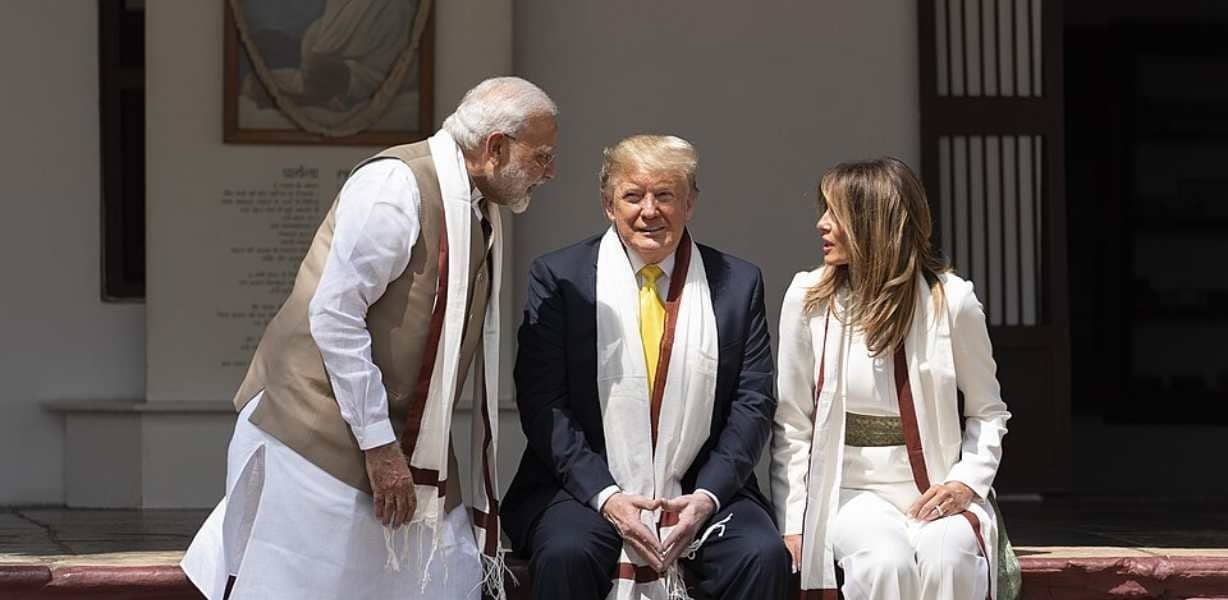
Many suspect that such a statement at this juncture may be under US pressure. While one cannot be certain of that, one thing that is definite is that India’s subservience to the US is on the rise. This was confirmed by the recent happenings where India quietly submitted to US pressure to raise the tariff from 3% to 50% and then bring it down to 18%. India meekly following instructions from the US not to buy oil from Russia was also part of the same series.
This got further confirmation from the statement, which was later withdrawn, by Ram Madhav, a prominent RSS-BJP leader. While speaking at Washington’s Hudson Institute, he said that India had tried to work with the US by conceding to its demands for a tariff hike and not buying oil from Russia. The gentleman went on to say, “Where exactly is India not doing enough to work with America.” When criticized, he was prompt enough to withdraw it; nevertheless, the cat was out of the bag.
Right from the beginning, the RSS was pro-US to the extent of even supporting the US in its invasion of Vietnam. Its earlier political progeny, the Bharatiya Jana SanghBharatiya Jana SanghAn Indian right-wing political party that existed from 1951 to 1977 and was the political arm of the RSS, later evolving into the BJP., was also against the cooperative model and public sector, which built the industrial structure of India. As Pakistan was under the umbrella of the US, it did not develop any substantive industrial, educational, and research infrastructure.
The present Indian regime is focused more on identity issues, temples, cow-beef, the rejection of Darwin’s theory, and the removal of the periodic table, while simultaneously promoting the blind faith babas of the ilk of Dhirendra Shastri, all while playing second fiddle to the US!
This submission to US might is, in a way, following the path of Pakistan, which right from the beginning submitted to the US and, in the process, blocked the avenues for the development of democracy and progress in the country.
This article is republished with permission from the author. It was originally published on NewsClick.
Disclaimer:The views and opinions expressed in this article are those of the author(s) and do not necessarily reflect the official policy or position of The Rift.