Opening The Rift
therift
© 2026 The Rift. All Rights Reserved.
Exposing “Speechless” Islamophobic Distortion
The “speechless” genre is trivializing and dishonest, reducing vital debates about religious authority and violence to a match with a winner and a weeping loser.

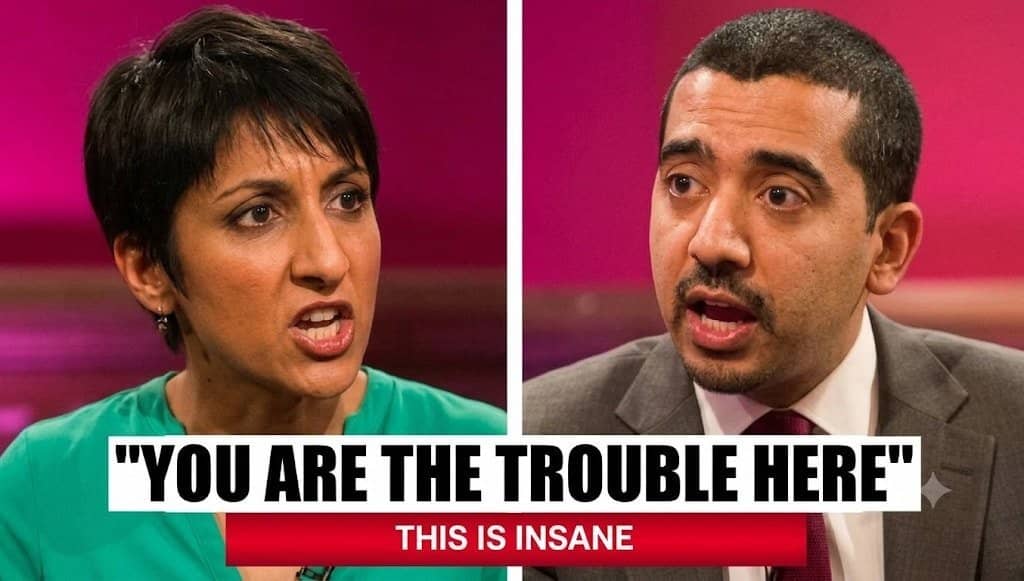
Via You tube Thumbnail
Key Takeaways
1 of 3
Automatically generated. Read full article for complete context.
Clickbait Histrionics, Missing States and the Manji-Hasan Exchange
In August 2026 an anonymous YouTube channel calling itself Speechless Rooms re-released a thirteen-year-old Al Jazeera programme under the title “Mehdi Hasan Starts CRYING After Irshad Manji Brutally HUMILIATES ISLAM With Facts”.
Hasan does not cry, Manji does not humiliate Islam, and the programme was not a debate between equals but an interview in which Hasan was the questioner.
This article does two things. First, it takes the title apart and shows what channels of this kind are built to do : manufacture emotional defeat, cast Muslims as props in a humiliation drama, and pass off an interchangeable template as reporting.
Second, it takes Manji’s arguments seriously, more seriously than the clip does, and shows where they fail : in loading responsibility for global extremism on poorly paid mosque functionaries, in reading the exception clauses of Qur’an 5:32 without the State that alone can apply them, and in a method that, followed to its end, would make every reader of a penal statute a lawful executioner and every lynch mob an enforcer of the law it breaks.
A Debate That Was Not, and Tears That Were Not
Begin with what actually happened. On 23 June 2013 Al Jazeera English broadcast an episode of its programme Head to Head titled “What is wrong with Islam today?”. It was recorded at the Oxford Union. The guest was Irshad Manji, the Canadian author of The Trouble with Islam Today and Allah, Liberty and Love.
Facing her was the presenter, Mehdi Hasan, supported by a panel of three: Shaykh Ibrahim Mogra, an imam and scholar from Leicester; Halla Diyab, a Syrian writer and women’s rights activist; and Myriam Francois-Cerrah, an academic and journalist. The episode ran for about forty-seven and a half minutes.
The format matters. Head to Head was built around a presenter who, in Al Jazeera’s own description, “goes head to head with a special guest, asking the probing and hard-hitting questions few dare to ask”, with an expert panel and a questioning audience. Hasan’s job that evening was to put Manji’s thesis under pressure. He was the examiner, not the examined.
A clip that presents him as a defeated debater collapsing under her “facts” has, before anything else, got the roles backwards.
Thirteen years later, on 26 August 2026, the episode resurfaced on Speechless Rooms (@Speechless.Rooms18) under the title quoted above. The edited version circulating with it appears to run to roughly half the length of the original broadcast.
Nothing in the exchange matches the title. Hasan is composed throughout and presses his questions as an interviewer should. No one cries. The title describes an event that did not take place, attached to footage of a different event that did.
Anatomy of the Title
The title deserves to be read as closely as a scriptural verse, because it was assembled with at least as much intent. Every element does a job.
“Starts CRYING” invents an emotion. It is the one claim in the title that a viewer could check against the footage, and it is false. Its purpose is not to inform but to promise a spectacle : the public breakdown of a prominent Muslim. “Brutally” borrows the vocabulary of physical violence and applies it to conversation, so that argument is experienced as assault and the viewer is invited to enjoy the beating.
“HUMILIATES” names the real product. The channel is not selling an argument about religious reform : it is selling humiliation, and humiliation needs a victim. “ISLAM” then reveals who the victim is. The supposed target is not Hasan, or even his arguments, but a faith followed by a quarter of humanity. Finally, “With Facts” is a seal of authenticity, an assurance that the humiliation is not prejudice but the verdict of reason.
The best evidence that the title is a template rather than a description is that it has been run in reverse. A second upload, indexed under the title “Irshad Manji Starts CRYING After Mehdi Hasan Brutally HUMILIATES …”, swaps the two names and keeps everything else. The same pattern appears across the channel’s listing, where a title such as “Muslim Heckler Starts CRYING After Katie Hopkins BRUTALLY HUMILIATES Him” follows the identical structure. The named people change. The Muslim who is reduced to tears does not.
There is a second victim the title rarely gets credit for : Manji herself. She is not an ex-Muslim and does not present herself as an enemy of the faith. Her stated thesis on the programme was that “we have allowed tribal culture to colonise the faith of Islam”. Her argument is that Muslims have failed Islam, not that Islam is a fraud. By announcing that she “humiliates ISLAM”, the channel conscripts a believing reformer into an anti-Islam pageant she did not sign up for, and turns an internal Muslim argument about interpretation into ammunition for people who reject the faith altogether.
Whatever one thinks of Manji, she is entitled not to have her words made to mean the opposite of what she said.
What channels of this kind actually do
Speechless Rooms is not unusual : it is a type. It is useful to set out plainly how the type works, because each technique is harmless-looking on its own and corrosive together.
First, anonymity without accountability. The channel publishes no identifiable editor, owner or address. It can fabricate a breakdown and suffer nothing for it, because there is no one to answer for it. Or its false, defamatory content.
Second, recycling other people’s broadcasts. The channel did not commission, record or moderate this exchange. It took a professionally produced programme, stripped away its context (the format, the panel, the audience questions, the date), cut it down, and put a new and false story on top of it. Nothing in the title tells the viewer that the “debate” is thirteen years old, that Hasan was the host, or that the original runs to about twice the length.
Third, invented emotion as the hook. The emotional event in the title is the one element that is not in the footage. That is not an accident of drafting. Emotion is what gets clicks, and invented emotion is cheaper to produce than real argument.
Fourth, out-group hostility as an engine. There is solid empirical work on why this pays. In a study of nearly three million social media posts from news outlets and members of the United States Congress, Rathje, Van Bavel and van der Linden found that language about political out-groups was among the strongest predictors of sharing : each additional out-group word substantially raised the odds that a post would be shared, by a much larger margin than emotional language in general. A title built on a humiliated religious minority is built for exactly that effect. Whether or not a given channel is directly monetised, the format is designed to harvest engagement.
Fifth, breaking a platform’s own rules. In December 2024 YouTube announced that it would step up enforcement, starting in India, against “videos where the title or thumbnail promises viewers something that the video doesn’t deliver”. A title promising tears that never fall is a textbook case. That such material continues to circulate shows how far the policy still has to go, and Indian viewers, the first audience for that enforcement drive, are entitled to report it as what it is.
Sixth, and most seriously, these channels lower the cost of contempt. Content that presents Muslims as weeping losers and Islam as something to be “humiliated” does not stay on a screen. It circulates in societies, India among them, where Muslims have been beaten and killed by mobs, and where the Supreme Court has had to remind the country that “the horrendous acts of mobocracy cannot be permitted to inundate the law of the land”. Humiliation entertainment does not cause lynching by itself. But it makes the humiliation of Muslims feel normal, and that normalisation is the ground in which worse things grow.
Taking Manji Seriously
Correcting the clickbait is the easy part. The harder and more useful task is to take Manji’s arguments on their merits, which the clip never does. Some of what she says is right. Selective quotation of Qur’an 5:32 is weak apologetics. The tradition of ijtihad, independent juristic reasoning, is real, and Muslims do need moral courage in confronting injustice done in their name. But at three points her reasoning fails, and the failures are connected.
A. The mullah as scapegoat: the malpractice analogy
Responding to the argument that religion, like medicine or architecture, is a field of specialised knowledge, Manji turns the analogy around : if doctors can be sued for malpractice when they cause harm, then mullahs should be held accountable for the harm their teachings cause.
The analogy sounds egalitarian. It fails on the facts of who these men are and what they are paid. A doctor is trained for years in state-accredited institutions, licensed by a statutory regulator, paid accordingly, insured, and works within hospitals and professional bodies that set and enforce standards. The ordinary mosque imam has none of this.
In Britain, the Imams Online Fair Wage Campaign of 2017 argued that imams in its network were earning below the national minimum wage, and research by Dr Riyaz Timol of Cardiff University, covering more than two thousand imams across over twelve hundred mosques, found that many work without contracts, or on zero-hours contracts with no paid leave, sick pay or pension, on call at all hours, and often holding second jobs to make ends meet.
In India the position is starker. Reporting from Maharashtra in November 2025 put the pay of imams at smaller mosques at between Rs 7,000 and Rs 15,000 a month, and that of migrant imams in Mumbai at Rs 10,000/- to Rs 12,000/- : the story that prompted the report was an imam selling eggs and groceries in his mosque compound to get by.
These are the people Manji’s framework asks to answer for global extremism. On a wage below that of a junior clerk, the local imam is expected to lead prayers, teach children, marry and bury the community, counsel the troubled, give the response to every atrocity reported on television, refute online recruiters, and speak for his community to the State and the press. He is expected, in short, to be a theologian, social worker, public intellectual and statesman at once. No profession is held to that standard, and certainly not one paid like this.
There is also a contradiction at the heart of the argument. Manji wants to strip the scholars of interpretive authority, so that every believer reads for himself, while holding them responsible for what believers do with their readings. Responsibility without authority is not accountability : it is scapegoating. In every legal system known to me, liability follows control. One cannot both deny the doctor any say over the patient’s treatment and then sue him for the result.
Indeed, the analogy cuts against her. Medical malpractice presupposes a doctor-patient relationship, a recognised standard of care, and a court to decide whether that standard was breached. No doctor is liable for a man who diagnosed himself from a textbook he found online and took the wrong drug. Yet the self-taught reader who lifts the exception clause out of 5:32 and acts on it is exactly that man. The “do-it-yourself Islam” against which Hasan and the panel warned is not the cure for this harm : it is the condition in which it thrives. If anything, the malpractice analogy is an argument for better-trained, better-paid, properly accountable scholars, which is the opposite of the conclusion Manji draws from it.
B. Qur’an 5:32 and the missing State
Manji’s sharpest point concerns Qur’an 5:32, the verse moderates often quote to show that Islam forbids killing. She observes, correctly, that the popular quotation drops a qualification. The verse, which is framed as a decree to the Children of Israel, reads in its operative part:
“… whoever kills a soul unless for a soul or for corruption \[done\] in the land, it is as if he had slain mankind entirely; and whoever saves one, it is as if he had saved mankind entirely.”
From this she argues that the verse contains exceptions under which killing is permitted, and that moderates who ignore those exceptions leave the field to extremists who exploit them.
The text is quoted accurately. The reasoning is not. Manji treats the exceptions as if they were permissions addressed to anyone who reads them. They are nothing of the kind. “For a soul” refers to retribution (qisas) for murder, and “corruption in the land” (fasad fi al-ard) to a category of grave public crime. Both are categories of legal punishment, and legal punishment in Islamic law, as in every developed legal system, belongs to the public authority which means a recognised sovereign, a ruler acting through courts, with evidence, procedure and the right of the accused to be heard.
The classical jurists treated the imposition of fixed penalties (hudud) as the prerogative of the ruler or his appointed deputy, and denied it to private persons. Even qisas, where the victim’s heirs hold the right, is claimed through a judge and not taken in the street.
The Qur’an’s own text points the same way. The very next verse, 5:33, sets out the penalty for those who “wage war against Allah and His Messenger and strive upon earth \[to cause\] corruption”, and 5:34 immediately exempts “those who return \[repenting\] before you apprehend them”. A provision that speaks of apprehending offenders and of a point in time after which repentance no longer avails is a provision addressed to an authority with the power to arrest, try and sentence. It is a penal clause, not a licence.
Similarly, 17:33 forbids killing the soul that Allah has made sacred “except by right”, and “by right” is a juridical phrase: it asks whether a lawful process has been followed, not whether an individual feels justified.
Modern Muslim scholarship says the same thing, in terms addressed precisely to those who take these verses into their own hands. The 2014 Open Letter to Abu Bakr al-Baghdadi, initially signed by 122 Muslim scholars, states among its basic propositions that “it is forbidden in Islam to inflict legal punishments without following the correct procedures to ensure justice and mercy”. That is the mainstream position. It was the position of the scholarly consensus that Hasan invoked on the programme. It is the position Manji’s argument leaves out.
By leaving it out, Manji ends up reading the verse exactly as the extremists do. Both treat an exception within a prohibition on killing as a grant of the power to kill, and both read the text without the institution that the text presupposes.
The difference is only that the extremist welcomes the conclusion and Manji fears it. Her critique of the moderates therefore rests on accepting the extremist’s method and then complaining about where it leads.
C. The penal code test: does naming a crime license it?
The point becomes obvious once it is moved from scripture to statute. Every modern penal code prescribes severe punishments, including in many jurisdictions death, for grave crimes. Section 103(1) of the Bharatiya Nyaya Sanhita, 2023, punishes murder with death or imprisonment for life. No lawyer in India would conclude that because the code prescribes death for murder, any citizen who believes his neighbour to be a murderer may hang him. The punishment is real, but it belongs to the State, and the State itself may not carry it out without a trial, a conviction and, in the case of a sentence of death passed by a Court of Session, confirmation by the High Court.
Now apply Manji’s method consistently. If an exception in a sacred text that permits killing “for a soul” authorises the individual reader, then a statute that prescribes death for murder authorises the individual citizen. Carry the argument one step further and it becomes absurd. Section 103(2) of the Bharatiya Nyaya Sanhita deals specifically with murder committed by “a group of five or more persons acting in concert” on the ground of race, caste, community, sex, place of birth, language, personal belief or any other similar ground, and provides that “each member of such a group shall be punished with death or with imprisonment for life”. This is Parliament’s response to mob lynching. On Manji’s reading of 5:32, the fact that the law mentions the mob would make the mob part of the law. A provision written to punish lynching would become evidence that lynching is lawful.
The Supreme Court of India has answered this as plainly as can be done. In Tehseen S. Poonawalla v. Union of India the Court held that “no one, and we repeat no one, is entitled to take the law into his own hands”, that “the law never confers the power on a citizen to become the law unto himself or take law into his hands”, and that the States have “the onerous duty to see that no individual or any core group take law into their own hands”.
Substitute “scripture” for “law” and that is the classical Islamic position on hudud. Both legal orders separate the existence of a punishment from the authority to carry it out, and both give that authority only to a public institution bound by procedure.
Both legal orders also recognise a separate and narrow right that should not be confused with punishment: the right to defend oneself or another against an imminent attack. Indian criminal law preserves the right of private defence; Islamic law recognises the repelling of an aggressor.
Neither is a licence to punish. Self-defence exists to stop an attack in progress; punishment comes after judgment. An argument that blurs the two, as a stripped-down reading of 5:32 does, removes the line that separates a legal system from vigilante violence.
An old error with a new purpose
The idea that every believer may read the text and act on it as judge and executioner is not new in Islamic history. It is the founding error of the Kharijites, the first sect to break away violently from the Muslim community. When they rose against the Caliph Ali under the slogan “There is no rule but for Allah”, Ali’s reply, preserved in the canonical collections, was: “A word of truth by which falsehood is intended.”
The slogan was a quotation from scripture, accurate as far as it went. What made it false was the claim it was used to support, that the believer needs no institution, no scholar and no court between himself and the sword.
Manji is no Kharijite, and her purpose is the opposite of theirs. But her method of reform, scripture read alone, authority dismissed, and exceptions read as licences, has the same structure. A reform built on that structure does not make Islam safer for liberal values.
It hands the text to whoever reads it most aggressively. The history of modern radical movements that made a point of dismissing the traditional scholars should give any reformer pause before calling for less scholarship rather than better scholarship.
Two Reductions
The clip and the argument fail in ways that mirror each other. Manji reduces fourteen centuries of legal reasoning to a single question, “does the text allow killing?”, and answers it by reading the text without the institutions that give it legal force.
Speechless Rooms then reduces her reduction further, turning a serious, if flawed, argument into a cartoon in which one Muslim weeps and another “humiliates Islam”.
The first reduction gets rid of the State; the second gets rid of the argument.
What remains is spectacle: a quarrel about whether scripture licenses violence, settled by footage edited to suggest that someone cried.
This is what makes the “speechless” genre trivialising and not just dishonest. A real debate about religious authority, reform and violence is too important to be settled by a thumbnail. When it is turned into a match with a winner and a weeping loser, the substantive questions disappear : who may interpret, who may punish, and who must answer for harm.
The audience is told that it has watched a demolition. It has watched nothing of the kind, and it leaves knowing less than when it started.
Mehdi Hasan did not cry. Irshad Manji did not humiliate Islam, and did not try to. The exchange was a robust interview at the Oxford Union in 2013, repackaged in 2026 by an anonymous channel whose titles are interchangeable templates of Muslim humiliation, applied without regard to who said what. Exposing that is a matter of simple accuracy.
Manji’s reasoning also deserves to be answered, and it can be answered on its own terms. Her malpractice analogy places the burdens of a profession on men who are given none of its standing, pay or protection, or authority, and if pursued it argues for investing in scholars, not discarding them.
Her reading of 5:32 isolates the exception clauses from the public authority that alone can apply them, and repeats the extremist’s method while condemning his conclusions. Her method, tested against any penal code, ends in the absurdity that the law’s mention of a lynch mob makes the mob lawful, a conclusion that the Supreme Court of India and the classical jurists have both rejected in nearly the same words.
If reform is to come, it will come through institutions that are properly funded, scholars who are trained and paid as the professionals they are expected to be, and a firm distinction between the text’s penalties and the power to impose them.
It will not come from the self-appointed reader with a verse and a grievance, and it will not come from a channel that tells its viewers someone cried.
Both Islam and Muslims have the courage and the ability to interpret the verses of the Qur’an to see its glorious illumination enlighten the world. And the Manjis and the Speechless falsifications can stand around and watch.
Jai Hind
Disclaimer:The views and opinions expressed in this article are those of the author(s) and do not necessarily reflect the official policy or position of The Rift.
*IslamophobiaIndian LawIrshad ManjiMedia BiasMehdi HasanQur'an InterpretationReligious ReformYouTube Misinformation