Opening The Rift
therift
© 2026 The Rift. All Rights Reserved.
Red Alert! Urgent Peace Steps Needed to Prevent the Baltic Crisis from Blowing Up into War
Can the Baltic countries and their border with Russia and Belarus become the scene of the most dangerous war of present times? A warning on the escalating tensions.

Representative Image
Key Takeaways
1 of 3
Automatically generated. Read full article for complete context.
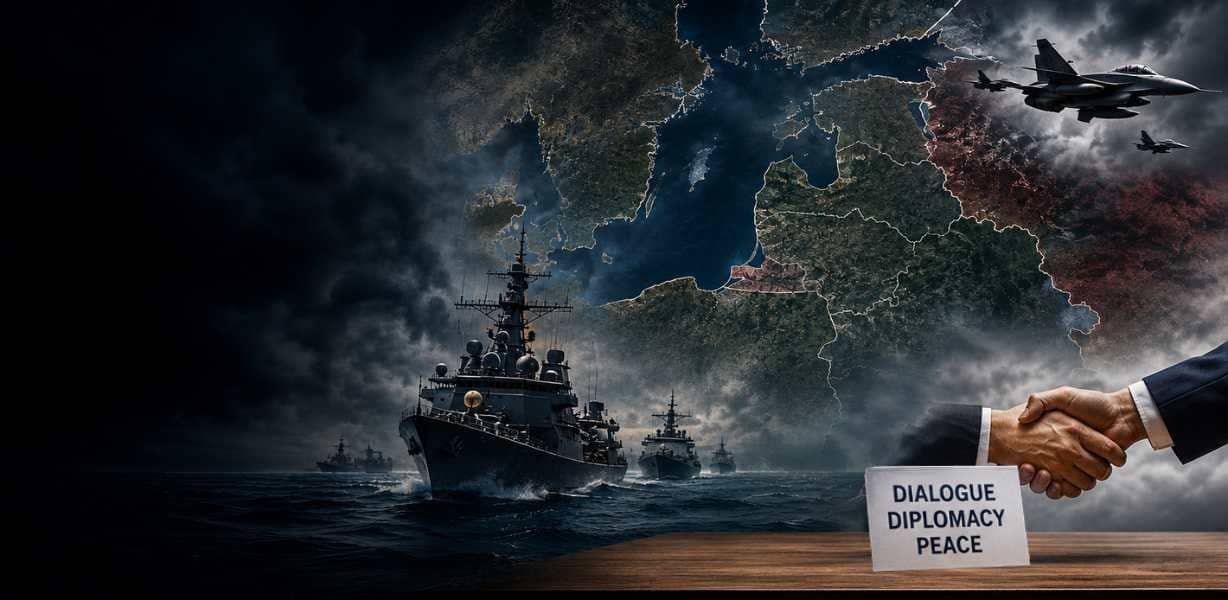
Can the Baltic countries and their border with Russia and Belarus become the scene of the most dangerous war of present times? Without sounding too alarmist, it needs to be emphasized that the possibility of this certainly exists. In recent days, the Baltic crisis has become important enough for the government of Latvia to collapse suddenly and for big threats to be issued regarding the possibilities of escalation.
While the Baltic countriesBaltic CountriesThe three sovereign states in Northern Europe on the eastern coast of the Baltic Sea: Estonia, Latvia, and Lithuania. are very small countries with a combined population of just over 6 million, it is their geo-strategic importance of bordering Russia and Belarus, and proximity to the Russian exclave of KaliningradKaliningradA Russian exclave situated on the Baltic Sea, bordered by Poland to the south and Lithuania to the north and east., which has given them a special place of importance in the context of hostilities between the western world and Russia.
All three Baltic countries (Latvia, Estonia, and Lithuania) are members of NATO as well as the European UnionEuropean Union (EU)A political and economic union of 27 member states located primarily in Europe.. Despite these being very small countries, they have been given an important place in the European foreign policy establishment and decision-making. This is also seen to be related to the fact that due to a complex of reasons anti-Russian feelings have been strong in the Baltic countries. These three countries have sided strongly with Ukraine in the ongoing Russia-Ukraine war.
Recently, there have been several cases of Ukraine’s drones meant for attacking Russia entering the airspace of the Baltic countries and passing through on their way to attack Russian targets. When these also hit oil storage facilities in Latvia, this led to a domestic crisis and the collapse of this country’s government. However, the bigger threat to world peace exists in the perception of Russia, openly voiced in the form of strong allegations, that the Baltic countries have intentionally allowed their airspace to be used to attack Russia. While Russia’s allegations derive support from several unnecessarily hostile statements issued from the Baltic countries or their representatives, these are denied by the Baltic countries and Ukraine, who say instead that the Ukrainian drones could have been diverted towards the airspace of the Baltic countries by electronic jammingElectronic JammingThe deliberate radiation, reradiation, or reflection of electromagnetic energy for the purpose of disrupting enemy use of the electromagnetic spectrum. caused by the Russians.
While the truth can only be verified by an impartial investigation by experts, the fact remains that in the middle of other hostile statements the tension has escalated rapidly. Russia has issued retaliation threats if there are future cases of Baltic countries’ airspace being used for drone attacks on Russia, and this has led to even more hostile statements against Russia.
If the situation deteriorates further and Russia actually attacks some sites in Baltic countries then, even if it is a small and largely symbolic attack that does not cause much harm on the ground, its implications will be huge and colossal. As this means a Russian attack on NATONATOThe North Atlantic Treaty Organization is an intergovernmental military alliance of North American and European countries. member countries, then will it mean further that the NATO forces will make counter-retaliatory attacks on Russia? Historically so far there has been no direct war between Russia on the one side and NATO or any NATO member country on the other side. No NATO member country has ever directly attacked Russia. Russia has never directly attacked any NATO member country. If this happens now in the Baltic countries, then this would be very close to the beginning of the Third World WarThird World WarA hypothetical future global conflict, generally expected to involve the use of nuclear weapons and cause unprecedented devastation..
Under Trump’s leadership, the USA has been distancing itself from Europe’s present and future warfare, and so it is unlikely that the USA will jump into such actions, at least in the initial stages. However, the bigger European countries like Germany, the UK, and France with all their hostility to Russia are unlikely to stand aloof. In any case, they are supporting Ukraine against Russia in many ways already without declaring open war, but in the case of Russian strikes on Baltic countries, the Big Three of Europe may join the war against Russia more directly. Poland being closer to the Baltic countries may also do so. Although we do not know to what extent such involvement of these countries will go initially, we know that once involvement starts it can go on increasing. It is easier to enter a quagmireQuagmireA complex or hazardous situation from which it is difficult to extricate oneself, often used to describe intractable military conflicts. than to exit.
Normally people assume that Russia, being a much bigger military power, has a big advantage in any possible war against the Baltic countries. However, the reality is that due to its ongoing war with Ukraine, the availability of Russian soldiers in Kaliningrad is very limited. It is estimated at present to be much less than the strength of the armed forces of the three Baltic countries. If Poland also comes to the help of the Baltic countries, then the Russian forces would be heavily outnumbered. The situation for Russia would become even more difficult with the active involvement of other NATO members in the war, particularly bigger powers like Germany, the UK, and France. It should not be forgotten that the present leadership of the UK and Germany, in particular, has been very hostile towards Russia, and they are supported by sections of their population that have strong, non-rational hostility against Russia. Both of these countries have no shortage of warmongersWarmongersIndividuals or leaders who encourage or advocate for aggression or warfare toward other nations or groups..
However, once Russia faces an existential crisisExistential CrisisIn a geopolitical context, a situation where a nation’s very survival as an independent sovereign entity is under severe threat. with too many countries attacking it, it has the option of using nuclear weapons. Russia has the highest number of nuclear weapons among all countries in the world. Russia also has thermonuclear weaponsThermonuclear WeaponsAlso known as hydrogen bombs, these weapons use a secondary fusion reaction to create explosive yields exponentially larger than early atomic bombs. or hydrogen bombs, whose destructive capacity is much higher than that of standard nuclear weapons. Hence, this war, which starts with conventional weapons, can very quickly move towards nuclear weapons. If Russia uses nuclear weapons, then, on the other hand, the UK and France can also do this (even if the USA stays away), thus leading to a very destructive exchange of nuclear weapons which will devastate western as well as eastern Europe directly, as well as in the form of the longer-term impact of radiation. This can cause millions of deaths, and its adverse impacts can spread beyond Europe.
Some may say that leaders will not allow the situation to go to such levels of destruction, and I am also not saying that this is likely to happen. What I am saying and warning is that such possibilities exist, and when such huge destruction is involved and such highly destructive weapons exist that are deployed in a state of readiness, when even their use based on misunderstanding and suspicions is possible, then it will be extremely stupid and short-sighted if the most dangerous but real possibilities are ignored or neglected.
Hence the most rational and safe course of action now is for all countries involved, including the USA, to take immediate steps to defuse the tensions and stop the possibilities of any escalation in the dangerous area in Baltic countries and close to the borders of the Baltic countries with Russia and Belarus.
Disclaimer:The views and opinions expressed in this article are those of the author(s) and do not necessarily reflect the official policy or position of The Rift.