Opening The Rift
therift
© 2026 The Rift. All Rights Reserved.
If exit polls are science, who is funding the experiment?
Exit polls in India no longer predict elections, they produce a media event, a financial stimulus, and a political atmosphere with the ultimate goal to mint money beside others.


Representative Image
Key Takeaways
1 of 3
Automatically generated. Read full article for complete context.
There is an old distinction in the philosophy of science between a prediction and a projection. A prediction submits itself to falsification: it specifies its assumptions, publishes its method, and accepts the consequences when reality disagrees. A projection, by contrast, is an assertion dressed in the language of data, designed not to be tested but to be consumed. The Bengal exit polls of 2026, taken as a body of work, are projections in precisely this sense. Today’s Chanakya hands the BJP 192 seats. People’s Pulse gives the TMC 177 to 187. That is not a margin of error. That is two entirely different elections being described by agencies operating in the same state, surveying the same electorate, on the same days, and arriving at conclusions separated by roughly a hundred seats. Neither agency will tell you how it got there.
It is worth pausing on that last point, because it is the one that collapses the entire edifice. In any serious democratic tradition, a polling agency that publishes a seat projection is expected to accompany it with a methodological appendix: the sample size at the constituency level, the respondent selection criteria, the demographic weighting model, the formula by which raw vote-share data is converted into seats, and the margin of error. In the United States, YouGov publishes all of this. So does Ipsos wherever they conduct the polls. In India, the audience gets a number, a party logo, a television graphic, and a panelist shouting over another panelist. Though, this was not the case always. Section 126A of the Representation of the People Act governs when exit polls may be published, not how they must be conducted. The Election Commission’s own guidelines ask for disclosure of methodology and margins of error, but these are advisory, carrying no legal force. The result is an industry that claims scientific authority while operating under no scientific obligation whatsoever. One may concede that polling a country as vast and heterogeneous as India is genuinely difficult. The challenge of converting vote shares into seat counts under a first-past-the-post system is real, and even sophisticated models can miss constituency-level swings. But difficulty is not an alibi for opacity. The harder the task, the greater the obligation to show your work. The refusal to do so is not a methodological limitation, it is apparently a commercial decision.
A dramatic prediction generates more viewership than a cautious one. The incentive structure is, in this sense, perfectly legible.The more definitive the projection, the higher the rating. The higher the rating, the more expensive the ad slot.
Consider the current Bengal numbers more carefully. Chanakya Strategies projects 150 to 160 BJP seats. Matrize says 146 to 161. P-Marq estimates 150 to 175. These are not independent data points converging on a truth. They are wide, overlapping bands of guesswork wearing the costume of statistical rigour. A range of 142 to 175 for a single party in a 294-seat assembly tells the viewer almost nothing, except that the agency itself is uncertain. The question is why this uncertainty is then broadcast with the confidence of a verdict.
The answer lies not in methodology but in money. Reportedly, for news channels election season commands advertising rates 20 to 30 times higher than regular programming . Exit poll specials are tentpole events, the Super Bowl of Indian television news, and their value lies not in accuracy but in spectacle. A dramatic prediction generates more viewership than a cautious one. The incentive structure is, in this sense, perfectly legible.The more definitive the projection, the higher the rating. The higher the rating, the more expensive the ad slot. None of this requires the projection to be correct. It requires it to be exciting. And exciting it is: prime-time anchors announce seat numbers as though reading out court judgments, complete with colour-coded maps, animated bar charts, and the performative gravity of a countdown.
For the pollsters themselves, the economics are more revealing still. Exit polls are often financially marginal or outright loss-making as standalone products. The real income comes from political parties themselves, many of which retain these same agencies as private consultants, commissioning internal surveys, booth-level analyses, and strategic assessments that are never made public. But these associations are not disclosed. The agencies project themselves as independent and autonomous entities, even as their commercial survival depends on relationships with the same political ecosystem they claim to measure objectively. There are no regulations in India requiring disclosure of who funds or commissions a specific exit poll. The audience has no way of knowing whether a projection is an independent statistical exercise or a paid narrative laundered through the language of data. When the same firm that advises a party’s campaign strategy also publishes that party’s projected seat count on national television, the conflict of interest is not a suspicion; it is a structural feature.
The track record, to be fair, speaks for itself. In 2021, nearly every major agency predicted a tight BJP-TMC contest in Bengal. The TMC won 215 seats. The BJP got 77. Most pollsters had overestimated the BJP by roughly 50 seats and underestimated the TMC by over 60. Today’s Chanakya, which now projects 192 BJP seats in 2026, earned its national reputation on a famously accurate 2014 Lok Sabha prediction. It also earned a formal apology after its 2015 Bihar forecast, where it predicted 155 seats for the BJP-led alliance; the actual winner was the Mahagathbandhan. The firm blamed a “computer template coding” glitch that allegedly swapped the two alliances’ numbers, an explanation that strained credulity then and strains it further with repetition. In Haryana 2024, nearly every poll projected a Congress wave; the BJP retained power. In the 2024 Lok Sabha, several agencies forecast 350-plus NDA seats; the final tally fell significantly short. These are not random misses scattered evenly across the political spectrum. They skew in identifiable directions, and the pattern has been consistent enough, and long enough, to suggest something more systematic than incompetence.
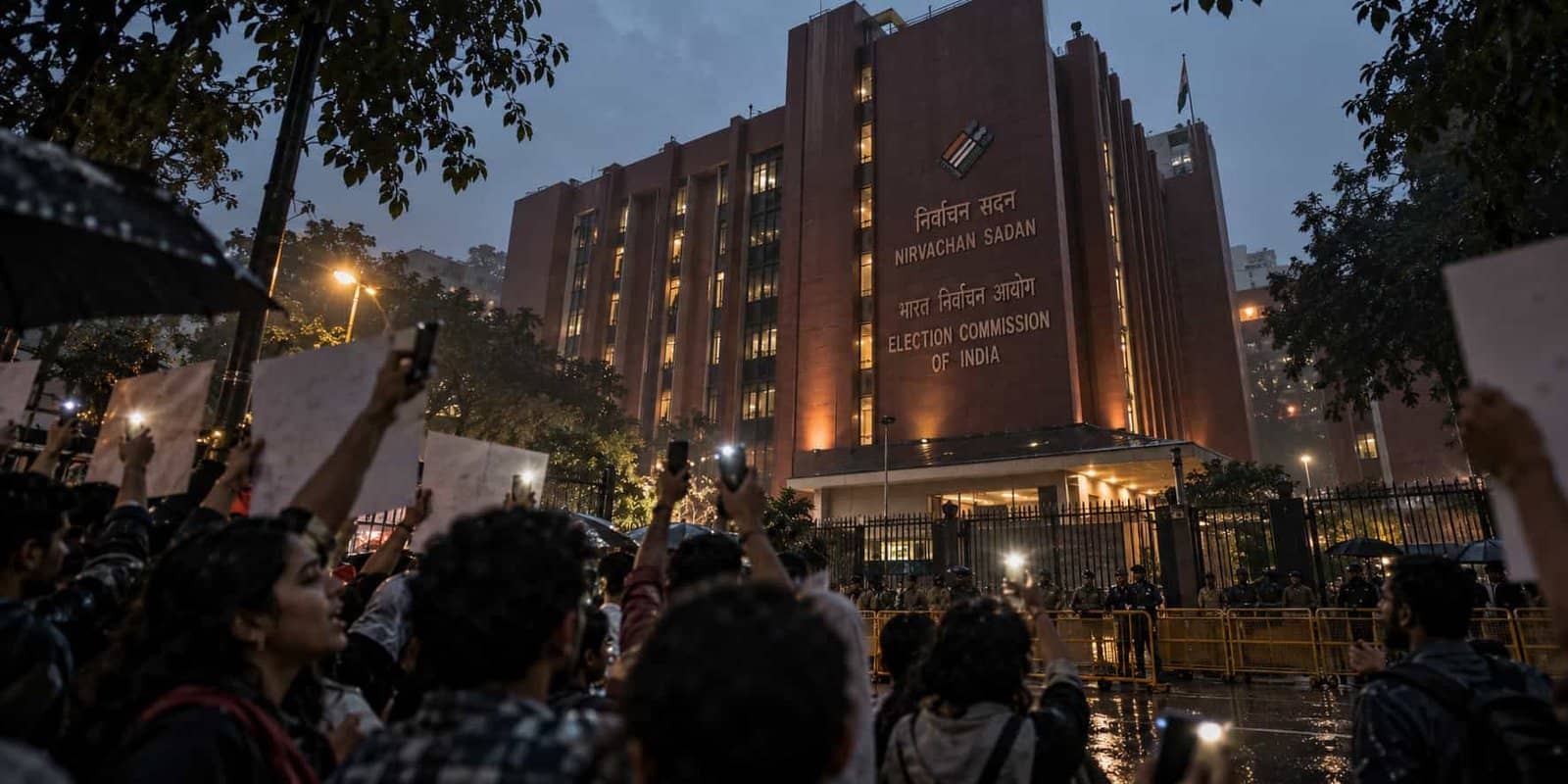
Meanwhile, as exit poll debates consumed every available hour of prime time this past week, the actual democratic machinery around the Bengal election was in open institutional crisis, and almost nobody was watching. The Election Commission ordered repolling in 15 booths across Magrahat Paschim and Diamond Harbour on May 2, after observers flagged irregularities in the second phase. The TMC challenged the ECI’s directive mandating that only Central Government employees serve as counting supervisors, arguing, not unreasonably, that when the Central Government is controlled by the ruling party’s primary electoral rival, the directive creates a structural apprehension of bias. The Supreme Court constituted a special bench of Justices P.S. Narasimha and Joymalya Bagchi to hear the plea on May 2, two days before counting begins. As the time of writing this, the SC has ordered the ECI to follow its own rules in letter and sprits. These are not trivial procedural disputes. Who physically supervises the counting process, and whether the administrative apparatus around an election is genuinely neutral, are questions that go to the heart of whether the exercise produces a legitimate outcome. They received a fraction of the coverage devoted to colour-coded seat projections from agencies that won’t publish their sample sizes. The media apparatus is structurally more interested in the horse race than the racecourse, and the exit poll industry is the mechanism by which this distortion is reproduced, cycle after cycle.
The deeper problem, then, is not that exit polls are sometimes wrong. That is inevitable. The problem is that they are structurally insulated from consequence. No agency publishes a post-mortem of its methodology after the results come in. No regulator demands an explanation for a projection that missed the outcome by a hundred seats. No media house revokes its contract with a pollster whose record is demonstrably poor. There is, in this sense, a peculiar inversion at work: the industry that claims to hold elections accountable is itself accountable to no one. Exit polls in India do not predict elections, they produce a media event, a financial stimulus, and a political atmosphere. They set expectations that frame the official result as either a triumph or a disappointment, influence stock markets that swing billions on projected outcomes, and create bandwagon effects that pressure fence-sitting legislators and potential coalition partners. In a 294-seat assembly where the “poll of polls” hovers around 140 to 146 seats for both sides, the framing matters as much as the number. Chief Minister Mamata Banerjee has dismissed the projections, claiming the TMC will win at least 226 seats. That number may be political bravado. But her scepticism of the exit poll industry is, on the evidence, better founded than the industry’s scepticism of her.
The counting begins on May 4. One set of numbers will be proven right, and a dozen will be proven wrong. Nobody will be held accountable. And by the next election, the same agencies will return with the same authority, the same graphics, the same undisclosed funding, and the same absence of transparency. We might call this a market failure, except that the market is functioning exactly as designed. The product was never accuracy. It was always spectacle, and spectacle, unlike science, does not need to answer for its errors.
Disclaimer:The views and opinions expressed in this article are those of the author(s) and do not necessarily reflect the official policy or position of The Rift.