Opening The Rift
therift
© 2026 The Rift. All Rights Reserved.
Justice Without Trial: Constitutional Morality and the Rule of Law in India
Encounter killings promise certainty but deliver constitutional uncertainty, diminishing not only Article 21 but the rule of law itself.

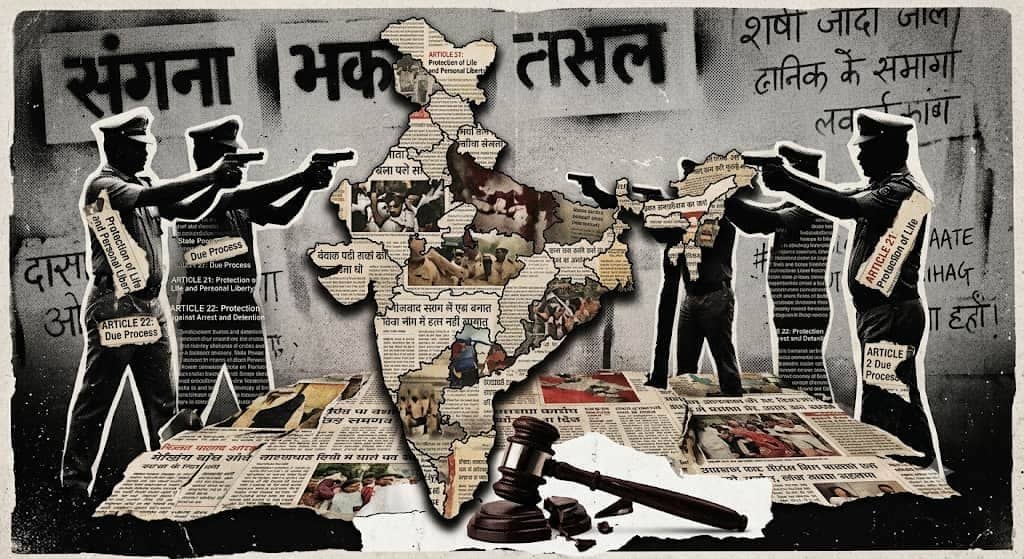
The Indian justice system grapples with upholding constitutional morality and the rule of law (Representative Image)
Key Takeaways
1 of 3
Automatically generated. Read full article for complete context.
Constitutions are not written for moments of constitutional comfort; they are written for moments of constitutional crisis. Their true test is not how they protect the innocent, but whether they restrain the State when public anger demands immediate punishment. The growing normalization of police encounter killings in India therefore raises a question that goes beyond criminal law: can a constitutional democracy permit the executive to extinguish life before a court determines guilt? Euphemistically framed by state actors and popular media as necessary, expedient responses to a fractured criminal justice system, these events reveal an interdisciplinary reality, pointing to a deeper systemic failure.
Where an encounter results in the deprivation of life without constitutional and statutory safeguards, it represents the simultaneous collapse of five constitutional pillars: independent investigation, objective prosecution, institutional defence, impartial adjudication, and appellate review. When the police arrogate to themselves the roles of investigator, prosecutor, judge, and executioner, that architecture is supplanted by unguided executive discretion, precipitating a structural crisis in the rule of law.
The term “encounter” has no statutory definition in Indian criminal law. In public discourse it broadly refers to any police operation resulting in the death of a suspect, but this obscures crucial distinctions. A genuine encounter, a defensive exchange of fire in which death results from an honest and proportionate response to an imminent threat, is legally and morally distinct from a custodial encounter, where a suspect already in police custody is killed, and from a staged or fake encounter, where officers engineer a confrontation to execute someone extrajudicially.
This article’s critique is directed at the latter categories— killings that bypass constitutional scrutiny under the guise of legitimate police action. It does not contend that every police use of lethal force is unconstitutional. Indeed, the law recognises that police officers, like any person, may lawfully use force in genuine self-defence, and Section 46 of the Bharatiya Nagarik Suraksha Sanhita (governing the use of force during arrest) permits force proportionate to the resistance offered by a suspect resisting or evading arrest. The constitutional objection arises only when force substitutes for process rather than responding to an immediate, verifiable threat.
The Doctrinal Transformation of Article 21 and Article 22
The constitutional validity of state-sponsored deprivation of life hinges entirely on compliance with “procedure established by law” under Article 21 of the Constitution of India. The doctrinal journey of this article reflects a shift from rigid textualism to substantive due processSubstantive Due ProcessA legal principle that allows courts to protect certain fundamental rights from government interference, even if not explicitly stated in the constitution, by requiring laws to be fair, just, and reasonable.. In A.K. Gopalan v. State of Madras (1950), the Supreme Court adopted a literal, formalistic interpretation, holding that “procedure established by law” meant any state-enacted statutory law, regardless of its inherent fairness. This executive-friendly paradigm was dismantled by the bench in R.C. Cooper v. Union of India (1970), which established that fundamental rights are not distinct silos but an interconnected web; any law depriving a person of liberty under Article 21 must also withstand the test of equality under Article 14.
This evolution culminated in Maneka Gandhi v. Union of India (1978), where the Court imported substantive due process into Indian jurisprudence. The Court held that the procedure depriving a person of life or personal liberty must be “fair, just and reasonable,” and cannot be “fanciful, oppressive or arbitrary.” This is the doctrinal seed of what B.R. Ambedkar described as constitutional moralityConstitutional MoralityA concept emphasizing adherence to the spirit and values of the constitution, even when not explicitly codified, ensuring restraint and fairness in governance.: the discipline of abiding by constitutional form and restraint even where a stricter, more direct exercise of power might feel more expedient. Encounter killings fail this discipline precisely because they substitute the comfort of immediate outcomes for the harder obligation of lawful process.
Furthermore, Article 22 complements Article 21 by embedding procedural safeguards immediately after arrest, ensuring that executive power remains subject to judicial supervision at the earliest stage of criminal process by guaranteeing the right to know the grounds of arrest, the right to legal counsel, and mandatory production before a magistrate within 24 hours.
An extrajudicial encounter is constitutionally distinctive because it does not merely violate one procedural safeguard; it renders every procedural safeguard impossible. Investigation, defence, adjudication, and appeal all disappear simultaneously the moment the State substitutes force for process. A fake or staged encounter extinguishes each of the three protections Article 22 guarantees in a single act: there is no arrest at which grounds can be communicated, no opportunity to consult a lawyer, and no production before a magistrate within 24 hours, because the person who would otherwise be produced is already dead. Article 22 is rendered not merely unenforced but structurally inapplicable. Such killings also violate Article 14 by introducing absolute arbitrariness and completely discarding the principles of natural justice: nemo judex in causa suaNemo Judex in Causa SuaA Latin legal maxim meaning ‘no one should be a judge in their own cause,’ a fundamental principle of natural justice preventing bias. (no one should be a judge in their own cause), since the police act as both accuser and executioner, and audi alteram partemAudi Alteram PartemA Latin legal maxim meaning ‘hear the other side,’ a fundamental principle of natural justice requiring that all parties be given an opportunity to present their case. (no one should be condemned unheard), since the accused is given no opportunity to answer the case against them before being killed.
Jurisprudential Directives vs. Institutional Reality
The Supreme Court has repeatedly built a robust body of jurisprudence designed to regulate state violence and ensure accountability, weaving strict boundaries around executive overreach. In D.K. Basu v. State of W.B. (1997), the Court formulated mandatory guidelines against custodial torture, unauthorized detention, and state violence. This was reinforced by Prakash Kadam v. Ramprasad Vishwanath Gupta (2011), where the Court observed that fake encounters constitute cold-blooded murder and, depending on the facts, may warrant the gravest punishment prescribed by law.
The baseline of policing power was further clarified in Om Prakash v. State of Jharkhand (2012), which affirmed that the police do not possess a license to kill, even when dealing with dreaded or hardened criminals. To ensure these declarations were backed by operational transparency, the landmark judgment in PUCL v. State of Maharashtra (2014) formulated 16-point mandatory guidelines involving independent magisterial and CID probesCID ProbesInvestigations conducted by the Criminal Investigation Department (CID), a specialized branch of the Indian police responsible for serious criminal cases. into every encounter death.
This jurisprudence builds upon foundational rulings like Nilabati Behera v. State of Orissa (1993) and Joginder Kumar v. State of U.P. (1994), which established that a prisoner’s strict constitutional rights do not vanish upon arrest. Structurally, Prakash Singh v. Union of India (2006) directed far-reaching police reforms, including the separation of investigation from law and order, and the creation of State Police Complaints Authorities.
Despite these clear directives, the structural gap between constitutional law and field policing persists. Contemporary instances, such as allegations emerging from the West Bengal encounter case or the Hrithik Roshan Tiwari case in Bihar, serve as regular indicators of this ongoing tension. While the specific facts of these ongoing matters remain subject to judicial determination, they underscore how easily administrative convenience can overrule the strict procedural safeguards laid down in PUCL (2014).
Empirical Interrogation of the Criminal Justice Crisis
The enduring nature of extrajudicial enforcement is fueled by deep structural crises within the formal criminal justice machinery. Data compiled from the National Crime Records Bureau (NCRB) and the National Judicial Data Grid (NJDG) reveal an overburdened, under-resourced system that struggling to deliver timely justice.
Judicial Pendency and Delay
According to data from the National Judicial Data Grid, tens of millions of criminal cases remain pending across district and subordinate courts. The average duration of a serious criminal trial, such as murder under Section 302 of the Indian Penal Code (or its corresponding section under the Bharatiya Nyaya Sanhita), frequently stretches between 5 to 10 years. This systemic delay erodes deterrence and frustrates the public’s demand for justice. Constitutionally, the significance of this delay is not merely administrative: it supplies the political cover under which extrajudicial force is rationalised as a substitute for a system perceived to have failed, even though delay in adjudication can never lawfully transfer the power to determine guilt from the judiciary to the executive.
High Undertrial Populations and Institutional Capacity
The NCRB Prison Statistics India reports consistently demonstrate that over 75% of the total prison population in India consists of undertrial prisonersUndertrial PrisonersIndividuals who are awaiting trial or whose trials are ongoing, and who are held in judicial custody without having been convicted of a crime.. This high rate highlights a reliance on pre-trial detention that stems from slow adjudication. Concurrently, data from the Bureau of Police Research and Development (BPR&D) highlights an average vacancy rate of 15 to 20% across state police forces, along with a lack of modern forensic infrastructure. Consequently, investigative units often lack the resources necessary to secure convictions through scientific evidence. Read constitutionally, this figure is telling: a system that already detains most of its accused population without a finding of guilt has not run out of coercive power over suspects; it has run out of the institutional capacity to convert that power into a lawful verdict, a deficiency encounter killings purport to remedy by force rather than by reform.
The Conviction Deficit
The systemic breakdown is further highlighted by low conviction rates in complex felonies. When ordinary prosecutions take years and often fail due to compromised crime scenes, hostile witnesses, or poor forensics, state actors face political and social incentives to deliver immediate, extra-legal outcomes. However, National Human Rights Commission (NHRC) inquiry outcomes show that very few encounter cases yield formal accountability for participating officers, cementing an environment of operational impunity.
Criminological Frameworks and Populist PenalismPopulist PenalismA criminological theory describing how public anger and demand for retribution, often fueled by media, can lead to harsher, more immediate, and less process-driven criminal justice policies.
To understand why extrajudicial violence often enjoys public support, we can look to established sociological and criminological frameworks. A.V. Dicey regarded the Rule of Law as antithetical to arbitrary executive power. Encounter killings invert this principle by replacing legal accountability with executive discretion, thereby subordinating constitutional government to administrative expediency.
The public celebration of encounter killings can be understood through John Pratt’s theory of Populist Penalism. When democratic institutions are perceived as slow or ineffective, public anger bypasses legal processes in favor of direct retribution. This climate is amplified by what Stanley Cohen terms a Moral PanicMoral PanicA term coined by Stanley Cohen, referring to a widespread fear, often exaggerated by media, that some evil or threat endangers the well-being of society., where the media and political actors frame specific criminal acts as existential threats, presenting immediate executive force as the only viable solution.
This dynamic directly contradicts Tom Tyler’s Procedural Justice TheoryProcedural Justice TheoryA theory by Tom Tyler suggesting that public compliance with the law and satisfaction with legal authorities depend more on the perceived fairness of the process than on the outcome itself.. Tyler’s empirical research shows that public compliance with the law depends heavily on the perceived fairness and legitimacy of the legal process, rather than the severity of punishments. When the state resorts to extrajudicial executions, it undermines its own institutional legitimacy.
While proponents of these methods often rely on traditional Deterrence TheoryDeterrence TheoryA theory of criminal justice that posits that fear of punishment can prevent people from committing crimes., empirical studies by institutions like the Centre for the Study of Developing Societies (CSDS) and the Commonwealth Human Rights Initiative (CHRI) show no long-term reduction in violent crime following waves of encounter killings. Instead, bypassing due process risks institutionalizing violence within the state apparatus.
Read together, these theories explain how encounter killings can acquire democratic popularity even as they corrode constitutional legitimacy: Cohen’s moral panic supplies the emotional urgency, Pratt’s populist penalism converts that urgency into political reward for visible retribution, and Tyler’s procedural justice research explains why this trade is ultimately self-defeating, since a state that abandons fair process erodes the very legitimacy it needs to secure long-term compliance with the law.
Comparative Constitutional Perspectives
India’s encounter paradigm stands out when evaluated against international legal standards and comparative constitutional frameworks.
United States: Under the Fourth Amendment’s protection against unreasonable seizures, the U.S. Supreme Court held in Tennessee v. Garner (1985) that deadly force may not be used unless necessary to prevent escape and preceded by a significant threat of death or serious physical injury.
South Africa: Section 11 of the South African Constitution explicitly guarantees the right to life. In State v. Makwanyane (1995), the Constitutional Court affirmed that the state must serve as the primary exemplar of a culture of human rights, a principle central to post-apartheid constitutional morality.
The Philippines: The recent history of the Philippines serves as a cautionary example. A state-sanctioned approach to criminal justice eroded democratic safeguards, hollowed out judicial independence, and led to scrutiny by the International Criminal Court (ICC).
These domestic approaches are supported by international frameworks. Article 6 of the International Covenant on Civil and Political Rights (ICCPR), which India has ratified, states that no one shall be arbitrarily deprived of life. Furthermore, the UN Basic Principles on the Use of Force and Firearms and the Minnesota Protocol on the Investigation of Potentially Unlawful Death mandate that all state-caused deaths undergo an independent, prompt, and thorough investigation.
The common denominator across comparative constitutional systems is not the absolute prohibition of police use of force, but the insistence that every deprivation of life remain subject to independent legal scrutiny. Accountability, not impunity, is the defining characteristic of constitutional policing.
A Structural Agenda for Institutional Reform:
Restoring the rule of law requires moving beyond normative criticism toward systemic, structural reforms. Article 50 of the Constitution, which directs the State to separate the judiciary from the executive in public services, reflects the same institutional logic that should govern the investigation of encounter deaths: the body that uses force should never be the body that judges whether that force was lawful. In order of priority:
Enforcement of Legal Directives:
The 16-point guidelines from PUCL v. State of Maharashtra must be strictly applied, ensuring that investigations into every encounter death are led by independent external agencies or a magisterial authority, rather than the same police station involved in the operation. This is the most immediate and least resource-intensive reform, since it requires enforcement of existing law rather than new legislation.
Insulated Investigative Mechanisms: In line with Prakash Singh, state investigative units must be structurally separated from law-and-order duties to prevent local political pressures from compromising oversight.
Judicial Fast-Tracking and Modernization: Addressing the bottlenecks highlighted by the NJDG requires increasing the number of specialized fast-track courts for serious offenses, filling judicial vacancies, and modernizing forensic labs through dedicated public funding.
Mandatory Technological Oversight: Law enforcement personnel involved in high-risk operations should utilize body-worn cameras and real-time GPS logs to establish objective records of encounters.
Conclusion:
Encounter killings promise certainty but deliver constitutional uncertainty. They may eliminate an accused, but they cannot establish guilt. In a constitutional democracy, legitimacy flows not from the speed with which punishment is inflicted, but from the legality of the process through which punishment is imposed. The Constitution does not merely protect life; it protects the institutional process through which the State acquires the authority to take it. Once that process is abandoned, it is not only Article 21 that is diminished; it is the rule of law itself. The gravest danger lies not in the bullet itself, but in the constitutional vacuum it leaves behind.
Disclaimer:The views and opinions expressed in this article are those of the author(s) and do not necessarily reflect the official policy or position of The Rift.