Opening The Rift
therift
© 2026 The Rift. All Rights Reserved.
Who Is a Dimagi Citizen in the Country?
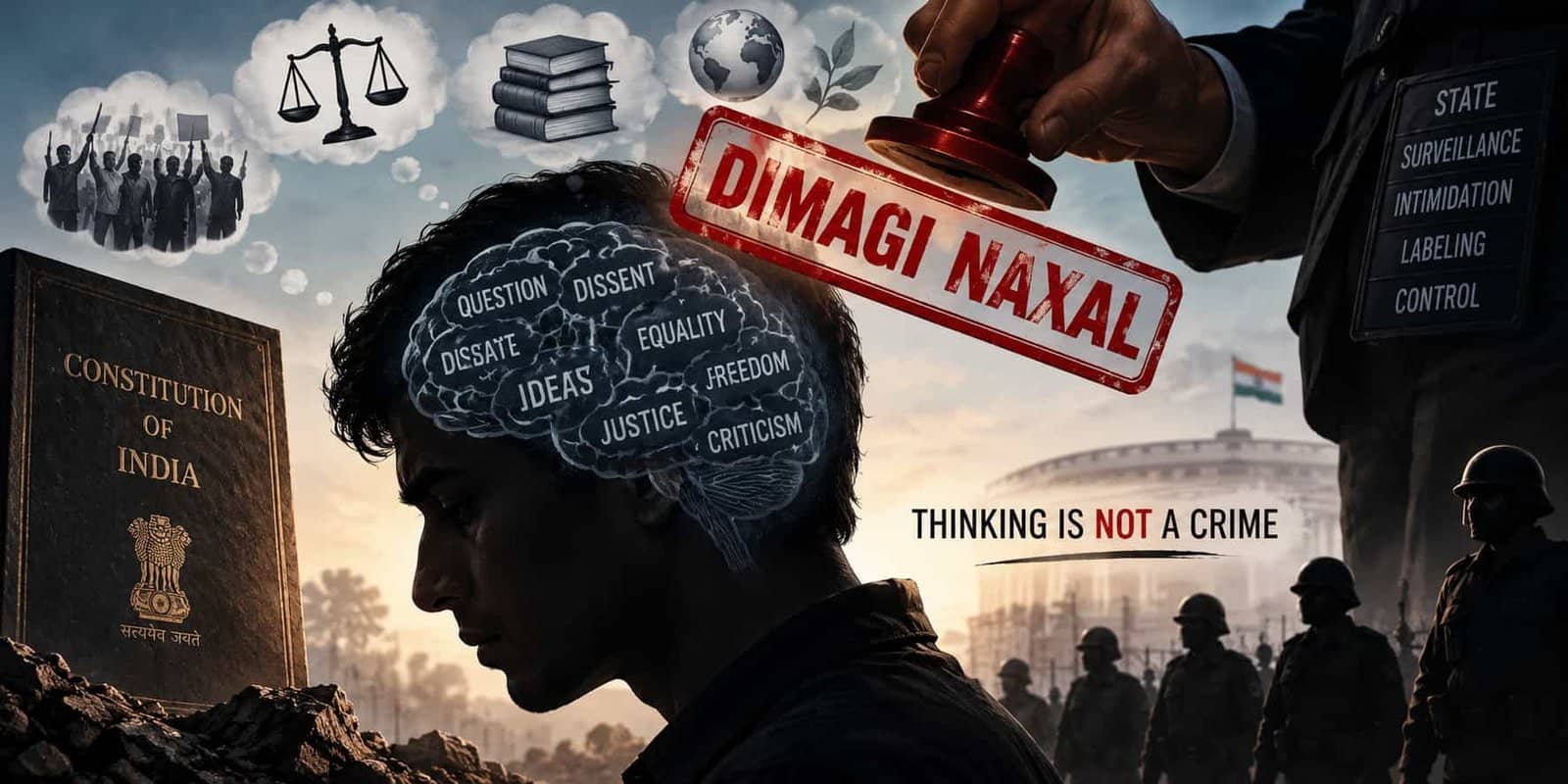
When the State begins to suggest that citizens are dangerous because of their opinions, we move into the policing of thought, a profoundly different proposition in a constitutional democracy.

Key Takeaways
1 of 3
Automatically generated. Read full article for complete context.
This may well be the question of the decade. When Narendra Modi declared that the country was likely to be held to ransom by “anti-nationals” who were out to destroy the unity and integrity of India, he never quite defined what he meant by the expression. More likely, he had not thought through what it actually meant, except that it was a convenient political description for those who opposed or criticised his government. Over the years, however, the vocabulary has become more expansive. We now seem to have arrived at the curious idea of the dimagi citizen — the citizen whose principal offence is not necessarily what he does, but what he thinks. That should concern us far more than it amuses us.
There is, after all, a perfectly legitimate distinction between a citizen who commits an offence against the State and one who disagrees with the government. A person who takes up arms against the country, assists an enemy, participates in terrorism or conspires to overthrow the constitutional order can be dealt with under the law. Such conduct can be defined, investigated and, where established, punished. But when the State begins to suggest that certain citizens are dangerous because of their opinions, their questions, their writings, their political beliefs or their refusal to accept the official narrative, we have moved into a very different territory. We are no longer talking about criminal conduct but about the policing of thought, and that is a profoundly different proposition in a constitutional democracyRule by Law and PeopleA system of government where the powers of the majority are exercised within the framework of a constitution that guarantees fundamental rights and limits governmental authority..
The recent use of the expression “dimagi Naxal takes this development to another layer. The traditional image of the Naxal is that of an armed insurgent engaged in a violent struggle against the State. The dimagi Naxal, however, is a rather different creation. The enemy has been moved from the forest to the mind. One does not necessarily have to carry a weapon, belong to an underground organisation or engage in violence. It is apparently enough to think in a way that is considered hostile to the prevailing political order. This raises an obvious question which should trouble any democracy: what exactly is a dimagi citizen? Is it the journalist who asks questions the government would rather not answer, the academic who challenges an official interpretation of history, the student who protests against a law or policy, the citizen who believes that the government has made a serious mistake, or simply the Indian who believes that citizenship carries with it the right to disagree?
There is a fundamental distinction that governments, particularly governments enjoying substantial political power, must never be permitted to erase: the nation is not the government. Governments come and go; nations endure. A government can be defeated at the ballot box, and the country does not cease to exist because its citizens have rejected the government of the day. Indeed, the capacity of citizens to disagree with their government is not a weakness of democracy but one of its defining strengths. Yet increasingly our political vocabulary appears to be collapsing these distinctions. To criticise the Prime Minister is sometimes presented as an attack on India itself. To question government policy can be portrayed as evidence of disloyalty. To protest against legislation is described as an attempt to destabilise the country. To defend the rights of minorities can be dismissed as appeasement, while challenging the actions of the State can be interpreted as hostility towards the nation. The underlying proposition is both simple and profoundly dangerous: if the government represents the nation, then opposition to the government becomes opposition to the nation. That is not democracy but the political appropriation of patriotism.
There is another reason why the language of “anti-nationalism” needs to be treated with caution. The expression has no precise, independent statutory definition in Indian law. There are, of course, laws dealing with offences against the sovereignty, security and integrity of India, but describing somebody as “anti-national” is not in itself a substitute for establishing that the person has committed an offence. The distinction is important because words can become instruments of power. Once a word such as “anti-national” is allowed to float free of any precise meaning, it can be applied almost at will. It may describe a person who genuinely threatens national security in one context and, in another, someone who has merely embarrassed the government by asking an uncomfortable question. The elasticity of the term is precisely what makes it politically useful and democratically dangerous.
A democracy depends not only upon institutions but also upon the meanings attached to its political vocabulary. If patriotism gradually comes to mean agreement with the government, and anti-nationalism comes to mean disagreement with it, then citizenship itself begins to acquire an ideological test. The obvious question is who administers that test. Is it the ruling party, the Prime Minister, the police, television anchors, social-media mobs or political commentators? None of them can legitimately do so. In a constitutional democracy, the Constitution must remain the ultimate reference point, and citizenship cannot be made conditional upon conformity with the political preferences of whoever happens to occupy office.
This is something we seem increasingly reluctant to remember. India was not created as a country in which citizens would have to prove their patriotism every morning. The freedom struggleIndia’s Independence MovementRefers to the Indian independence movement, a series of historic efforts by various groups and individuals to end British colonial rule in India and establish an independent nation. was not fought so that one political party could acquire an exclusive right to define the nation. The Constitution did not establish a system in which citizens would be divided between those who unquestioningly accepted the government and those whose patriotism could be placed under suspicion. It created citizens who were, at least in principle, equal before the law and entitled to the freedoms necessary for a democratic society. Those freedoms include the freedom to speak, to assemble, to organise, to criticise and to dissent. The right to disagree with a government is not a concession granted by a benevolent administration; it is part of the democratic compactMutual Agreement of GovernanceThe unwritten understanding or agreement between the state and its citizens, outlining mutual rights and responsibilities, including the right to dissent and the state’s obligation to protect it. itself.
There is a very practical reason why this matters. Once citizens begin to fear that an inconvenient question may be interpreted as disloyalty, they become cautious about asking questions. When journalists fear that criticism may attract a political label, self-censorship begins to replace journalism. When academics worry that an unpopular interpretation of history may make them targets, intellectual inquiry becomes timid. When students are taught that protest itself is evidence of insufficient patriotism, universities cease to be places where ideas are tested and become places where conformity is rewarded. The damage is not always dramatic, because democracies rarely collapse in a single afternoon. More often, the erosion is gradual: a word here, a label there, a summons somewhere else, a public denunciation, a television campaign, an accusation that someone is working against the country. Eventually citizens learn to measure every sentence before they speak, and by the time that happens the formal institutions of democracy may still be standing, but the democratic culture that gives those institutions meaning has already been weakened.
This is why the idea of the dimagi citizen is more disturbing than the expression itself might suggest. The dimagi citizen does not necessarily have to carry a gun or cross a border. He does not have to belong to an underground organisation. He may simply be someone who thinks independently and refuses to accept that the government is always right. India has never lacked such people. Indeed, independent thinking is part of the inheritance of the republic. Gandhi challenged an empire and repeatedly challenged the assumptions of his own political allies. Ambedkar challenged the social order into which he had been born and insisted that political democracy could not survive without social equality. Bhagat Singh questioned colonial authority as well as conventional political thinking. Tagore warned against the dangers of aggressive nationalism. Countless ordinary Indians participated in the freedom struggle because they believed that established authority could be wrong and that obedience was not the highest form of citizenship. If independent thought is now to be treated as suspicious, one wonders what we are supposed to make of that history.
There is, of course, nothing wrong with patriotism. A country needs citizens who care deeply about its security, sovereignty, unity and future. What is dangerous is the attempt to monopolise patriotism by suggesting that only one political interpretation of India is authentically Indian. Patriotism belongs to the citizen, not to the government. The flag belongs to every Indian. The Constitution belongs to every Indian. The country belongs to every Indian, including those who disagree with the government that happens to be in power. A government confident in its record should be able to answer its critics rather than attempting to discredit them. A nation confident in its identity should not be frightened by dissent, and a Prime Minister secure in his authority should not need to turn political disagreement into a test of national loyalty.
Calling somebody a dimagi is ultimately an admission of intellectual defeat because it avoids the argument by discrediting the person making it. Instead of answering the criticism, question the critic. Instead of demonstrating that a policy has worked, suggest that those who oppose it are working against India. Instead of engaging with an uncomfortable fact, question the patriotism of the person who has raised it. It is politically convenient, but it is intellectually bankrupt. The purpose of political argument in a democracy is not to establish that one side possesses a monopoly on patriotism but to persuade citizens through reason, evidence and debate. Once the argument is replaced by labels, democracy itself is diminished.
India does not need fewer thinking citizens; it needs more of them. We need citizens capable of distinguishing between the country and its government, between patriotism and nationalism, between loyalty and obedience, between criticism and sabotage, and between peaceful dissent and violence. We need citizens who can love their country deeply while believing that their government can sometimes be wrong. We need journalists who ask difficult questions, academics who challenge conventional wisdom, students who debate and protest, and ordinary citizens who are not afraid to say that something is going wrong. Such citizens may be inconvenient, they may be irritating, and they may even be described as dimagi, but they are indispensable to the health of the republic.
The real danger to a democracy is therefore not that its citizens think too much but that they eventually become afraid to think at all. When that happens, the most important question will no longer be who the dimagi citizens are, but whether India still has enough citizens prepared to be one.
Disclaimer:The views and opinions expressed in this article are those of the author(s) and do not necessarily reflect the official policy or position of The Rift.