Opening The Rift
therift
© 2026 The Rift. All Rights Reserved.
Women Carry Water on Their Heads, AI Industries Hold It in Their Hands
The question of AI is not only about algorithms and model architecture; it is also a question of water, justice, and gender equality.

Key Takeaways
1 of 3
“Large data centers can consume up to 5 million gallons of water per day, meaning the annual water usage of a single center can be equivalent to that of a small town with a population of ten thousand to fifty thousand.”
Automatically generated. Read full article for complete context.
The condition of groundwater in India is becoming increasingly serious day by day, and this crisis has been neglected for many decades. The National Green Tribunal expressed strong displeasure in January 2026 over the report submitted by the Central Ground Water Authority. The report lacked important information that had been sought, it avoided explaining what criteria are used to grant permissions for development projects in groundwater-stressed areas, and the overall tone of the document was vague and incomplete. When the tribunal raised questions about this, the authority stated that the task of setting criteria falls under the jurisdiction of state-level regulatory bodies. But the tribunal immediately posed the next question: when most states have not even established such bodies, how exactly is the permission process being implemented? Whether audit reports for commercial usage are published, whether no-objection certificates are issued from time to time, how much environmental penalty has been imposed on those who violate the rules: the authority had no answers to any of these questions. This situation is not merely administrative negligence but a deep gap in the management of one of the country’s most fundamental natural resources.
According to the 2024 report of the Central Ground Water Board, the average rate of groundwater extraction in India has reached 60.47 percent, which is higher than 59.26 percent in 2023. In 2024 alone, 245.64 billion cubic meters of groundwater was extracted. Of this, 87 percent (that is, 213.29 billion cubic meters) was consumed by the agricultural sector alone, domestic use accounts for 11 percent and industrial use for a mere two percent. Out of 6,746 assessment units in the country, 751 units (meaning more than 11 percent) have been classified as “over-exploited,”Over-exploitedAn assessment unit where the annual groundwater extraction rate exceeds the natural annual recharge rate. meaning that in those areas, groundwater extraction exceeds annual recharge. In Punjab, Haryana, Rajasthan, Delhi, and Dadra and Nagar Haveli, extraction is over 100 percent, meaning more water is being drawn from the ground than nature replenishes. This picture is not merely alarming but extremely dangerous for future generations.
The quantity of groundwater is declining, that is true, but the quality of groundwater is also deteriorating rapidly. While citing the 2024 Annual Groundwater Quality Report, the NGT pointed out that in Haryana, Rajasthan, Gujarat, Punjab, and western Uttar Pradesh, the levels of salinity, fluoride, and heavy metals in groundwater are increasing. Even more shocking is the presence of uraniumUranium ContaminationHigh levels of uranium in drinking water are toxic, causing severe kidney damage and potential developmental issues when exceeding the WHO limit. in India’s groundwater. In 2019-20, a nationwide survey was conducted for the first time, in which 14,377 samples were tested. It was found that in some places, the uranium content in water is as much as 96 times higher than the prescribed limit. The World Health Organization has set the limit of uranium in drinking water at 30 micrograms per liter. In Punjab alone, 24.2 percent of wells were found to have uranium levels exceeding this limit, in Haryana 19.6 percent, in Delhi 11.7 percent, and in Telangana 10.1 percent of wells face this alarming situation. The Bureau of Indian Standards has still not established any national standard for uranium in drinking water, which is a symbol of the neglect toward the seriousness of this problem. 151 districts across 18 states are partially affected by this high uranium concentration, and millions of people are unknowingly drinking this contaminated water.
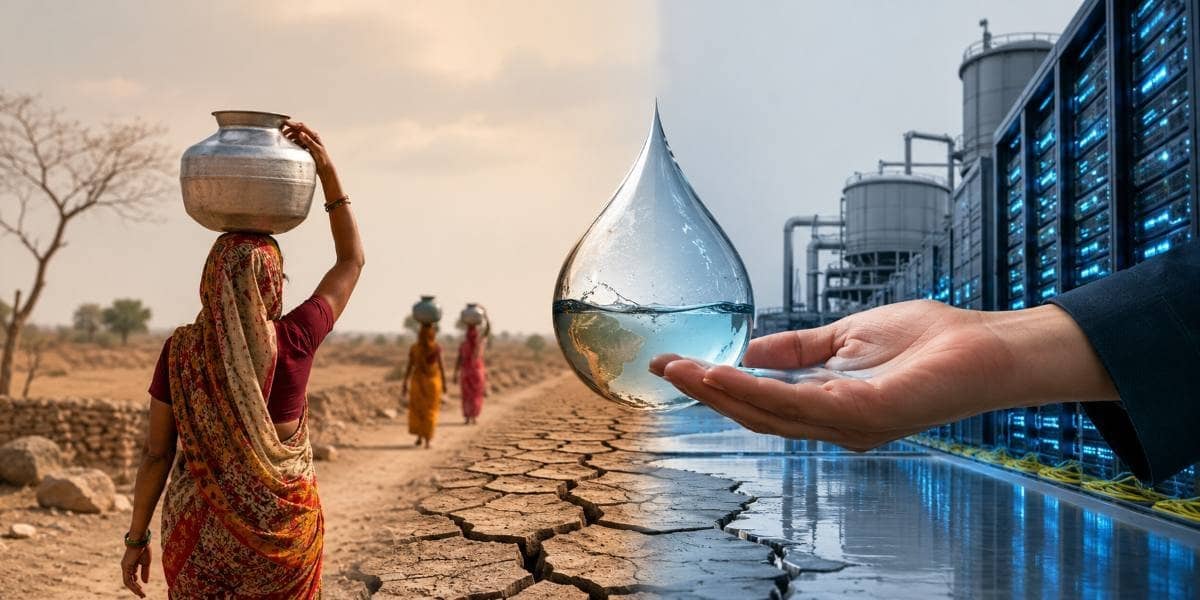
The most painful and human face of this entire water crisis is that of women and girls. According to United Nations statistics, in water-stressed areas, 80 percent of the responsibility of fetching water falls on women. Carrying pots on their heads, buckets and drums in their hands, these women spend approximately 250 million hours every day solely in procuring water. This is the time that could have been invested in their education, livelihood, and health. The scarcity of water directly wounds the education of girls. From sanitation to safe childbirth, 27 percent of women in the world are at health risk due to insufficient water. The irony is that the women who have the most direct experience of water management have less than 17 percent participation in decision-making. The labor is women’s, but the rights and policies remain in men’s hands; this inequality persists even today.
Now against this backdrop, a new, comparatively invisible but rapidly intensifying water crisis is emerging: one connected to Artificial Intelligence, or AI. We usually see AI as a mobile app, chatbot, or image-generating tool, and make the mistake of considering it virtual. But the machinery behind these services is extremely physical: data centers filled with thousands of servers, where chips with billions of transistors work round the clock. These chips consume enormous electricity while running AI models and generate heat in equal proportion. If this heat is not controlled, the chip gets damaged and the entire system can collapse. That is why large amounts of water are needed to keep these data centers constantly cool. A medium-sized data center can use approximately 110 million gallons of water per year solely for cooling, which is roughly equal to the annual water needs of nearly one thousand households. Large data centers can consume up to 5 million gallons of water per day, meaning the annual water usage of a single center can be equivalent to that of a small town with a population of ten thousand to fifty thousand. In developed countries, the growth in the number of data centers in just a few years has been so rapid that local administrations are having to allocate more water to industries and digital infrastructure than to domestic use.
The water footprintWater FootprintThe total volume of freshwater used directly and indirectly to produce the goods, services, and digital processes consumed. of AI is not limited only to running models in data centers. It begins from the very manufacturing of the semiconductor chips on which AI models run. The production and cleaning of these chips requires extremely pure water, and this purification process itself is immensely water-consuming. A single chip, which eventually gets installed in a data center, has already consumed thousands of gallons of water during its manufacturing journey. After that, the same chip demands more water for cooling while running AI models. The energy requirements of AI make this water equation even more complex. In many parts of the world, electricity still depends on coal and gas-based thermal power plants, which consume enormous amounts of water. According to the World Energy Outlook and World Water Development reports, in many countries including the United States, China, and France, 30 to 40 percent of the total water share goes solely into energy production. After cooling, some water returns, but in a heated state, which affects the ecological systems of local rivers and lakes. The remaining water exits the usage cycle as vapor. This means that in addition to the water directly used in data centers, there is a large invisible water footprint hidden behind the electricity they consume.
Understanding how deep the impact of all this is in everyday usage is important. According to research conducted on large language models, a simple AI conversation (a query and response of 100 to 200 words) has indirectly already consumed approximately one bottle’s worth of water. Since this water does not visibly appear, we do not feel it, but when billions of users run millions and billions of prompts every day, this invisible water usage transforms into a colossal figure. According to the research paper ‘Making AI Less Thirsty,’ in just the single year of 2025, the total water that global AI systems could indirectly use may reach the level of the entire bottled water industry’s annual water consumption worldwide.
Here emerges the sharpest contradiction of the modern age. On one side is a girl who, every morning before going to school, walks two to three kilometers to fetch water and whose education is often interrupted for this very reason. On the other side is a data center, a large part of which is often filled with unnecessary prompts, consuming in a single day the amount of water that perhaps hundreds and thousands of women like her have never seen in their pots even across a lifetime. Both are drawing from the same limited global freshwater reserves, but there is a profound gap between them in terms of decision-making power, distribution of benefits, and participation.
The benefits of AI-based services most often accrue to those same societies and classes that are already comparatively prosperous: the corporate sector, the global north, the urban middle class and upper class. But the blow of the water crisis falls on those communities which have the least control over water and whose large part of the day goes in searching for water. This is not merely a technical or economic inequality but an ethical question that demands an answer today. This does not mean that AI is “inherently malicious” or that we should turn away from technology. The question is: in what form, at what cost, and with what responsibility is AI being developed and used? If AI models are playing a positive role in health, education, agriculture, climate, research, or disaster forecasting, then that is welcome. But this role will be just only when the water used in their development and operation does not threaten the water availability of communities already in serious crisis, especially women and the poor. For this, it is necessary that companies transparently disclose the total water consumption of their AI models. In cooling technology, only recycled or non-potable water should be used. It is also necessary to raise digital awareness among general users that behind every unnecessary AI process, somewhere an additional burden of water gets added. This does not mean that we should be afraid to ask every question, but it means that we should thoughtfully consider whether the use of AI is truly necessary for every task. The time has come for policymakers and companies to be asked, alongside “how intelligent is your AI”: “how much water does it drink?”
If we want that in the future no girl should have to stake her education and health for a few buckets of water, then we must ensure today that the water hunger of AI and data centers does not gain priority over the rights and needs of those communities, especially women and the poor. The question of AI is not only about algorithms and model architecture; it is also a question of water, justice, and gender equality. The fundamental need of water must be given the highest priority first. Responsible technology will be that which accepts this truth and keeps water and the people connected to it at the center of every new expansion plan.
Disclaimer:The views and opinions expressed in this article are those of the author(s) and do not necessarily reflect the official policy or position of The Rift.
*Women and WaterAI Water FootprintData CentersEnvironmental InjusticeGroundwater CrisisUranium Contamination