Opening The Rift
therift
© 2026 The Rift. All Rights Reserved.
Credibility in Crisis: Youth, Media, and Accountability in India
Young India is now demanding accountability from the very systems that shape its future, pushing education and unemployment to the center of public discourse.

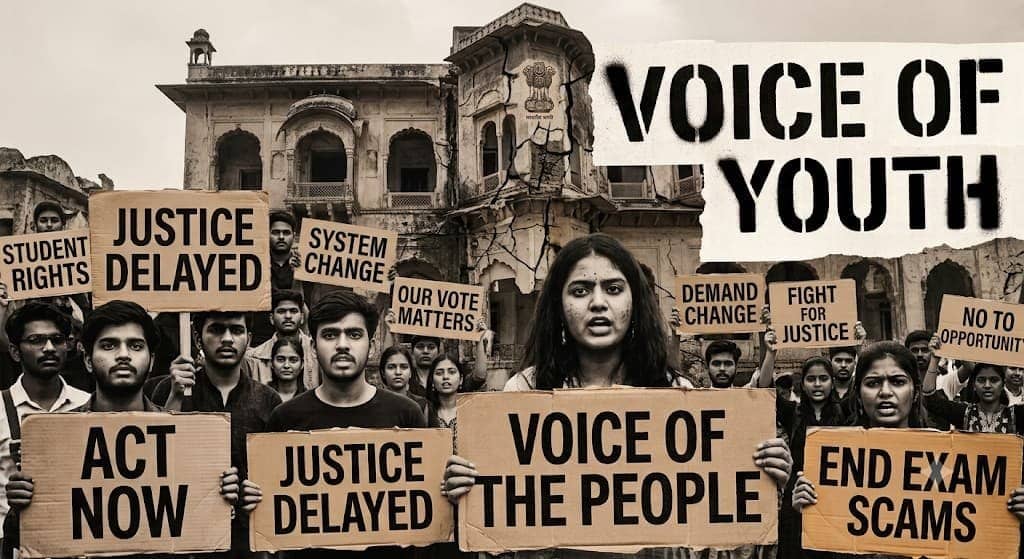
Youth in India demand greater accountability from media outlets, highlighting the need for credible journalism (Representative Image)
Key Takeaways
1 of 3
Automatically generated. Read full article for complete context.
A government that refuses to bend to the will of its people always carries the risk of breaking. The resignation of Union Education Minister Dharmendra Pradhan, following an agitation led by young people under the satirically named “Cockroach Janata PartySatirical Youth MovementA satirically named, leaderless youth movement that spearheaded protests in India against examination paper leaks and demanded accountability from the government.” (CJP), is not merely a case of a minister stepping down over a paper-leak scandal. It marks a significant turning point in what political analysts describe as the party system dominated by the Bharatiya Janata PartyRuling Political Party of IndiaOne of the two major political parties in India, currently the ruling party at the national level. (BJP), a system in which a fragmented opposition has rarely found real opportunity. In a country where most employment lies in the unorganized sector, entrance examinations remain almost the only gateway determining which young people will be able to enter the limited but secure world of formal employment. Repeated incidents of paper leaks across various examinations have turned the entire machinery meant to assess merit into an instrument of massive corruption. Nearly two million students, despite rigorous preparation alongside their school examinations, were forced to retake the National Eligibility cum Entrance Test (Undergraduate). Many among them could not survive this gruelling process intact. This shared grievance brought together young people across castes and religions — the very identities that have, in recent times, tended to limit political organising in the country.
Sidestepping television media largely aligned with those in power, the protesters without any single prominent face gathered massive support on social media within just a few days. The aggressive conduct of the Delhi Police, along with attempts to cut off internet access and restrict movement around protest sites, only swelled the ranks of the demonstrators further. The government eventually realised that this movement could not be crushed, splintered, ignored, or allowed to simply fade away, as other protests had been over the past twelve years. It was left with no option but to engage in dialogue, and the CJP’s legitimate demands made it impossible for Pradhan to remain in office. The despair of protesters who had nothing left to lose acquired a political identity — one that emerged precisely because they stayed away from established parties preoccupied with elections. Neither the ruling establishment nor the opposition, no political class of any stripe, managed to co-opt or weaken this movement.
Yet Pradhan’s resignation announcement inspires little real confidence. Rather than accepting moral responsibility for the chaos in how various examinations were conducted and evaluated, he framed his resignation as an effort to thwart “anti-national” forces supposedly seeking to exploit the situation created by the protests. His resignation letter lays bare the government’s underlying mindset that a section of students was working with hidden motives against the Indian state. Carrying this same narrative forward, Delhi Police used shock batons, pellet guns, and nail-studded sticks against the protesters. This action amounted to nothing less than calculated brutality, in which every norm of crowd control was cast aside. This step was taken only after every attempt to paint the movement as communally motivated, as engineered by foreign forces, or as driven by political self-interest had failed completely. Several missteps were made along the way. Initially, the government chose to behave as though most of the followers on social media were fake accounts or bots that would vanish once blocked. Later it assumed that this online presence would have no bearing on the real world, and finally it believed the protesters could be managed through Instagram reels. Only after all these approaches failed did the government accept Pradhan’s resignation. Commendably, though, the protesters withdrew their agitation the moment their demands were met. And one scene at Jantar Mantar spoke volumes protesters cheering a YouTuber-journalist for his fair and fearless reporting. Many such journalists, still striving to safeguard the credibility of the press, exist today. They deserve recognition.
Over these thirty-five days of protest, many things occurred that will be remembered for a long time. Among them were the slogans young people raised against the so-called “Godi Media” — a term the media establishment itself would do well to reflect upon seriously. The manner in which protesters raised their voices against certain mainstream news channels ought to be a matter of real concern for the media itself.
The attacks on some journalists during the protests at Jantar Mantar cannot be justified. Young people have every right to express their discontent with the media, and their anger may well be legitimate, but physical assaults on journalists can never be defended. Having said that, a serious question about the image of the press does arise. The section of the media popularly known today as “Godi Media” is, broadly speaking, a government-aligned press. It is journalism’s task to present both the shortcomings and the achievements of a government to the public.
The role of journalism in a democracy is unambiguous that of an honest watchdog. It is democracy’s fourth pillar, and the greatest strength of this pillar lies in its credibility. Society expects a journalist to present, honestly and without bias, what has been observed and understood; this is the true test of impartiality. There was once a time when readers placed near-complete trust in the printed word — that trust has always been journalism’s greatest asset and its greatest strength. Today, that very strength is visibly eroding, and understanding how this situation came about is essential.
It is unfortunate that a large section of the country’s press today faces accusations of blindly toeing the government line. One example of this very bias appeared in the initial phase of the youth movement itself, when the activities of the Cockroach Janata Party mysteriously went missing from television news channels for days on end. Newspapers, too, largely relegated related coverage to their inside pages. It was only as the youth movement continued to grow and become impossible to ignore that mainstream television reporters arrived, perhaps for the first time, to cover the “Cockroach movement” on the ground and it was perhaps then, for the first time, that the young protesters’ anger toward “Godi Media” surfaced with such intensity.
Journalism has always commanded respect in society, and media professionals have largely been viewed with esteem. But today, when journalism has become merely a business rather than a mission-driven calling, when newspapers are sold like bars of soap, and when the country’s largest media houses openly declare that “we are in the business of selling advertisements,” expecting society to continue regarding the media’s role with special respect would be a failure to grasp the reality of the situation. And if journalism is indeed just another kind of business, it is not unreasonable to expect media houses to remain vigilant about protecting what makes that business distinctive in the first place. Unfortunately, this vigilance appears to be lacking, and as a result, our media today finds itself in a serious crisis of credibility.
This crisis of declining credibility keeps deepening. Whatever the causes, it is evident that public trust in the media continues to erode. A closer look reveals many readers and viewers who have stopped reading newspapers or watching television news altogether. According to the Reuters Institute Digital News Report’s global survey, consumption of newspapers, radio, and television news has declined by double digits over the past decade. The same survey notes that this decline is not confined to a younger generation simply not adopting these media; older readers and viewers, too, are drifting away from traditional outlets. The single biggest reason behind this is the erosion of credibility.
It is not that people have lost interest in news. People still want to know what is happening, but they have increasingly come to understand that mainstream media today are bound more closely to the interests of their owners than to their readers and viewers and these owners see greater advantage in standing alongside those in power. The extent to which governments today benefit the media is staggering. The sheer volume of government advertising flooding television channels makes it easy to understand why our media outlets remain so wary of displeasing governments. In a written reply in the Lok Sabha, the Government of India stated that between 2014 and 2022, Rs 6,491 crore was spent on advertising. It is not hard to imagine why a media that earns crores of rupees every month from the government would be reluctant to upset it. Whether it is government pressure, market pressure, or mob pressure, media outlets that bend to such forces and disseminate misinformation must now recognise that credibility is their greatest capital and that, once lost, it cannot be recovered anywhere.
BJP leaders have also repeatedly claimed that ministers in this government do not resign. This youth movement recalled the farmers’ protest, when a year-long agitation eventually forced the government to repeal three farm laws. This time too, the government has had to acknowledge a crisis that has been eating away at India’s education system for decades. The message from students who took to the streets was unambiguous: young India is now demanding accountability from the very systems that shape its future. Another point has become equally clear — this movement has once again pushed two of the country’s biggest challenges, education and unemployment, to the centre of public discourse. It is not that these issues had never been discussed before, but that discussion had largely been confined to policy documents and election speeches. Ironically, one government after another has never confronted this challenge head-on.
Key Indicators of India’s Accountability Crisis
Students Affected by NEET-UG Scandal
~2 Million
Govt. Advertising Spend (2014-2022)
₹6,491 Crore
India’s Population Under 30
>50%
VISUALS BY THE RIFT
This student movement has also proved that the generation we have often dismissed as “lost in the digital world” is fully capable of coming forward, with complete awareness, in support of institutional reform. Undoubtedly, the central government must now undertake serious introspection following the education minister’s resignation. But this desire for reform must not be limited merely to replacing ministers and officials. In a situation where millions of candidates compete fiercely for a limited number of seats in education and jobs, the government must think seriously about how to make entrance examinations genuinely transparent. How responsibly these examinations are conducted deserves rigorous scrutiny. Proposed stringent laws against examination fraud, fast-track courts, and severe punishment may well be necessary steps, but strict laws alone will not repair a system that has broken down at so many levels. What is truly essential is transparency, technological security, and independent oversight across the entire framework of the National Testing Agency and public examinations. The futures of students must never be turned into a battleground for political maneuvering. India today is a young nation, with more than half its population under the age of thirty. In such a moment, what the country needs is an education system that preserves the trust of its youth while also ensuring justice for deserving candidates. One message, however, is unmistakable: Generation Z must now be taken seriously.
Disclaimer:The views and opinions expressed in this article are those of the author(s) and do not necessarily reflect the official policy or position of The Rift.