Opening The Rift
therift
© 2026 The Rift. All Rights Reserved.
4,000 EVMs Destroyed in Alipore Fire Following Bengal Elections
A massive blaze in a Kolkata government building has destroyed thousands of voting machines, prompting a police investigation and raising questions about post-election deliberate sabotage.

Via: ANI
Key Takeaways
1 of 3
Automatically generated. Read full article for complete context.
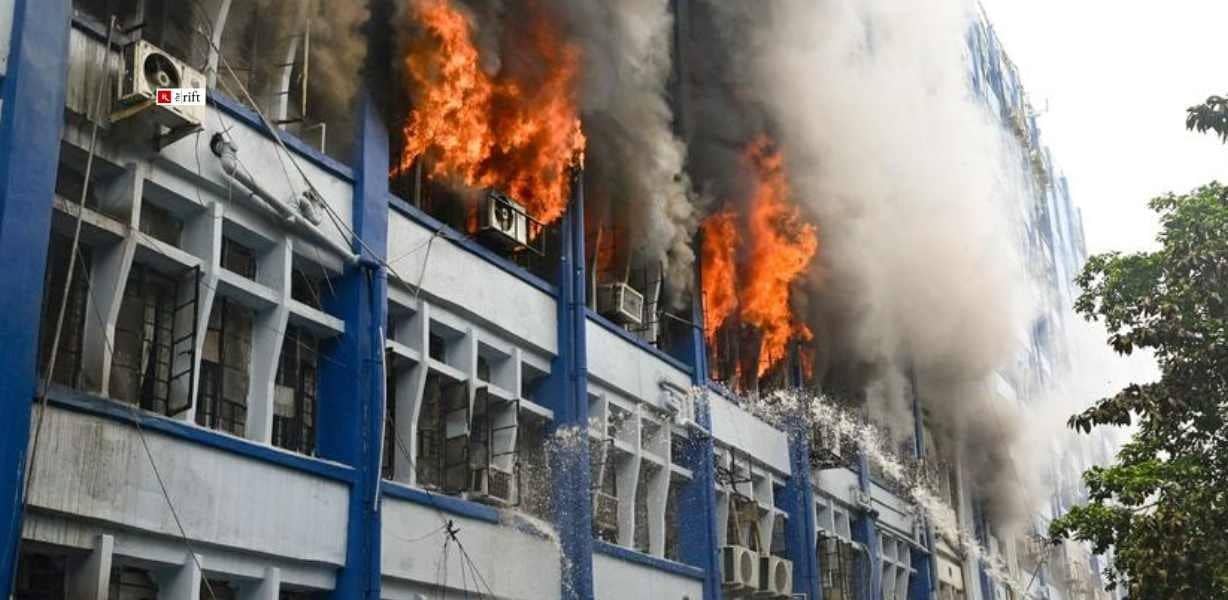
On June June 10, 2026, a major fire broke out in a government building in the Alipore area of Kolkata, West Bengal. The blaze, which occurred shortly after the conclusion of the highly contested state assembly elections, resulted in the destruction of approximately 4,000 Electronic Voting Machines (EVMs).
The incident took place in the nine-storey facility housing the office of the South 24 Parganas District Council. According to officials, the damaged equipment included Control Units, Ballot Units, and VVPATsVVPAT (Voter Verifiable Paper Audit Trail)An independent verification system for voting machines that allows voters to verify that their vote was cast correctly, serving as a crucial paper backup during disputes.. These specific machines had been recently utilized across 10 different constituencies during the polling process.
Sabotage Concerns
In the aftermath of the incident, the Kolkata Police formally registered an FIR and established a Special Investigation Team (SIT)Special Investigation Team (SIT)A specialized law enforcement team appointed by state governments or courts to investigate high-profile, complex, or politically sensitive cases that require focused expertise. to determine the cause of the fire.
Early observations from state officials have raised suspicions that the incident may not have been a simple electrical malfunction. West Bengal’s Minister of State for Fire and Emergency Services, Kaushik Chowdhury, publicly highlighted the “unusual spread” of the blaze. The fire reportedly bypassed certain floors entirely while severely affecting others where the machines were stored. This non-linear spread has led investigators to actively explore the possibility of deliberate sabotage.
The destruction of the physical evidence from 10 constituencies has naturally brought the Election Commission’s logistical safeguards into focus, as authorities work to determine how thousands of machines could be compromised in a state-run facility.
The Media Response
While the incident represents a significant breach in electoral infrastructure, the public response has been notable for its media divergence.
Regional and national print outlets documented the scale of the destruction, the formation of the SIT, and the official statements regarding potential foul play. However, the story has seen limited traction across national television. Mainstream news networks largely bypassed the incident during prime-time programming.
This disparity in coverage means that while the facts are available on the printed page, the broader national audience remains largely unaware of the security lapse and the ongoing sabotage probe.
Given the gravity of the incident and serious political distrust by opposition parties both against the ruling government and the Election Commission of India, a standard police inquiry may not suffice to clear the air. To ensure absolute transparency and restore faith in the electoral process, this fire destruction of voting machines demands nothing less than an independent judicial probe.
As the SIT continues its investigation, the focus will likely remain not just on what started the fire, but on how to ensure such a critical loss of electoral equipment amid the allegations of vote chori by the opposition parties, does not happen again.