Opening The Rift
therift
© 2026 The Rift. All Rights Reserved.
Bulldozer Demolitions of Muslim Homes Continue Despite Supreme Court Ban
HRW’s 2026 report documents a normalised system of displacement, labelling, and collective punishment targeting Indian Muslims.
Quick Summary
Viswanathan issued what should have been a definitive ruling: no property shall be demolished as punishment, authorities must give 15 days' written notice, and any official who violates these guidelines faces personal consequences.
Between 2022 and 2025, Citizens for Justice and Peace documented demolitions targeting Muslim properties in Uttar Pradesh, Madhya Pradesh, Delhi, and Gujarat, almost always in the wake of communal incidents, protests, or simply political convenience.
The statement used language the Indian government typically reserves for its neighbours: "collective punishment." HRW's 2026 report went further, documenting that authorities had also expelled hundreds of Bengali-speaking Muslims to Bangladesh, many of whom held Indian citizenship or had pending asylum claims.
Automatically generated. Read the full article for complete context.
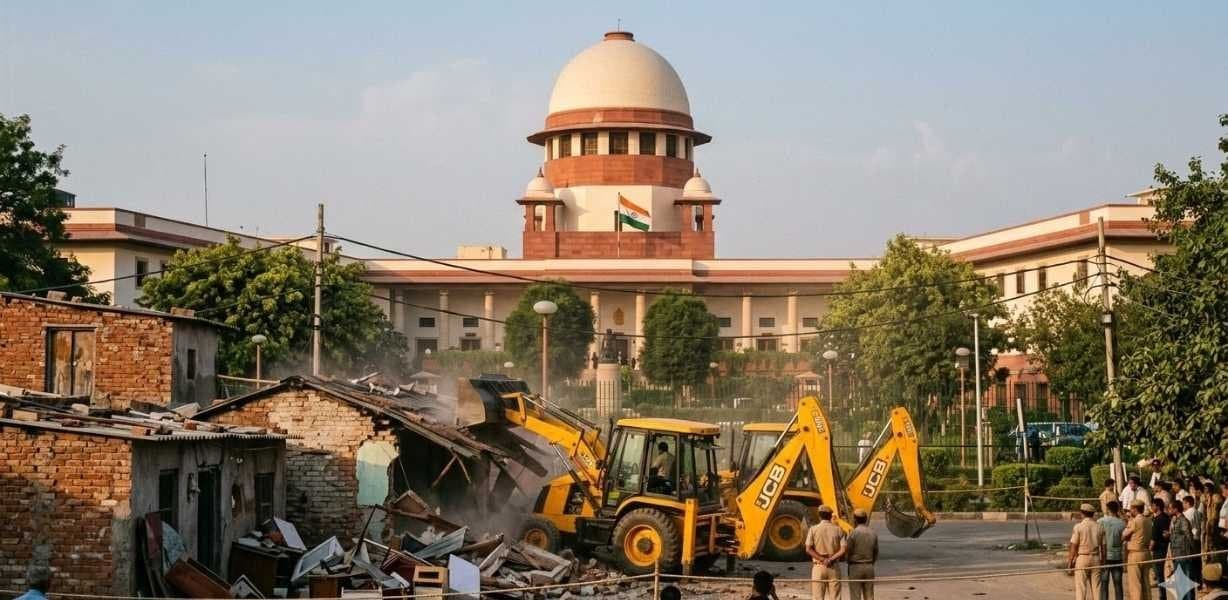
India bulldozer demolitions against Muslims did not stop when the Supreme Court said they must. On November 13, 2024, a three-judge bench led by Justices B.R. Gavai and K.V. Viswanathan issued what should have been a definitive ruling: no property shall be demolished as punishment, authorities must give 15 days’ written notice, and any official who violates these guidelines faces personal consequences. The order was unambiguous. It was also, within months, irrelevant.
On April 29, 2025, bulldozers rolled into Chandola Talab, a densely populated settlement on the edge of Ahmedabad. By the time the Ahmedabad Municipal Corporation finished its work across three separate drives in April and May, over 10,000 structures had been razed. Homes, shops, a mosque. Around 8,500 families lost everything.
The justification was national security. Authorities claimed the neighbourhood was a hub for undocumented Bangladeshi immigrants, linking the operation to the aftermath of the Pahalgam attack. The reality was more mundane and more damning. Of the thousands displaced, roughly 200 were eventually identified as undocumented. The rest were Indian citizens, migrant workers from Uttar Pradesh, Bihar, West Bengal, and Rajasthan, holding valid identity documents. They were Muslim, and that was enough.
The Pattern Is the Point
What happened at Chandola Talab was not an aberration. It was the latest iteration of a governance model that Human Rights Watch, in its World Report 2026, called the normalisation of violence against religious minorities through “discriminatory policies, hate speech, and politically motivated prosecutions.”
The bulldozer has become India’s most potent extrajudicial tool. Between 2022 and 2025, Citizens for Justice and Peace documented demolitions targeting Muslim properties in Uttar Pradesh, Madhya Pradesh, Delhi, and Gujarat, almost always in the wake of communal incidents, protests, or simply political convenience. The pretext shifts: “illegal construction” in one state, “encroachment” in another, “Bangladeshi infiltrators” in Gujarat. The outcome is consistent.
What makes the Gujarat demolitions particularly brazen is timing. They occurred five months after the Supreme Court’s landmark ruling. Not five years. Five months. And the response from the state government was not defiance exactly, but something worse: indifference. No official was disciplined. No contempt proceedings were initiated. The court’s order, it turned out, was a suggestion.
The UN Noticed. The Government Didn’t.
In June 2025, UN human rights experts issued a formal statement calling on India to halt arbitrary demolitions targeting minorities and marginalised communities. They noted that the demolitions disproportionately affected Muslims and were often framed as anti-encroachment drives or national security operations. The statement used language the Indian government typically reserves for its neighbours: “collective punishment.”
HRW’s 2026 report went further, documenting that authorities had also expelled hundreds of Bengali-speaking Muslims to Bangladesh, many of whom held Indian citizenship or had pending asylum claims. The pattern, HRW noted, was not demolition alone but a layered system: label a community as foreign, demolish their homes, deport whoever you can, and scatter the rest.
What the Court Ruling Actually Changed
On paper, quite a lot. The November 2024 ruling required written notice, a hearing, and a reasoned order before any demolition. It banned the practice of razing homes of accused persons as punishment. It placed personal liability on officials who violated the guidelines.
The gap between judicial pronouncement and executive compliance is not new in India. But in the case of bulldozer justice, the gap is the policy. State governments have learned that the political reward for demolishing Muslim properties, the visible assertion of majoritarian power, far outweighs the legal risk of a contempt notice that may never come. The court speaks. The bulldozer answers.
The question for the judiciary is not whether it can issue stronger orders. It already issued a strong one. The question is whether it is prepared to enforce what it said, or whether its November 2024 ruling will join the growing archive of Indian constitutional promises that exist only on paper.