Opening The Rift
therift
© 2026 The Rift. All Rights Reserved.
India’s Coaching Institutes: A Systemic Safety Crisis Demanding Urgent Action
Haphazard growth and the rush for quick profits have led to structural safety flaws in India’s coaching institutes, demanding urgent, systemic change.

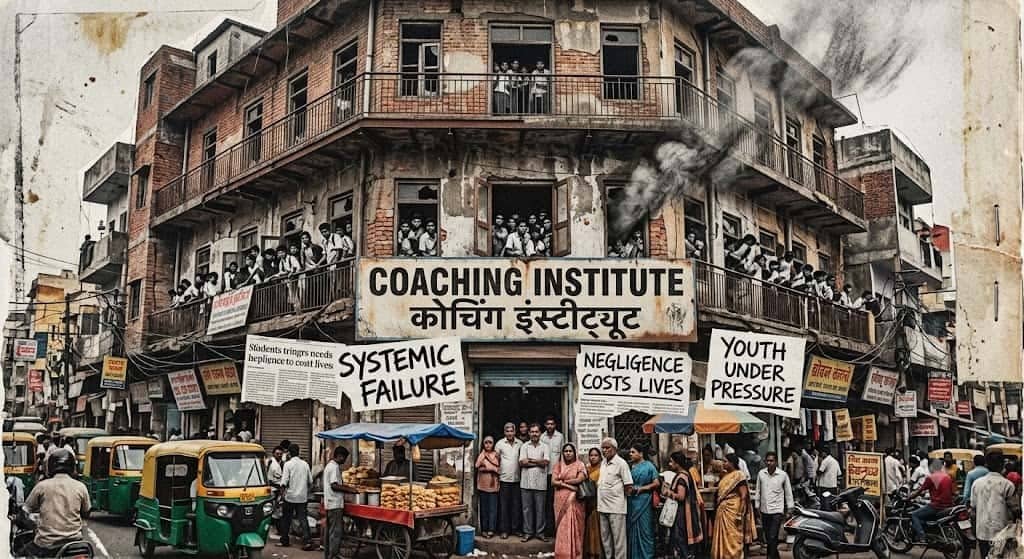
Coaching institutes in India face a systemic safety crisis, prompting calls for immediate action to address the concerns and ensure student well-being (Representative Image)
Key Takeaways
1 of 3
Automatically generated. Read full article for complete context.
There has been a huge proliferation of coaching institutes in many cities of India. As these have grown quickly and haphazardly, their growth guided not by any planned development but by the rush for quick profits, safety concerns have been frequently ignored. As a result congested buildings ill-equipped for this purpose have been conducting classes for a very large number of students with highly inadequate safety provisions.
Following the tragic death of 15 students in Lucknow and an earlier case of students perishing in a basement flood in Delhi, there has been a belated awakening of sorts regarding safety concerns in the context of coaching institutes. Delhi in particular has launched a time-bound drive for improving safety. It is good that the Federation of All India Medical Associations has also flagged serious safety concerns regarding coaching institutes in a recent letter.
Welcome as this rather newfound concern is (which has not spread to all leading centers of coaching institutes), it is still unlikely to address all safety concerns. As in the course of their haphazard, rapid and unplanned proliferation, the coaching institutes did not care to create spacious and safe buildings and environs as required considering the space needed for a large number of students and teachers, not to mention the frequent visitors including parents and others who come to pick up students when the classes end, there are structural reasons why adequate safety is difficult to provide in congested buildings using high electricity loads. In addition, as there are several hubs of coaching classes and institutes, invariably there is high concentration in a small area not just of students, teachers, and visitors, but also of hawkers, traffic and various vehicles around these institutes. In many cases staircases were not designed for the hundreds of students they have to accommodate in a rush when classes end. Whenever one sees this rush, one shudders to think what the situation would be in the case of an accidental fire. Surprisingly, adequate emergency exits do not always exist even in the case of some of the high profit and high profile institutes, let alone the more ordinary ones.
Thus, when there are such structural flaws in safety systems, it is unlikely that all important safety concerns can be addressed in hurriedly conducted safety inspections. What can be expected, and even this is welcome, is that some of the more dangerous basements can be sealed and some inadequately functioning fire extinguisher systems can be improved. However this by itself cannot be adequate. Another problem arises if some of the highly profitable setups try to circumvent their safety lapses by paying bribes.
Thus it is important that the safety issue should not be seen just as a one-time drive of inspections. Instead, this should become an integral part of the functioning of these institutes, and an essential part of the requirements they need to fulfill. safety auditsSystematic Safety ReviewsA systematic, independent, and documented process for obtaining evidence and evaluating it objectively to determine the extent to which safety criteria are fulfilled. should be more comprehensive and must include representatives of students, their parents, and teachers, apart from safety experts and concerned safety officials. Worst-case possibilities should not be ignored or brushed aside. Once safety improvements have been listed, there should be regular monitoring of their implementation. At parent meetings, the safety issue should also be taken up, and when students, teachers, and parents become aware of any safety lapses, they should quickly bring this to the notice of the management for remedial action. If prompt remedial action is not taken, then details of such safety issues should be sent to the concerned government authorities, where systems for prompt and adequate response should be in place.
Disclaimer:The views and opinions expressed in this article are those of the author(s) and do not necessarily reflect the official policy or position of The Rift.