Opening The Rift
therift
© 2026 The Rift. All Rights Reserved.
Institutional Accountability, Dereliction of Duty and Failure to Protect
When institutions look away, the law must look back with accountability.

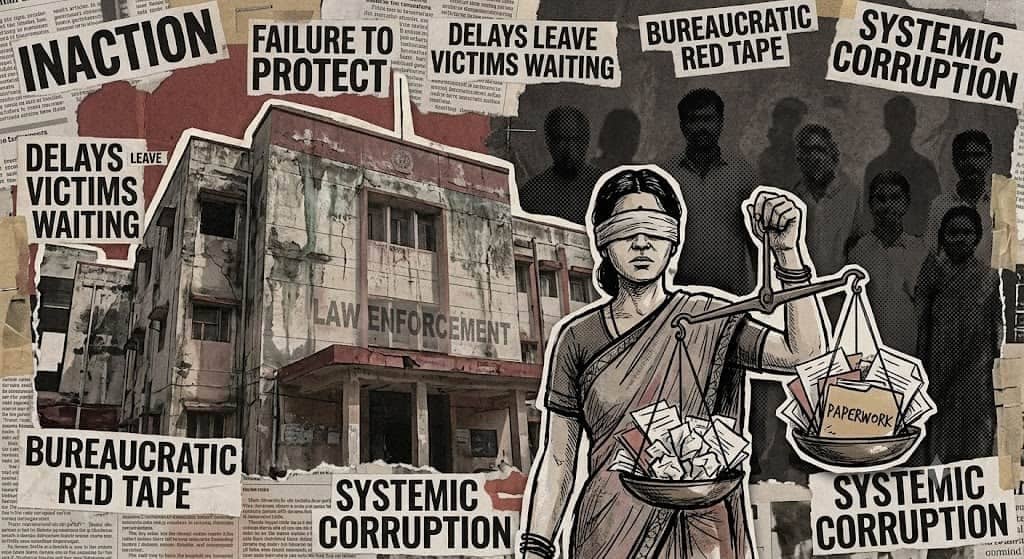
Institutional failures lead to lack of accountability and protection (Representative Image)
Key Takeaways
1 of 3
Automatically generated. Read full article for complete context.
The recent suspension of a police officer for dereliction of duty in the Shabad case, Telangana, following a multi-victim tragedy involving an accused person released on bail in a POCSOProtection of Children from Sexual Offences ActA comprehensive law in India enacted to protect children from sexual abuse and exploitation. matter, underscores a deeper crisis in institutional accountability. This incident, while reactive in its immediate consequences, reveals a systemic pattern of administrative apathy that extends beyond individual negligence. When law enforcement fails to monitor high-risk offenders or respond promptly to foreseeable threats, the state’s constitutional duty to protect life and liberty is compromised. That failure becomes even more disturbing when viewed alongside the state’s uneven response to hate speech and targeted violence against vulnerable communities.
India is a party to the International Covenant on Civil and Political RightsICCPRA multilateral treaty adopted by the United Nations General Assembly, committing states to respect the civil and political rights of individuals., which requires states to prohibit advocacy of national, racial, or religious hatred that constitutes incitement to discrimination, hostility, or violence. Article 20 of the ICCPR is especially relevant in contexts where speech escalates into coordinated harm. Domestically, however, the challenge is less the absence of legal principles than the failure of timely and consistent enforcement. In that sense, the problem is not only doctrinal but administrative.
The Law Commission of India’s 267th Report on hate speech recognized this gap and proposed a more precise legal framework. It recommended new penal provisions to address incitement to hatred and speech that causes fear, alarm, or violence, while also emphasizing contextual factors such as the status of the speaker, the vulnerability of the target group, and the likely impact of the expression. The Commission also stressed that legal prohibition should be accompanied by public sensitisation and education on responsible speech. The recommendations were ignored, possibly because they did not dovetail into a majoritarian agenda, myopically perceived as beneficial in the short term.
The Supreme Court has repeatedly held that the State cannot remain passive where hate speech or mob violence threatens constitutional order. In Tehseen S. Poonawalla and Shaheen Abdulla, the Court required police authorities to act on their own motion instead of waiting for private complaints. Those directions were meant to transform policing from reactive enforcement into a preventive constitutional duty. Yet, the persistence of inaction suggests that formal legal commands alone are insufficient. The Law Commission’s broader criminal justice reforms are relevant here. Its police reform recommendations, reflected in the 154th Report and echoed in governmental references to those recommendations, favoured separating investigation from law and order functions, improving specialization, and reducing the burden of routine public-order duties on investigative staff. That separation is directly relevant to hate-speech enforcement and to monitoring release conditions in high-risk cases, because weak investigation and overextended station-level policing often produce delayed or ineffective responses.
Key Law Commission Recommendations for Justice Reform
| Report No. & Focus | Core Recommendations |
|---|---|
| 267th Report: Hate Speech |
|
| 154th Report: Police Reform |
|
| 268th Report: Bail Reform |
|
VISUALS BY THE RIFT
The Shabad tragedy also revives a different but related issue: bail supervision in cases involving dangerous offenders. The Law Commission’s 268th Report on bail reform proposed a more disciplined approach to arrest, bail, and compliance monitoring. It recommended stricter scrutiny of arrests and bail conditions, proportionate and non-onerous sureties, a stronger role for magistrates in checking compliance, and victim-oriented safeguards, including notice to victims before release in serious matters and the use of victim impact assessments in appropriate cases.
Those recommendations matter because dereliction often occurs not at the level of abstract principle but in the administrative handling of release, follow-up, and surveillance. Where authorities fail to track high-risk accused persons, the problem is not merely a lapse in procedure; it is a failure of preventive governance. A more robust bail-monitoring framework, particularly for offences implicating children, communal tensions, or repeat violence, would better align criminal process with the state’s duty of care.
The persistence of “look-away” policing points to the need for independent oversight rather than purely internal discipline. The Law Commission’s reform orientation supports institutional specialization, clearer accountability, and stronger procedural checks. In practical terms, that means police stations should maintain transparent digital records of hate-speech complaints, preventive action, release conditions, and follow-up steps, with supervision by an independent authority rather than only by the same hierarchy that may be politically or administratively compromised.
This is especially important because hate speech and targeted violence rarely arise in a vacuum. They are often preceded by repeated warnings, public intimidation, and known patterns of escalation. A system that records complaints but does not escalate them in real time merely converts accountability into paperwork. Independent monitoring would help ensure that constitutional obligations are not treated as optional administrative preferences.
The Shabad case is a reminder that the cost of institutional inaction is paid in human lives. The legal system already contains the raw materials for a stronger response: prohibitions on hateful incitement, judicial mandates against passivity, police reform recommendations, and bail safeguards that prioritize risk and victim protection. What remains missing is consistent implementation, backed by meaningful oversight.
If the state continues to rely on reactive tokenism rather than preventive responsibility, it will keep reproducing the very conditions that make violence predictable and avoidable. Genuine accountability requires more than punishment after disaster. It requires an administrative culture that treats protection as a constitutional obligation, not a discretionary act.
What this case demonstrates is not merely administrative weakness but the erosion of the rule of law itself. The Supreme Court has repeatedly insisted that the State’s obligation is affirmative, not reactive: it must protect life, preserve order, and ensure that power is exercised as a trust, not as a convenience. In Nilabati Behera, the Court affirmed that constitutional remedies exist because public law must respond when the State fails in its duty. The lesson is plain: when institutions look away, the law must look back with accountability.
Jai Hind
Disclaimer:The views and opinions expressed in this article are those of the author(s) and do not necessarily reflect the official policy or position of The Rift.