Opening The Rift
therift
© 2026 The Rift. All Rights Reserved.
Fuel Tax in India: The invisible levy draining the working class and MSMEs
India’s over-reliance on fuel taxation is not just a fiscal inefficiency but a socio-economic injustice. It is regressive in design, inflationary in effect, and structurally hostile to the MSME sector and working-class households that have the least capacity to absorb it.

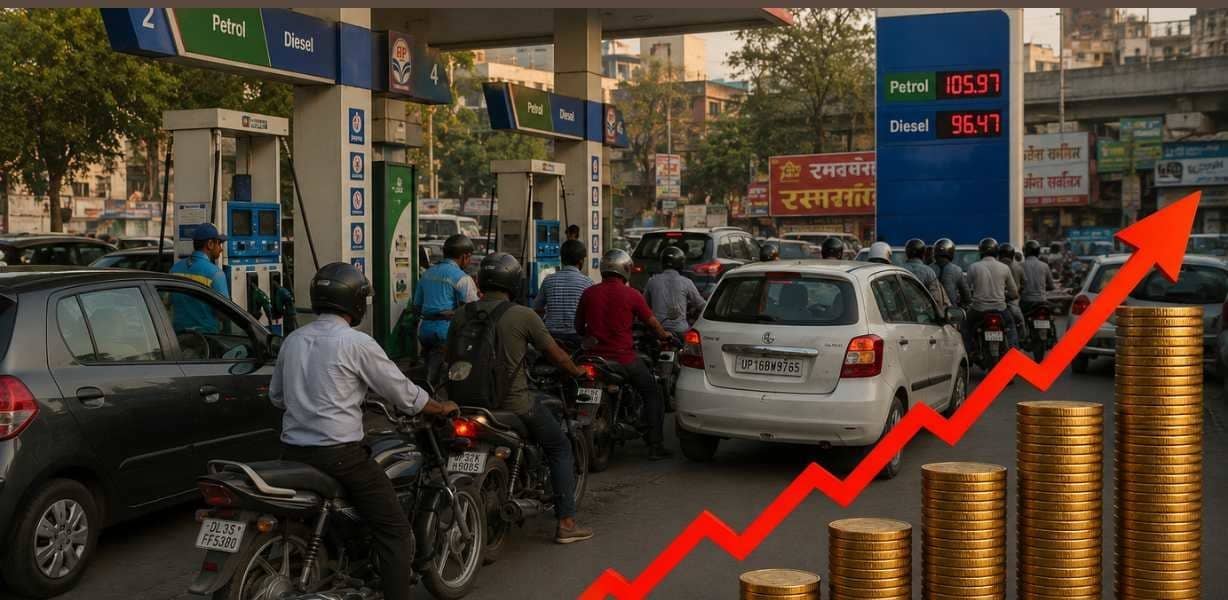
Image | Representative
Key Takeaways
1 of 3
Automatically generated. Read full article for complete context.
India’s fuel pricing structure has long operated as a two-headed mechanism: one head tracking global crude markets, the other steadily siphoning revenue into government coffers through indirect taxationIndirect TaxationTaxes levied on goods and services rather than on income or profits.. While crude oil price volatility and geopolitical factors routinely dominate the conversation around pump prices, the tax component is arguably the more consequential and less scrutinised driver. As of 2024, taxes — central excise dutyCentral Excise DutyA form of indirect tax levied by the central government on the production or manufacture of goods. plus state VATValue Added Tax (VAT)A consumption tax placed on a product whenever value is added at each stage of the supply chain. — account for approximately 55% of the retail price of petrol and 50% of diesel across India. In peak periods, that share surged as high as 69% for petrol and 58% for diesel (June 2020). These are not marginal levies; they are the dominant cost in every litre a citizen buys.
In 2023–24, the petroleum sector generated over ₹7.5 lakh crore (₹7.5 trillion) in combined tax revenue for the central and state governments — making it one of the single largest revenue streams in Indian public finance. The central government alone collected ₹2.73 lakh crore in excise duty from petroleum in FY24, down 4.8% from the previous year, but still constituting roughly 18–19% of gross central tax revenue. For state governments, petroleum VAT and sales tax account for 25–35% of their own tax revenues, and in states like Gujarat, Tamil Nadu, and Maharashtra, the dependency is even higher. This is not merely a tax on fuel; it is a structural pillar of India’s fiscal architecture.
Petrol Tax Burden
55%
Share of retail price (Peak: 69% in 2020)
Total Revenue (FY24)
₹7.5T
Combined central & state petroleum tax
I argue that India’s over-reliance on fuel taxation is not just a fiscal inefficiency but a socio-economic injustice. It is regressive in design, inflationary in effect, and structurally hostile to the MSME sector and working-class households that have the least capacity to absorb it. The evidence demands not only acknowledgement but urgent policy reform.
The Regressive Burden
Indirect taxes — levied on goods and services rather than incomes — are by design blind to economic circumstance. Whether a daily-wage labourer in Hyderabad or a corporate executive in Mumbai fills their tank, they pay the same ₹19.90 per litre in central excise duty on petrol and ₹15.80 per litre on diesel. On top of this, state governments layer VAT at widely varying rates: Andhra Pradesh charges 31% plus additional cess; Delhi charges approximately 19.4%; Maharashtra charges 25–26% depending on the region. The result is that the effective tax burden on a single litre of petrol ranges from roughly ₹30 to ₹45 depending on the state.
This uniform-rate structure makes fuel taxation textbook regressive taxationRegressive TaxationA tax system that takes a larger percentage of income from low-income earners than from high-income earners.. A household earning ₹15,000 per month that spends ₹2,000 on fuel is allocating 13% of its income to a fuel tax. A household earning ₹1.5 lakh per month spending the same amount allocates just 1.3%. The burden is not equal; it is inverted. This is the core equity argument that must be expressed explicitly: India’s fiscal system is currently structured so that its poorest citizens shoulder the highest proportionate cost of government revenue generation.
The Regressive Impact of Fuel Tax
Low Income (₹15k/month)
13% Burden
High Income (₹1.5L/month)
1.3% Burden
A critical structural issue is that petroleum products remain outside the Goods and Services Tax (GST) framework. While GST rationalised and unified indirect taxation across sectors, petrol and diesel were deliberately excluded — precisely because they are too lucrative for both Centre and states to relinquish. This exclusion has locked in a regressive, opaque tax regime on one of the most universally consumed goods in the country.
A Fiscal Addiction
The pandemic years exposed how deeply India’s fiscal management had come to depend on fuel tax revenue. When global crude prices collapsed in 2020 amid demand destruction, the central government moved quickly to raise excise duties — not to pass on the windfall to consumers, but to capture the margin for the treasury. Duty on petrol rose from ₹19.98 per litre to ₹32.90 per litre; on diesel from ₹15.83 to ₹31.80. The result: central excise revenue from petroleum hit its highest-ever level in FY21 at ₹3.89 lakh crore, even as the economy contracted by 7.3%.
This is the revealing episode. The government’s response to a global price windfall was not consumer relief; it was revenue consolidation. Fiscal deficits, healthcare spending, and infrastructure commitments required revenue, and fuel taxation offered an inelastic, captive source. People continued to buy fuel regardless of price because they had no alternative. This is precisely what makes fuel such an attractive tax base — and precisely why its overuse is so damaging.
Excise collections have since moderated. FY24 saw ₹2.73 lakh crore, the fourth consecutive year of decline, driven by partial duty cuts in May 2022 and the winding down of the windfall tax on crude oil production (introduced in July 2022 and discontinued in December 2024). Yet the structural dependency persists: petroleum taxes still account for close to 18–19% of the Centre’s total tax receipts, and state revenues remain substantially tethered to VAT on fuel.
The Price Spiral
The macroeconomic transmission mechanism of fuel taxes is well-documented but consistently underemphasised in policy discourse. Diesel is the workhorse of India’s freight economy. It powers the trucks that carry vegetables from farms in Punjab to markets in Delhi, the tractors that irrigate fields in Telangana, the generators that keep factories running in Tamil Nadu. When diesel prices rise — whether from crude appreciation or tax hikes — every link in the supply chain absorbs a cost increase and passes it forward.
India’s logistics costs were estimated at 7.97% of GDP in FY2023–24 by a DPIIT-NCAER study — a figure significantly higher than in comparable economies like China (approximately 14% historically but declining) and the US. Fuel constitutes the single largest variable component of logistics costs. When excise duty on diesel was at its pandemic-era peak of ₹31.80 per litre, freight costs surged, and the resulting cost-push inflationCost-Push InflationInflation caused by an increase in the cost of production (such as raw materials or wages), driving up prices. rippled through food, medicine, and manufactured goods. Retail inflation hit 7.6% in 2022 — a seven-year high — during precisely the period when fuel taxes were at their most elevated.
This is the logical chain the government rarely acknowledges: fiscal consolidationFiscal ConsolidationGovernment policies aimed at reducing deficits and accumulation of debt. through fuel taxes triggers logistics inflation, which triggers consumer price inflation, which triggers monetary tighteningMonetary TighteningActions by a central bank, such as raising interest rates, to slow down economic growth and control inflation., which raises borrowing costs, which slows growth. The tax that appears to “stabilise the budget” may ultimately destabilise the economy it is meant to fund.
The MSME Squeeze
India’s 5.93 crore registered MSMEsMSMEMicro, Small and Medium Enterprises, a sector crucial to the Indian economy for employment and exports. employ over 25 crore people and account for 45.73% of the country’s total exports in 2023–24. They are simultaneously the economy’s most important engine and its most vulnerable participant. Unlike large corporations, MSMEs cannot hedge fuel costs through long-term supply contracts, pass costs forward easily in competitive markets, or absorb margin compression over extended periods.
The Confederation of Indian Industry (CII) estimated in 2021 that elevated fuel prices had led to a 30% increase in MSME operational costs, a figure that is not abstract: it represents the difference between viability and closure for businesses already operating at 5–10% net margins. In sectors like food processing, textile manufacturing, and last-mile logistics, fuel is a top-three cost item. A ₹3 per litre increase in diesel — comparable to a single excise revision — can compress margins by 2–4 percentage points.
The sectoral cascades are real and measurable. Agriculture faces higher irrigation and transport costs; e-commerce and quick-commerce platforms — whose delivery economics depend on narrow per-kilometre cost assumptions — face fundamental margin recalculations; manufacturing clusters face reduced competitiveness against imports from countries with lower fuel tax burdens. India’s logistics sector, already navigating a structural shift, must now factor fuel-tax risk into pricing models that were built on a more predictable cost base.
Who Really Pays
The canonical principle of public finance — that taxation should be proportionate to ability to pay — is violated by India’s fuel tax structure. Indirect taxes on essential goods like fuel are regressive not by accident but by design: fixed per-litre charges ignore income entirely. The argument that “cars are a luxury” collapses against the reality of India’s two-wheeler economy, where motorcycles and scooters are the primary vehicles of the salaried lower-middle class — delivery workers, daily-wage earners, teachers, nurses — all of whom pay the same ₹19.90 per litre as the luxury-car owner.
Critics of the status quo have increasingly described fuel taxation as an “invisible tax” — a charge so embedded in pump prices that most consumers do not consciously register its magnitude. When a citizen pays ~95 for a litre of petrol in Delhi, they are paying roughly ₹40–45 in combined taxes. That is not a marginal surcharge; it is close to half the transaction value. The invisibility is not incidental; it is politically convenient.
The growing GDP-consumption paradox is telling: India has consistently reported 6–8% GDP growth, yet surveys of household financial stress — particularly in urban lower-middle-class segments — indicate rising vulnerability. One mechanism through which this contradiction operates is the regressive consumption tax on fuel. The macro numbers look healthy; the micro experience of tens of millions of households does not. Indirect taxation of fuel is one of the structural reasons for this divergence.
A Path to Reform
The case for reform is both economic and ethical. India requires a taxation framework that does not systematically penalise mobility, commerce, and daily economic activity. Several concrete reforms merit serious consideration:
First, bringing petroleum products under GST at a rationalised rate (ideally 18%) would immediately reduce the retail price of petrol by an estimated ₹10–15 per litre based on current base-price calculations. The resistance from states — who fear losing discretionary VAT revenue — is legitimate but negotiable through a compensation framework similar to the one used during the original GST rollout.
Second, the central government must accelerate the transition to direct taxation as the primary revenue mechanism. India’s direct-to-indirect tax ratio remains skewed. As per Budget 2023–24 data, direct taxes account for approximately 55% of total tax revenues and indirect taxes 45% — an improvement from a decade ago but still reflecting substantial regressive burden. Expanding the income tax base and closing avoidance loopholes would reduce the fiscal pressure that currently drives over-reliance on fuel taxes.
Third, countercyclical fuel tax policyCountercyclical PolicyEconomic policies that go against the prevailing economic trend to stabilize the economy. — cutting duties when global crude prices spike and recovering revenue when prices fall — would partially insulate consumers from worst-case scenarios. The government has demonstrated it can move quickly on excise revision (as in May 2022); what is missing is an automatic stabiliser framework rather than ad hoc political responses.
Fourth, accelerating the transition to electric mobility and public transport infrastructure directly reduces the tax base exposed to these regressive levies — and more importantly, reduces the financial vulnerability of low and middle-income households to fuel price volatility.
The reason these reforms have stalled is straightforward: the fiscal system is addicted to fuel taxes. The same ease and inelasticity that makes fuel a “reliable” revenue source also makes it politically difficult to surrender. States are especially resistant, since petroleum VAT often funds committed expenditures. The reform requires not just political will but an agreed fiscal transition path — comparable in ambition to the GST itself.
Conclusion
India’s fuel taxation regime is a case study in the tension between fiscal pragmatism and economic justice. The numbers are not in dispute: ₹7.5 lakh crore extracted annually from petroleum taxes, taxes comprising 50–55% of retail fuel prices, a 30% increase in MSME costs at taxation peaks, and retail inflation touching seven-year highs during periods of maximum fuel tax burden. What is in dispute is whether this represents acceptable fiscal policy or a structural injustice embedded in the price of daily life.
The argument here is that it is the latter. A tax system that disproportionately burdens the least wealthy, triggers economy-wide inflation, undermines the competitiveness of the enterprises that employ most Indians, and operates largely invisible to those paying it does not meet the standard of equitable fiscal governance. Revenues matter; so does who pays for them. India’s growth story will remain incomplete if its fiscal architecture continues to run on the silent sacrifice of its middle and lower classes.
Reform is not optional — it is overdue.