Opening The Rift
therift
© 2026 The Rift. All Rights Reserved.
India’s Freedom Could Have Come Much Sooner if Mahatma Gandhi had led a National Movement to Protect Bhagat Singh
Mahatma Gandhi missed a great opportunity for wider unity and firm resolve, resulting in much greater progress of the freedom movement and early realization of the goal of full independence.

Key Takeaways
1 of 3
Automatically generated. Read full article for complete context.
Peace movements generally always oppose capital punishment or death penalty. Death penalty is inherently against the precept of nonviolence. Peace and human rights movements thereby often oppose death penalty even in the context of dangerous criminals.
What then should be the stand of the activists of peace and nonviolence when they are examining the question of capital punishment imposed on freedom fighters who are held in the highest respect by millions of people because of their very high ethical values and deep commitment to their country’s independence? There should not be even a moment’s hesitation to say that capital punishment or death penalty for such freedom fighters should be strongly opposed (even if it is additionally true that they may have killed or were involved to some extent in the killing of a representative of colonial rulers believed to have been involved in cruelties). In such a case, anyone from peace movement will tell us, a prison sentence imposed by colonial rulers can be accepted, but capital punishment clearly cannot be justified at all.
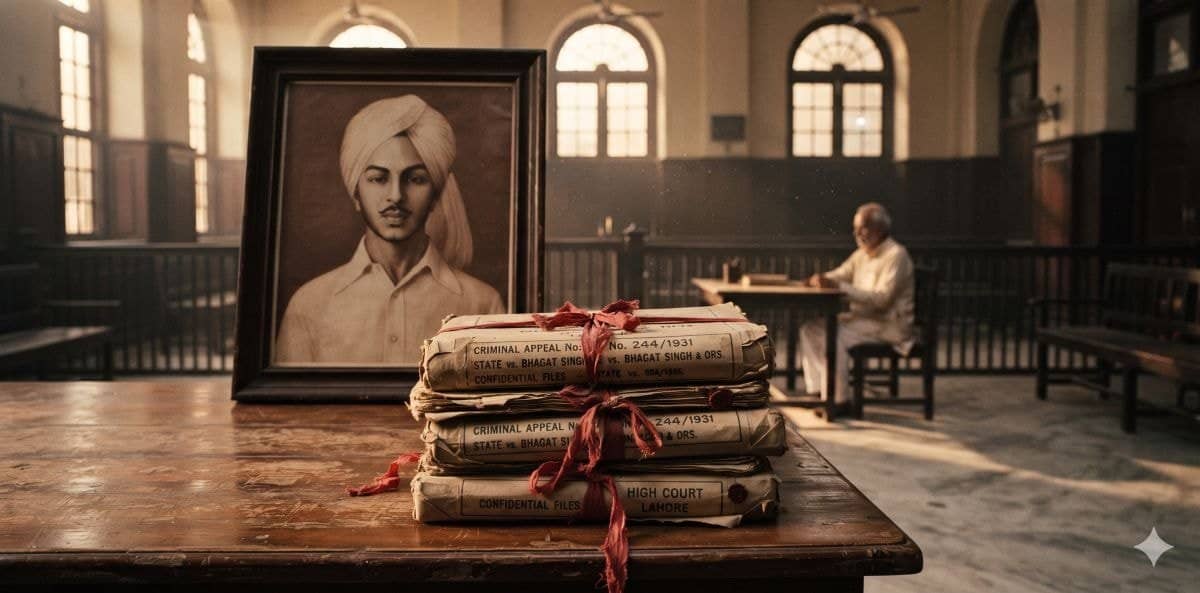
This was a crucial question that faced India in October 1930 as news of death penalty for three of the most highly respected and valiant freedom fighters of India was announced by the colonial British government and its entirely farcical judicial system and shocked the entire country. These three great freedom fighters were Bhagat Singh, Rajguru and Sukhdev. It was widely recognized even at that time that the trial had been very badly rigged by the top authorities to pave the way for pre-mediated murder by another name.
Clearly there was a very strong justification at this critical juncture to take back or commute this death penalty. At the very least, if the colonial rulers had some strong internal resistance to commuting this death sentence, this should have been suspended and postponed indefinitely with the understanding that this death sentence will be eventually withdrawn and as even various persons given life imprisonment ultimately are often released after a shorter period on the basis of various considerations, similarly these highly respected political prisoners too will be released after some years (other comrades of these three freedom fighters had sentences of life imprisonment and other prison sentences).
The conditions were in fact conducive for raising this demand. A national civil disobedience movement had been launched a few months back and was continuing. So the battle lines were already drawn, the troops of the nonviolent movement under the leadership of Mahatma Gandhi were already mobilized.
Mahatma Gandhi as a firm believer in peace and nonviolence could have led a big movement for commuting the death penalty for these three freedom fighters without in any way compromising with his ideals of complete commitment to nonviolence and peace because, as already pointed out above, the concept of nonviolence is inherently opposed to death penalty.
Mahatma Gandhi certainly tried to save the life of Bhagat Singh, Sukhdev and Rajguru in his own way by pleading for this at the highest level with the Viceroy Lord Irvin. This he did in the course of the early negotiations regarding the wider movement, but he also continued these efforts later and in fact till the very day of the hanging (23 March, 1931) when, after meeting relatives of Bhagat Singh, Gandhi wrote to the Viceroy, using “all methods of persuasion” in the letter in which, Gandhi recalled later “I had poured my whole being—heart and soul.”
What Gandhi did not do however was to launch a mass national movement for commuting the death sentence, or else to include this demand as an integral non-negotiable demand of the ongoing wider movement so that either the death sentence would have been commuted as a part of the Gandhi-Irwin pact (clinched on March 5, 1931), or else the talks would have failed and the wider movement would have continued, with the demand of commuting the death sentence becoming an extremely strong demand, shaking the foundations of colonial rule as the announced execution date approached.
In fact this demand could have been broadened to abolish the death penalty at least in the context of freedom fighters and then this demand would have gathered even more support as so many valiant freedom fighters had been executed in the past on the basis of death penalty and others were threatened. If this demand was accepted at that time when the issue had confronted the nation in an explosive form, then this would have led to saving the life of not just Bhagat Singh, Rajguru and Sukhdev, but also of other great freedom fighters executed in coming years like Masterda Surya Sen, Tarakesrar Dastidar, Kaushal Konwar and Hema Kalani would also have been saved.
Unfortunately, Mahatma Gandhi and several senior Congress leaders failed to either include this demand as one of the essential and non-negotiable demands of the wider movement, or to launch a separate mass national movement for this demand. This happened despite some of the most senior leaders Subhash Chandra Bose and Jawaharlal Nehru being known for their great admiration for the courage of Bhagat Singh.
In the absence of such a movement, the colonial rulers went ahead with the execution on 23 March, 1931 leading to great sadness and many protests in the country. Many people felt that the Gandhi-Irwin pact minus the commutation or indefinite postponement of this death penalty was a hollow achievement, and went against the basic spirit of reconciliation. In any case the spirit of the pact was not honored by the colonial rulers as there was a new wave of repressions, particular after the arrival of a new Viceroy.
In my humble opinion, a great opportunity for wider unity and firm resolve, resulting in much greater progress of the freedom movement and early realization of the goal of full independence, was missed by Mahatma Gandhi and the Indian National Congress.
To realize the significance of what could have been achieved but was missed, one must take a look at several happenings of those crucial years 1929-31. At a time when the freedom movement was in one of its low phases, the work of Bhagat Singh and his fellow-revolutionaries had helped to energize the movement. However they felt that there were limits to which an organization working secretively could advance the freedom movement, and so Bhagat Singh and B.K.Dutt allowed the authorities to arrest them in April 1929 after a daring act, as they wanted to use the jail sentence and the court cases to reach out to their people more directly. As later some other companions were arrested, they repeatedly reached out to people using court hearings, other messages and prolonged protests and fasts in jail. Day after day people were moved deeply by the great sufferings including beatings and starvation week after week accepted happily in jail for the sake of the freedom of their country and people.
When news of the hunger strike of the jailed freedom fighters reached people, 30 June (1929) was observed as Bhagat Singh—B.K. Dutt Day in many parts of Punjab. In Lahore over ten thousand people attended a meeting called by the City Congress Committee on this issue. Thousands of people observed solidarity fast. Bhagat and Dutt were hailed as the honor of the country. Protest and solidarity marches were taken out carrying pictures of the honored prisoners. Activists and leaders courted arrest. 21 July was observed as all-India Bhagat Singh-Dutt day.
When one of the fasting freedom fighters Yatindra Nath Dass died in the course of the fast, several hundred thousand people gathered to pay their homage at numerous cities and railway stations as his body was taken from Lahore to Calcutta, where as many as about 700,000 people joined the funeral procession.
Later as the news of the death penalty for Bhagat Singh, Sukhdev and Rajguru reached people, there was an unending spate of protest meetings, collection of signatures and appeals for commutation of the death sentence. In distant Tamil Nadu the Congress Committee insisted that commutation was an essential condition for peace. There was a huge upsurge in the inspirational appeal of Bhagat Singh and all that he stood for. The impact of this upsurge could be seen in the Congress moving very quickly towards the goal of attaining complete independence and this being declared openly in the historical Lahore annual session of December 1930 (continuing into the dawn of the next year 1931).
Appeals for commutation of death sentence signed by thousands appeared even in Britain.
Thus clearly there was great opportunity for building a mass movement on the commutation issue, perfectly within the framework of peace and nonviolence, and this could have gathered at least some support even in Britain as well as in some other important countries like the Soviet Union, China, USA and Germany.
Above all such a movement could have played a great role in uniting all freedom initiatives under the leadership of Mahatma Gandhi as everyone realized how much Gandhi cared for the revolutionaries and had launched a big movement to protect their leaders. In the new conditions Congress leaders like Jawaharlal Nehru, Subhash Chandra Bose, Badshah Khan and Ganesh Shankar Vidyarthi could have played a great role in ensuring unity of all for the greatest ever upsurge yet of the freedom movement which could have continued till freedom was attained. Hence it is likely that India would have achieved independence much earlier (before World War II started) in conditions of great unity of all people, without any possibility of partition and all the resulting violence.
Disclaimer:The views and opinions expressed in this article are those of the author(s) and do not necessarily reflect the official policy or position of The Rift.