Opening The Rift
therift
© 2026 The Rift. All Rights Reserved.
President Kennedy’s inspiring call for peace has even more urgency now to prevent the most destructive war
I am talking about genuine peace, the kind of peace that makes life on earth worth living… not merely peace for Americans but peace for all men and women.

Key Takeaways
1 of 3
Automatically generated. Read full article for complete context.
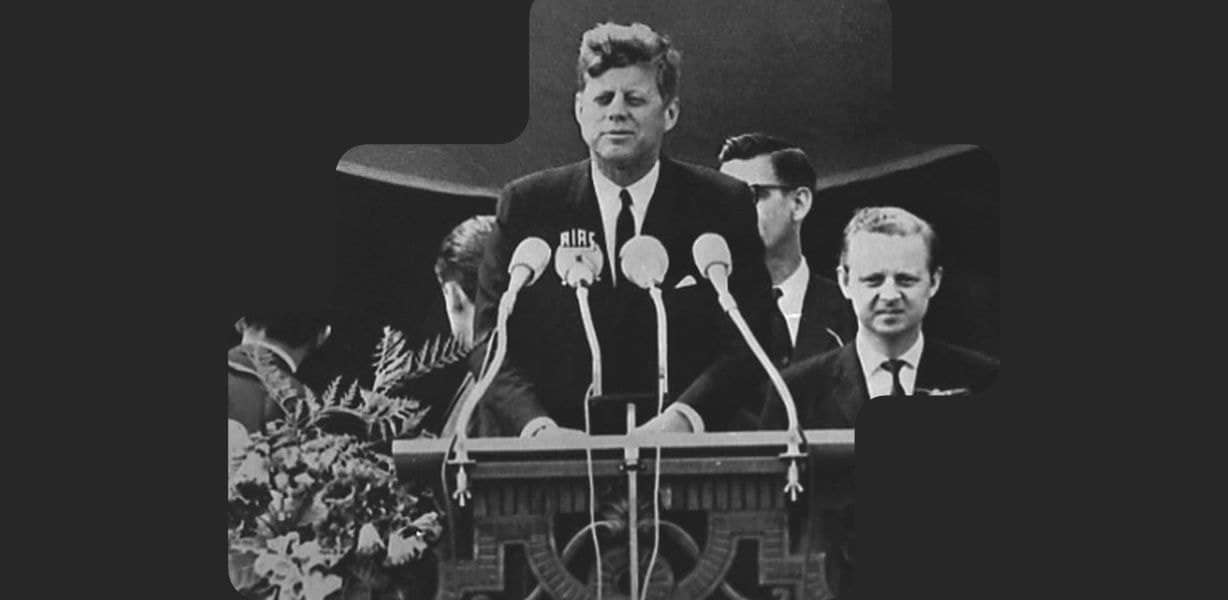
While many speeches of President John F. Kennedy have durable value for peace, special attention should be drawn to his speech on June 10, 1963 at the American University. This speech has now acquired an even greater urgency due to the increasing dangers of a Russia-NATO war, perhaps even a nuclear war potentially the most destructive war.
If they are looking for guidance from the most respected and visionary western leader of the post-war years, policy makers should read this speech many times not just in the USA but in other NATO member countries as well. They must have certainly read this in college, but appear to have forgotten its essential message, judging from recent policy trends. For the peace movement and all those committed to peace, this speech has always been invaluable.
The wider significance of this speech is related also to the greatness that Kennedy had already achieved even before making this speech at a young age as a result of, together with Nikita Khrushchev (top leader then of the Soviet Union), pulling the world back from the very edge of a likely exchange of nuclear weapons. In the case of Kennedy the credit was even greater than that for Khrushchev because Kennedy had to take this step in the face of opposition of some of his own top military and intelligence officials. He was thus taking a great personal risk in this effort ( a series of steps he took to make US systems more responsive to peace and justice ultimately led to a very severe backlash by entrenched powerful interests, culminating in his assassination, one of the saddest, most tragic events of recent history. I was a child at that time in distant India, but I also cried, as I saw family elders crying.
Kennedy’s deep commitment to peace was enhanced by his wisdom in maintaining a dialogue with Khrushchev to increase trust which was vital for securing an agreement heavily reliant on verbal assurance—while the Soviet Union was to withdraw nuclear missiles immediately, the USA made secret promises to withdraw its nuclear missiles from Turkey after some time, a promise it kept. Thus with their wisdom and mutual trust these two leaders, with their wisdom and mutual trust, were able to save the world from nuclear war despite a flashpoint having been reached.
Thus President Kennedy was sincerely and firmly on the path of world peace when he made this speech; he had significant moral strength to back what he said. This cannot be said of any recent Presidents or the present one, whether Clinton or Obama or Bush or Biden or Trump. Of course even in Kennedy’s speech, the USA’s commitment to peace at that time is sometimes described as greater than the real situation, but this is because the President is trying to take his people forward on the path of peace in a more gentle and less controversial way, knowing the extent of opposition from powerful interests. from powerful interests. Let us not forget that when this speech was made, the previous president Eisenhower’s famous warning regarding the military industrial complex getting too powerful had already been voiced.
While making a strong pitch for world peace, President Kennedy asked—“what kind of peace do I mean? What kind of peace do we seek?” He replied—“Not a Pax Americana enforced on the world by American weapons of war. Not the peace of the grave or the security of the slave. I am talking about genuine peace, the kind of peace that makes life on earth worth living, the kind that enables men and nations to grow and to hope and to build a better life for their children–not merely peace for Americans but peace for all men and women–not merely peace in our time but peace for all time.”
This definition of peace—the kind of peace President Kennedy advocated—must be considered by the present US leadership because at present when they speak of peace it is the kind that was very specifically negated by President Kennedy.
Then he spoke words which are clearly even more relevant today—“Total war makes no sense in an age when great powers can maintain large and relatively invulnerable nuclear forces and refuse to surrender without resort to those forces. It makes no sense in an age when a single nuclear weapon contains almost ten times the explosive force delivered by all the allied air forces in the Second World War. It makes no sense in an age when the deadly poisons produced by a nuclear exchange would be carried by wind and water and soil and seed to the far corners of the globe and to generations yet unborn.”
NUCLEAR DESTRUCTIVE POWER
A Single Nuclear Weapon’s Force
Explosive Force Compared to WWII Allied Air Forces
10x
Greater than all Allied air forces in WWII
VISUALS BY THE RIFT
Looking at some contradictions of the world’s understanding of security, he said, “Today the expenditure of billions of dollars every year on weapons acquired for the purpose of making sure we never need to use them is essential to keeping the peace. But surely the acquisition of such idle stockpiles–which can only destroy and never create–is not the only, much less the most efficient, means of assuring peace.”
Then he spoke of the great importance of the agenda of peace and why it should not only focus on rivals or supposed enemies but must also look inwards at our own attitudes. President Kennedy said—
“I speak of peace, therefore, as the necessary rational end (objective) of rational men. I realize that the pursuit of peace is not as dramatic as the pursuit of war–and frequently the words of the pursuer fall on deaf ears. But we have no more urgent task.”
Now we come to a very important part of this speech unlike other leaders who generally only blame other countries or demand their change, President Kennedy asked Americans to look inwards and said very clearly and emphatically that this was very important for achieving peace. He elaborated, “Some say that it is useless to speak of world peace or world law or world disarmament–and that it will be useless until the leaders of the Soviet Union adopt a more enlightened attitude. I hope they do. I believe we can help them do it. But I also believe that we must reexamine our own attitude–as individuals and as a Nation–for our attitude is as essential as theirs. And every graduate of this school, every thoughtful citizen who despairs of war and wishes to bring peace, should begin by looking inward–by examining his own attitude toward the possibilities of peace, toward the Soviet Union, toward the course of the cold war and toward freedom and peace here at home.”
Addressing more practical aspects of a peace program, he invited his audience to focus on “more attainable peace– based not on a sudden revolution in human nature but on a gradual evolution in human institutions–on a series of concrete actions and effective agreements which are in the interest of all concerned. There is no single, simple key to this peace–no grand or magic formula to be adopted by one or two powers. Genuine peace must be the product of many nations, the sum of many acts. It must be dynamic, not static, changing to meet the challenge of each new generation. For peace is a process–a way of solving problems.
“With such a peace, there will still be quarrels and conflicting interests, as there are within families and nations. World peace, like community peace, does not require that each man love his neighbor–it requires only that they live together in mutual tolerance, submitting their disputes to a just and peaceful settlement. And history teaches us that enmities between nations, as between individuals, do not last forever. However fixed our likes and dislikes may seem, the tide of time and events will often bring surprising changes in the relations between nations and neighbors.”
Speaking of the Soviet Union, he asked his people to go beyond a narrow view to see the common stake of both countries in peace, He said—“Among the many traits the peoples of our two countries have in common, none is stronger than our mutual abhorrence of war. Almost unique among the major world powers, we have never been at war with each other. And no nation in the history of battle ever suffered more than the Soviet Union suffered in the course of the Second World War. At least 20 million lost their lives. Countless millions of homes and farms were burned or sacked. A third of the nation’s territory, including nearly two thirds of its industrial base, was turned into a wasteland–a loss equivalent to the devastation of this country east of Chicago.
WWII IMPACT ON SOVIET UNION
The Devastating Cost of War (1941-1945)
Lives Lost
20M+
Soviet citizens
Territory Devastated
1/3
of national land
Industrial Base Destroyed
2/3
of total capacity
VISUALS BY THE RIFT
“Today, should total war ever break out again–no matter how–our two countries would become the primary targets. It is an ironic but accurate fact that the two strongest powers are the two in the most danger of devastation. All we have built, all we have worked for, would be destroyed in the first 24 hours. And even in the cold war, which brings burdens and dangers to so many nations, including this Nation’s closest allies–our two countries bear the heaviest burdens. For we are both devoting massive sums of money to weapons that could be better devoted to combating ignorance, poverty, and disease. We are both caught up in a vicious and dangerous cycle in which suspicion on one side breeds suspicion on the other, and new weapons beget counter weapons.
“In short, both the United States and its allies, and the Soviet Union and its allies, have a mutually deep interest in a just and genuine peace and in halting the arms race. Agreements to this end are in the interests of the Soviet Union as well as ours–and even the most hostile nations can be relied upon to accept and keep those treaty obligations, and only those treaty obligations, which are in their own interest.”
President Kennedy pleaded—“If we cannot end now our differences, at least we can help make the world safe for diversity. For, in the final analysis, our most basic common link is that we all inhabit this small planet. We all breathe the same air. We all cherish our children’s future. And we are all mortal.”
President Kennedy said, speaking at a time when the biggest adversary of the USA ( the Soviet Union) was a communist country, said, we must “persevere in the search for peace in the hope that constructive changes within the Communist bloc might bring within reach solutions which now seem beyond us. We must conduct our affairs in such a way that it becomes in the Communists’ interest to agree on a genuine peace. Above all, while defending our own vital interests, nuclear powers must avert those confrontations which bring an adversary to a choice of either a humiliating retreat or a nuclear war. To adopt that kind of course in the nuclear age would be evidence only of the bankruptcy of our policy–or of a collective death-wish for the world.”
The last two sentences quoted above are, I think, of the highest importance in the present context for stopping a very destructive war.
Further, expressing commitment to diversity of views and systems, President Kennedy said—“We are unwilling to impose our system on any unwilling people–but we are willing and able to engage in peaceful competition with any people on earth…There can be no doubt that, if all nations could refrain from interfering in the self-determination of others, the peace would be much more assured.”
Calling for increased understanding with the Soviets, he said that increased understanding will require increased contact and communication. One step in this direction is the proposed arrangement for a direct line between Moscow and Washington, to avoid on each side the dangerous delays, misunderstandings, and misreading of the other’s actions which might occur at a time of crisis.
President Kennedy said, “We have also been talking in GenevaGeneva NegotiationsRefers to various international diplomatic meetings held in Geneva, Switzerland, often concerning arms control and disarmament during the Cold War. about the other first-step measures of arms control designed to limit the intensity of the arms race and to reduce the risks of accidental war. Our primary long-range interest in Geneva, however, is general and complete disarmament, designed to take place by stages, permitting parallel political developments to build the new institutions of peace which would take the place of arms.
“The one major area of these negotiations where the end is in sight, yet where a fresh start is badly needed, is in a treaty to outlaw nuclear tests. The conclusion of such a treaty, so near and yet so far, would check the spiraling arms race in one of its most dangerous areas. It would place the nuclear powers in a position to deal more effectively with one of the greatest hazards which man faces in 1963, the further spread of nuclear arms. It would increase our security–it would decrease the prospects of war. Surely this goal is sufficiently important to require our steady pursuit, yielding neither to the temptation to give up the whole effort nor the temptation to give up our insistence on vital and responsible safeguards.”
He then made an important announcement, stating, “I am taking this opportunity, therefore, to announce two important decisions in this regard.
First: Chairman Khrushchev, Prime Minister Macmillan, and I have agreed that high-level discussions will shortly begin in Moscow looking toward early agreement on a Comprehensive Test Ban TreatyComprehensive Test Ban Treaty (CTBT)A multilateral treaty that bans all nuclear explosions, for both military and peaceful purposes, in all environments.. Our hopes must be tempered with the caution of history–but with our hopes go the hopes of all mankind.
Second: To make clear our good faith and solemn convictions on the matter, I now declare that the United States does not propose to conduct nuclear tests in the atmosphere so long as other states do not do so. We will not be the first to resume.”
Finally, President Kennedy drew a close link between the pursuit of world peace and domestic reforms, something that is often ignored in foreign policy. He called upon fellow Americans—“let us examine our attitude toward peace and freedom here at home. The quality and spirit of our own society must justify and support our efforts abroad. We must show it in the dedication of our own lives… Wherever we are, we must all, in our daily lives, live up to the age-old faith that peace and freedom walk together. In too many of our cities today, the peace is not secure because the freedom is incomplete. It is the responsibility of the executive branch at all levels of government–local, State, and National–to provide and protect that freedom for all of our citizens by all means within their authority. It is the responsibility of the legislative branch at all levels, wherever that authority is not now adequate, to make it adequate. And it is the responsibility of all citizens in all sections of this country to respect the rights of all others and to respect the law of the land.”
Thus at various levels President Kennedy sought to chart out a path of peace and disarmament which was idealistic yet practical enough to be implemented in real conditions and made important announcements which are significant breakthroughs in this direction on their own and also clear the path for further actions. It is also an exceptionally well-written speech, an inspiring document that still offers hope. As a historical document, it provides firm evidence of how firmly committed President Kennedy had become to the pursuit of world peace at a relatively early stage of his presidency. Surely he would have achieved much more by the time he completed his first term, and much, much more if the highly popular president was re-elected, as was likely, to serve two full terms ( 8 years).
Sadly, and very unfortunately, President Kennedy was assassinated less than six months after making this speech. Evidence has been accumulating over time that he was assassinated by insiders in the system who did not like the USA to walk on the path President Kennedy was preparing, a path based on peace, disarmament and justice.
Disclaimer:The views and opinions expressed in this article are those of the author(s) and do not necessarily reflect the official policy or position of The Rift.