Opening The Rift
therift
© 2026 The Rift. All Rights Reserved.
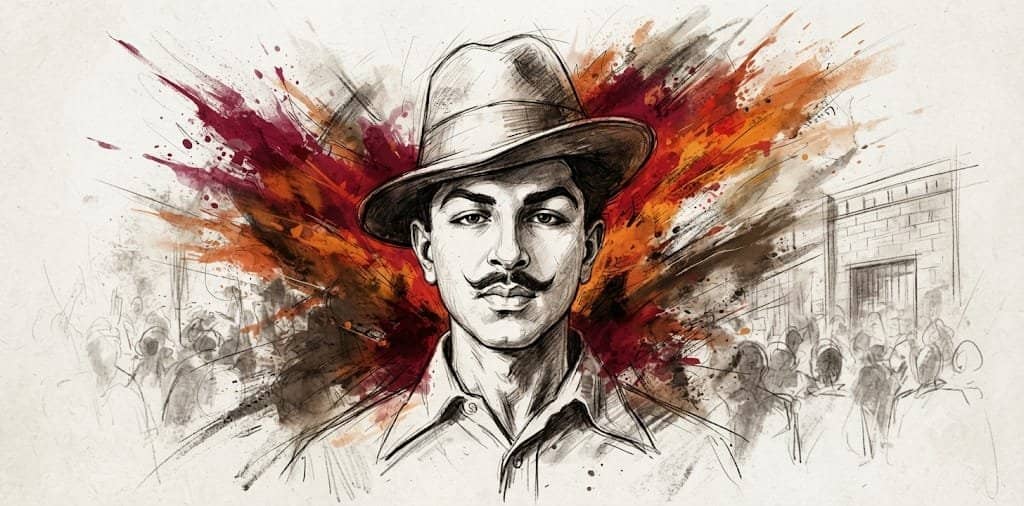
Learnings from the Life of Bhagat Singh, and from his Martyrdom at the Age of 23 for the Freedom of India
Bhagat Singh, martyred at 23, remains India’s most powerful symbol of justice, inspiring countless struggles for an exploitation-free world.

Key Takeaways
1 of 3
Automatically generated. Read full article for complete context.
Sincere work taken up very thoughtfully, courageously and with great commitment for serving humanity, for serving humanity’s urgent need for justice and equality, for creating a society free of exploitation, will always bring good and great results, although it may take time for the impact to be realized. This is one of the most enduring lessons emerging from the untiring, daring and visionary efforts of Shahid (Martyr) Bhagat Singh and his companion freedom fighters and comrades during the eventful years of the freedom movement of India (approximately) 1924-31.
Before proceeding, kindly permit me to re-emphasize a few words of the previous para as their significance is often missed. In the first sentence I speak of the courageous efforts but in addition also of very thoughtful efforts as well. The courageous part is always highlighted in the context of Shahid Bhagat Singh (September 28, 1907—March 23 1931) and his fellow revolutionaries as it is so obvious, but the thoughtful part is sometimes (perhaps frequently) neglected. It is very important to emphasize that a very important part of the Bhagat Singh story is the constant study, consultation and reflection and based on this the evolving and improving of their program and activities in such a way that it can give the best possible results in the prevailing very difficult and hostile conditions. It is this study and refection which led Bhagat Singh and his colleagues, still in their late teens or early 20s to raise highly mature issues of not just freedom for India but of creation of exploitation free world based on justice, equality and fraternity for which sustained struggle against imperialism was seen as extremely important.
Further in the second sentence in the first para I have spoken of “those eventful years of the freedom movement”. This too needs a little explanation. In fact the time around 1924 was one of the less inspiring and more worrying times in India as following the withdrawal of the non-cooperation movement by Mahatma Gandhi due to some incidents of violence taking place, times of great uncertainty had started in the freedom movement as compared to the surge of enthusiasm and unity in the recent past. This uncertainty was being used by the colonial rulers and their collaborators to break the unity of people. In these difficult times it were the great and courageous initiatives of Bhagat Singh and his companion freedom fighters which played a very important role in the return of unity and enthusiasm among the masses and carried them towards asserting in very inspiring and encouraging ways the demand for complete freedom from colonial rule.
It was at the age of only 23 years that Bhagat Singh along with his two dear friends Sukhdev and Rajguru was hanged by the British rulers following cases that saw some of the most glaring violations of the basic precepts of justice by the colonial rulers. This was in 1931. 95 years later Bhagat Singh still continues to be one of the most enduring symbols—many would say the most powerful symbol—of justice for numerous struggles big and small. For countless people he is simply the most inspiring historical figure. However there is also a different side of this immense popularity—some people who are not at all true to his ideals and thoughts also try to misuse his name for their narrow selfish ends. So it is important to have clarity on his commitments and his priorities.
Perhaps his strongest emphasis was on the creation of a society, in India as well as other countries, based on equality, justice and fraternity of all people. As imperialism was the biggest hurdle in the realization of this goal then in India, he was very firmly committed to the complete independence of India from colonial rule and in fact his courageous actions, and those of his comrades and colleagues, helped to take the mainstream Congress party in this direction. He had a strong sense of history from his ever continuing readings and studies at a young age, and this brought him to a wider opposition of imperialism beyond just the freedom movement of his own country, even though India’s freedom was of course the objective dearest to his heart for which he lived, and died at a very young age.
The society based on justice and equality for which Bhagat Singh stood firmly had absolutely no room for discrimination, injustice or violence based on caste, religion, color or other such narrow identities. He spoke very strongly for the liberation agenda of dalits or the so-called lower castes and for the unity of people of all faiths. A society based on brotherhood and fraternity was what he desired, and he referred to the objective of fraternity of all humanity or university fraternity as the noblest objective. In this context he should be seen as a very strong supporter of world peace, the kind of justice based peace that can truly help to end destructive wars. Clearly even former exploiters like the colonialists could also be included in his fraternity once they gave up their exploitative and colonizing ways. Bhagat Singh was basically against all forms of exploitation. So apart from being opposed to all forms of imperialism, he was clearly also strongly in favor of some more enlightened form of socialist society which also values liberty and human rights.
It is on the basis of these basic commitments of Shahid Bhagat Singh that we should evaluate the efforts of various forces to claim his legacy and find out for ourselves how sincere these persons or organizations are.
India’s freedom movement had several streams and the stream led by Bhagat Singh and his comrades made a very special contribution. It is important to see these streams as flowing together and often contributing to the flow of each other. There are many inspiring examples of how Shahid Bhagat Singh and his comrades contributed great vigour and sense of urgency to the Congress led movement and on the other hand, there are also examples of how Congress leaders came to the help of revolutionaries. The struggle of Bhagat Singh and his comrades like Jatindra Das during the last phase of their struggles in jail which included prolonged fasts was not very different from the struggles of Mahatma Gandhi.
It is clear that Bhagat Singh and his colleagues with hardly any resources and working in very adverse situations were able to create a massive impact in terms of creating high levels of commitment and courage for the freedom movement. This they achieved by their personal example of great courage and noble conduct, and also by careful planning of how to make the best possible use of their very limited resources to somehow take their message in a very convincing way to people. In all of this Bhagat Singh as strategist played a very significant role. The impact of the fasts and other courageous actions of Bhagat Singh and his colleagues could be specifically seen in the Congress moving rapidly towards the goal of full freedom (Complete Independence) from colonial rule.
He and his colleagues also made it amply clear to people that they did not believe in indiscriminate violence and greatly valued human life. All misunderstandings on this score were cleared by them in their statements.
Bhagat Singh wrote very clearly, “non-violence as a policy indispensable for all mass movements” while force is justifiable only “when resorted to as a matter of terrible necessity.” During the trial, Bhagat Singh and B.K. Dutt said in a joint statement, “We hold human life sacred beyond words.” When asked to define ‘revolution’ they said equally clearly that it did not mean the cult of ‘bomb and pistol’. A somewhat similar message was sent to Punjab Student Conference Lahore and it was emphasized that it is more important to work with continuity for and with workers and peasants.
Bhagat Singh and his colleagues emphasized in their several documents that basic changes in the existing system rooted in injustice are needed. The system of capitalism and imperialism has to be confronted on a wider scale to remove the basic causes of exploitation and injustice. Only then conducive conditions will emerge for ending war and establishing real and stable peace based on justice. World level fraternity based on equality in the true sense was emphasized by Bhagat Singh who also stated that this should be rooted in justice and equality at world level.
On another aspect of peace, Bhagat Singh gave very high priority to ending all sectarian conflicts based on narrow and aggressive interpretations of religious beliefs. He was very active on this front in Punjab, Delhi and Kanpur, establishing close collaboration with others like Ganesh Shankar Vidyarthi who were very devoted to this work. Naujawan Bharat Sabha formed by Bhagat Singh and his colleagues was very active on this front in adverse situations and helped to check the spread of communalism.
Bhagat Singh also gave very high priority to the strong mobilisation of dalits for ending discrimination and exploitation within Indian society. He assigned great importance to social revolution based on the mobilisation of dalits and this also was a part of the freedom struggle. He called upon the dalits to get united and challenge the entire society against the injustices suffered by them for so long. At the same time he warned them against the manipulations of bureaucracy of the capitalist-imperialist system to misguide and use them for its own ends.
Bhagat Singh called upon the youth to mobilise workers and peasants as they are the real strength of the movement. Bhagat Singh equally emphasized workers and peasants, city slums and village huts.
The establishment of a socialist system was emphasized by Bhagat Singh, as is evident from the fact that largely on his insistence the name of their organisation was changed from Hindustan Republican Association to Hindustan Socialist Republican Association.
All this remains highly relevant for India today and a lot of this is also relevant in the international context. It is amazing that Bhagat Singh as the leading ideologue of his organisation was able to formulate such mature agenda at an age of 20 to 23 years. All the time he was extremely tied up in various activities of his party or he was jailed, yet he was able to study and write extensively. Finally, all these ideas could be used in such a way as to inspire millions of people only because of the immense sufferings that Bhagat Singh and his comrades were able to face with great courage and nobility of conduct. It is the combination of all these achievements which makes Bhagat Singh one of the greatest freedom fighters of India and also one of the most inspiring figures of all liberation struggles who continues to inspire millions of people even today.
Disclaimer:The views and opinions expressed in this article are those of the author(s) and do not necessarily reflect the official policy or position of The Rift.
*Bhagat SinghAnti-ImperialismDalitsin focusIndian Freedom MovementSocial JusticeSocialismYouth Activism