Opening The Rift
therift
© 2026 The Rift. All Rights Reserved.
India Canada Nijjar Trade Deal: Sovereignty Sold for $5.5B
Canada’s $5.5 billion trade reset with India quietly shelves the Nijjar assassination, the expelled diplomats, and the sovereignty violation. The Sikh diaspora is asking: at what price accountability?
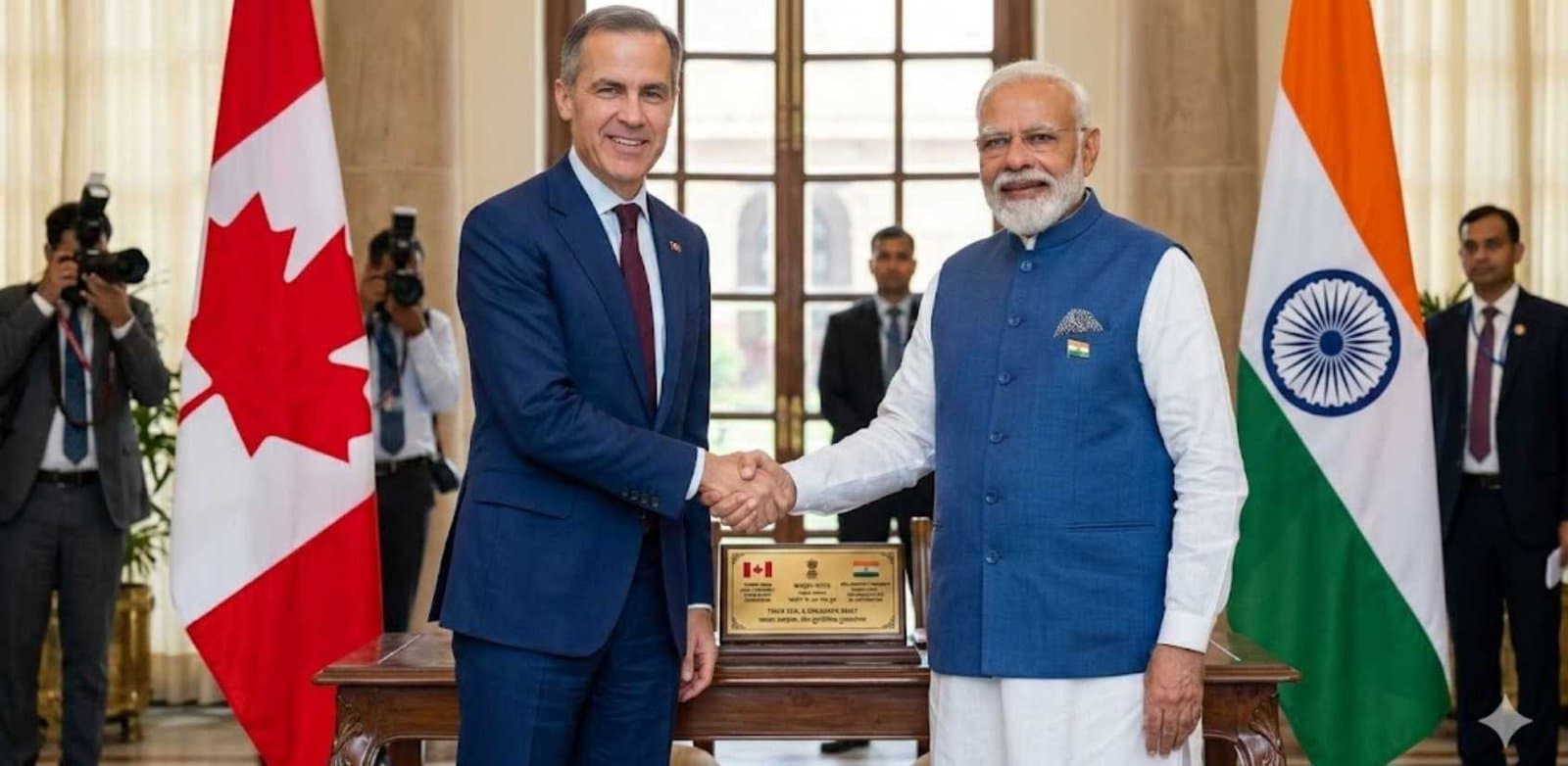
AI generated
Quick Summary
India Canada Nijjar trade deal is the story of an assassination made convenient to forget.
None of this would be remarkable if a Canadian citizen named Hardeep Singh Nijjar had not been shot dead outside a Surrey gurdwara in June 2023, and if the Canadian government had not publicly accused Indian state agents of ordering the killing.
Two days before Carney departed for Delhi, a senior Canadian government official told reporters that "India is no longer a threat" to Canadian security.
Automatically generated. Read the full article for complete context.
India Canada Nijjar trade deal is the story of an assassination made convenient to forget. On March 2, 2026, Canadian Prime Minister Mark Carney stood beside Narendra Modi at Hyderabad House in New Delhi and announced what both governments called a “new partnership”: five memorandums of understanding spanning energy, critical minerals, AI, defence, and culture, worth a combined $5.5 billion. The two leaders pledged to finalize a comprehensive free trade agreement by year’s end, and committed to expanding bilateral trade to 70 billion Canadian dollars by 2030.
None of this would be remarkable if a Canadian citizen named Hardeep Singh Nijjar had not been shot dead outside a Surrey gurdwara in June 2023, and if the Canadian government had not publicly accused Indian state agents of ordering the killing. Diplomats were expelled. Intelligence agencies issued warnings. The RCMP opened an investigation. Justin Trudeau stood in Parliament and declared there were “ever clearer indications” that India had violated Canadian sovereignty.
Then Carney replaced Trudeau. And the conversation changed.
What Was Said, and What Was Not
Two days before Carney departed for Delhi, a senior Canadian government official told reporters that “India is no longer a threat” to Canadian security. Al Jazeera’s analysis of that statement was precise: Canada had performed a U-turn, reclassifying a country once accused of orchestrating extraterritorial assassination from strategic threat to strategic partner, in time for a photo opportunity.
The joint statement issued after the meeting contained a single vague reference to “transnational repression.” There was no mention of Nijjar by name. No reference to the expelled diplomats. No acknowledgement that criminal proceedings are ongoing against Indian nationals charged in connection with the killing. India, for its part, categorically rejected all allegations, calling them “baseless, politically motivated and unsupported by credible evidence”.
CNBC framed the deal as two nations resetting ties because trust in the US under Trump had faltered. That is a generous reading. A less generous one is that Canada decided an unsolved assassination was a price worth paying for AI centres in Calgary and defence cooperation memorandums.
The Sikh Community Responds
The World Sikh Organisation of Canada was unsparing. It accused the Carney government of having “failed to hold India accountable” and demanded that the investigation extend “beyond the gunmen to those who directed” the killing, “including officials in the Government of India.” The organisation also warned that no meaningful safeguards had been established to protect Sikh Canadians from transnational repression, even as the two governments celebrated their renewed partnership.
This is not a fringe objection. The Sikh diaspora in Canada numbers over 770,000. Its concerns about state-sponsored targeting are supported by ongoing criminal proceedings in Canadian courts. When a government sidelines those concerns in exchange for trade pledges, it communicates something specific: that the rights and safety of a particular minority community are negotiable when the deal is large enough.
The Precedent That Matters
The India Canada Nijjar trade deal sets a template that should unsettle democracies everywhere. If a G7 nation can publicly accuse another state of assassinating one of its citizens on its soil, launch criminal investigations confirming that accusation, and then shelve the entire affair for $5.5 billion in bilateral agreements, what remains of the principle that sovereignty violations carry consequences?
India benefits enormously from this reset. It exits the diplomatic isolation that the Nijjar allegations created without conceding a single point. Canada benefits economically. But the precedent is corrosive. It tells every state actor capable of projecting covert force abroad that time, money, and a change of government in the target country will make the problem disappear.
Carney himself, testifying before a parliamentary committee days before his departure, sidestepped direct questions about the Nijjar allegations. The Wire headlined its coverage with a phrase that captured the diplomatic choreography perfectly: “Renewed Strategic Partnership Amid Silence on Nijjar Case.”
Silence, it turns out, is also a foreign policy position. And in this case, it was for sale.