Opening The Rift
therift
© 2026 The Rift. All Rights Reserved.
Prof. Jagmohan Singh: A Legacy Forged on Bhagat Singh’s Difficult Path
A great legacy is never completed and honored just by taking birth in such a family. It is fulfilled when you make all efforts to learn and understand it.

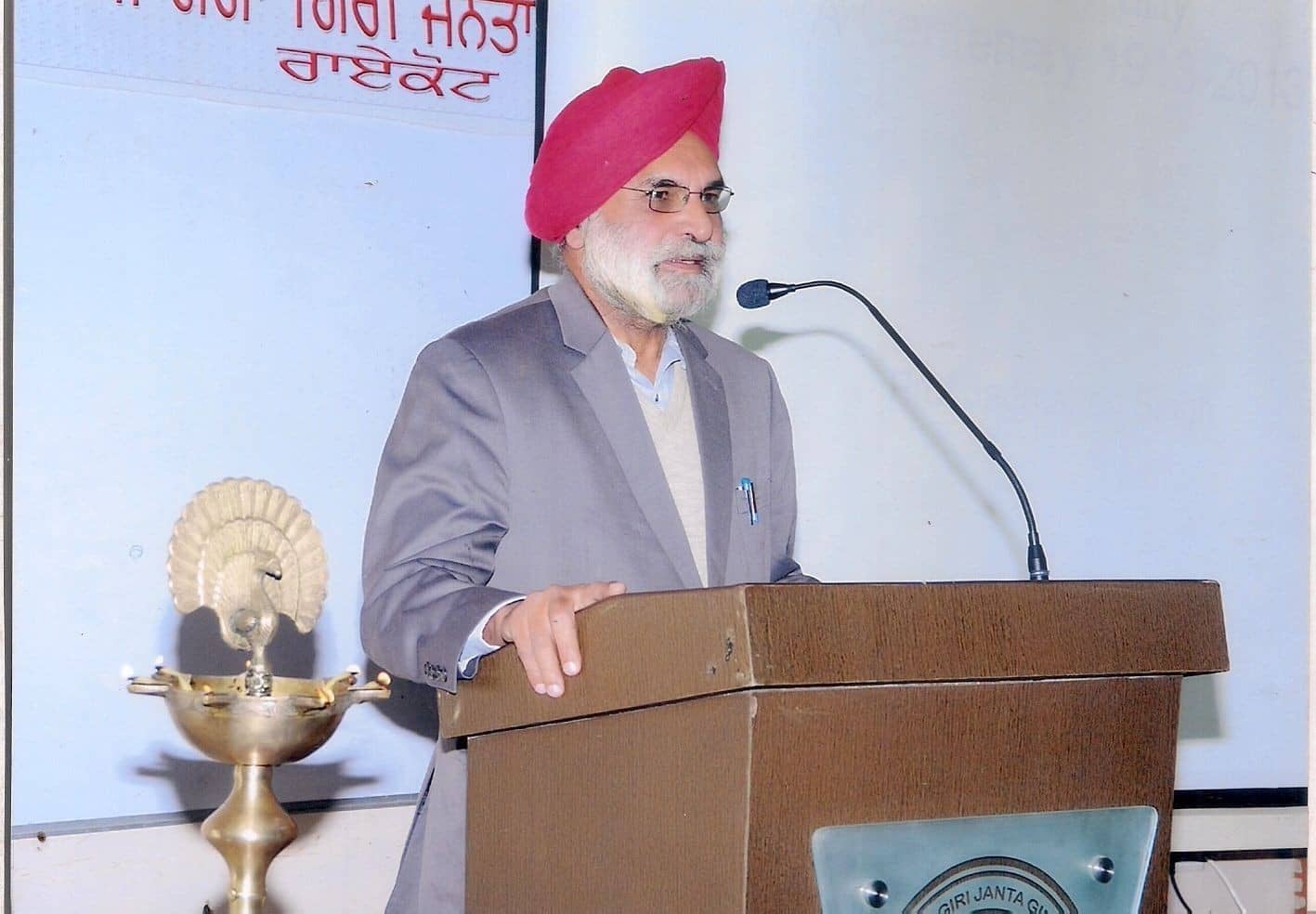
Prof. Jagmohan Singh addressing a public gathering.
Key Takeaways
1 of 3
Automatically generated. Read full article for complete context.
The teenager had just returned from his college after cycling a very long distance. He was quite tired but at the same time he was so happy that his tiredness was not at all reflected in his action. He danced around jovially. Noticing his exceptional happiness this evening his mother smiled. Giving him a glass of milk she said affectionately—Oh my son seems very happy today.
Her son put the glass of milk on the table and held her hands playfully. Oh Bibi Ji (Mother), he said, how fortunate I am! Today many guests had come to our college and everyone wanted to meet me and speak to me.
The mother laughed too and shared the undiluted joy of her son for some time. Then she suddenly became serious and holding her son’s hands firmly, she looked closely into his eyes and said, “Be very happy with your great family legacy but at the same time never forget that a great legacy is never completed and honored just by taking birth in such a family. It is fulfilled and honored when you make all efforts to learn and understand it, then help to take it forward in the right spirit with this carefully acquired understanding and above all when you are prepared to accept the difficulties that come with these responsibilities.”
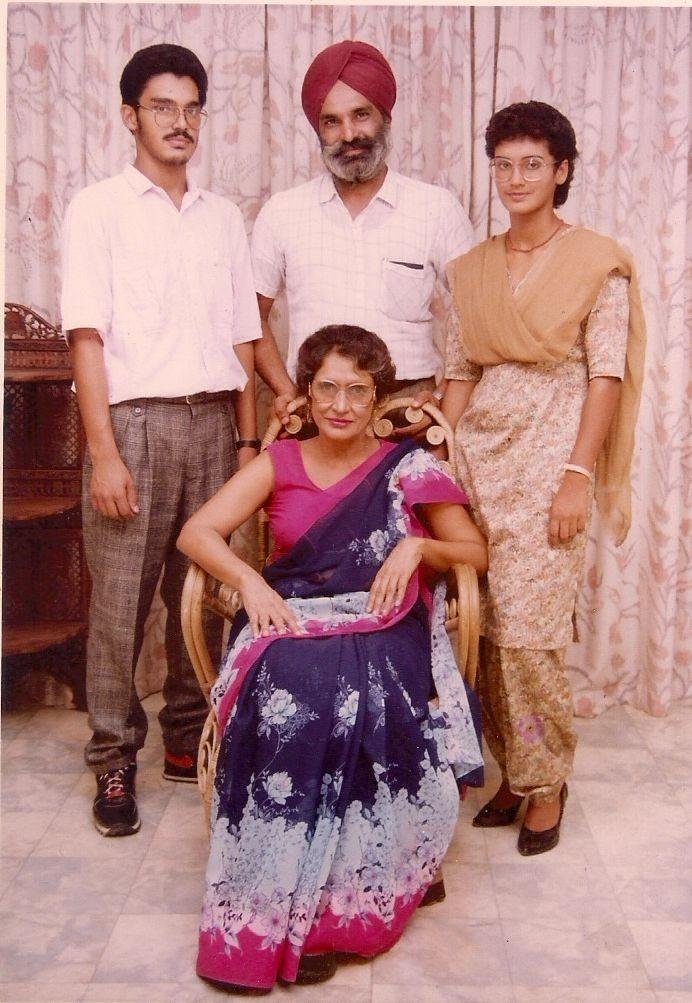
wife Dr. Amarjeet Kaur and children
The mother left as she had a lot of work pending, but the boy turning into a youth kept thinking about what his mother had just told him. It took him some time to grasp the full meaning and implications of these words but once he understood and assimilated them, this helped to shape his entire life. His life had now acquired a new meaning and guidepost. While he was a sincere and hard-working student earlier too, now he became even more devoted to learning a lot and expanding his horizons as he realized that he had much wider responsibilities and challenges in life. He had been studying in difficult conditions earlier too—his elder brother had to get together a lot of his savings to arrange the 143 rupees needed to buy a bicycle to take him to college every day. However now the student started preparing mentally himself for a life of more difficulties as this may be required of him. This also made him very thoughtful and somewhat aloof from the somewhat frivolous activities of some of his other friends, while at the same time he was keen to explore more abiding partnerships with those friends, including those elder to him, who shared his concerns.
The mother in the true life very short story related above (of the time around year 1959) is Bibi Amar Kaur, the younger sister of Shahid Bhagat Singh, the famous martyr of the freedom movement of India who was hanged by colonial rulers in 1931 at the age of only 23 years. The teenager in this story is Jagmohan, widely known today as Prof. Jagmohan Singh. The scene is Village Dyalpur, near Jalandhar in Punjab.
Today at the age of 82 Jagmohan Singh can take solace in the fact that he has lived up to this resolve of his young days. The determination of early days prepared him to decide in favor of those paths of difficulties and risks that could be true to the commitments of his legacy. Whether it is his untiring efforts to take the ideas and writings of Bhagat Singh and his fellow-revolutionaries to an increasing number of people, or to document inspiring episodes of their life, or to wage a relentless battle against sectarian elements who try to misinterpret the message of revolutionaries to suit their narrow ends, or oppose numerous atrocities and repressions while helping many constructive activities which bring hope to people, Prof. Jagmohan Singh has been in the thick of all this while at the same time sustaining high professional achievements of a brilliant academic record and engineering innovations that proved helpful to farmers.
“Whatever I could achieve was possible only because of the generous help and close cooperation of many friends and colleagues. In addition I had the blessings of great freedom fighters from early childhood days” –Jagmohan Singh said while discussing his work and achievements.
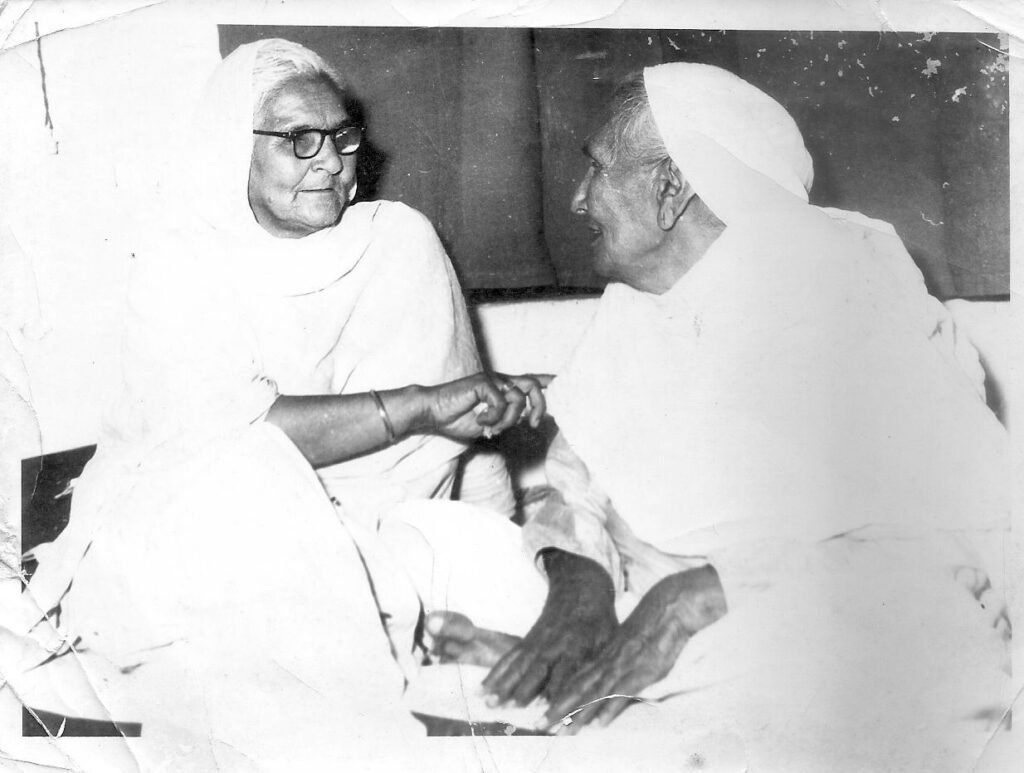
Jagmohan Singh) Bibi Amar Kaur with mother of Bhagat Singh (maternal
grandmother of Jagmohan Singh ) Bebe Ji Mata Vidyawati.
Jagmohan’s mother Bibi Amar Kaur lived up to the ideals of her great brother and participated at several levels in the freedom movement. His father Sardar Makhan Singh was known as a hard-working farmer active in social work and eager to contribute to the ideals of his inspiring brother-in-law. Jagmohan was born in 1944 in village Chack 206 Sialwala, located in Lyalpur district (now in Pakistan). His mother Bibi Amar Kaur was sentenced to imprisonment in 1945 for one and a half years for her speeches against colonial rule, and one year plus baby Jagmohan also went to Ambala Central Jail with his mother to make his first contribution against imperialism! This jail also had INA freedom movement prisoners and when they met Bibi Amar Kaur they insisted on taking the baby to play with him in their part of the prison. However the jailer felt that the child needed company of other children also and so he tried to appear generous by allowing Jagmohan to play with his son. However when his son snatched a toy of his new playmate, Jagmohan lost no time in beating him up. The jailor’s generosity vanished and he ordered—this child to be kept confined to the cell of his mother!
When the child went back to the village of his birth, political activities of his mother were increasing. On the hand her participation in the freedom movement was very important. On the other hand she also accorded great importance to the proper upbringing of her children. She initiated a good experiment which only a large-hearted woman could undertake. She had many good friends and sympathizers and she selected one each for her children for their proper upbringing. Jagmohan who was the baby among the various children too was given in the care of a young lady called Bebi Jaan who belonged to a family of freedom fighters, including revolutionary poet Melaram Wafa. In the run-up to partition various families got separated. 3 year old Jagmohan was sent with other children to a Jalandhar village while his mother stayed on till weeks after independence to take care of women and children in refugee camps.
For several months after being shifted the three-year old Jagmohan continued to ask—where is my Jaan. His reference of course was to Bebi Jaan who took very loving care of him and to whom he had become very deeply attached. About six decades later when at a meeting in London he was telling people about the memories of this second mother, a lady got up to introduce herself as Bebi Jaan whose full name was Santosh Sanghar. Imagine the great joy this unexpected meeting brought to both of them. To Jagmohan it appeared that he had found his long-lost mother. He called her Amijaan .
The days of impending partition were very difficult and worrying for the family as Bibi Amar Kaur had stayed back till late on what was now the Pakistan side to help in the evacuation of some of the more vulnerable women in particular to India. While everyone felt threatened, Amar Kaur insisted that those women who were more helpless or alone will get the first priority at the time of evacuation. She took out a sword and stood guard to protect them. People only realized after Bibi Amar Kaur had herself reached India that she had all along been in a late stage of pregnancy while doing all this high risk work in Pakistan. Her sixth and last child was born here in the ancestral village of Khatkhar kalan near Nawan Shehar in what was then the wider Jalandhar district.
In the middle of a lot of family happenings in post-partition days, two younger brothers of Bhagat Singh Kultar and Kulveer had settled in Saharanpur and Jagmohan went to live with them for some time. From here Jagmohan has memories of his first school, a Madarsa in which he was taught by a Muslim teacher. However as his parents settled soon in Dyalpur village near Jalandhar, which was better connected to facilitate the social and political role of Bibi Amar Kaur, Jagmohan was also brought here soon.
Here also Amar Kaur continued to help distressed women, including those who needed evacuation to Pakistan, and also facilitated some livelihood support activities for local women. Never wanting to say no to the many people who came to her seeking help, she was always involved in some social concern or the other.
Growing up in these environs, in these childhood days Jagmohan collected many memories of courageous exploits of freedom fighters, particularly those freedom fighters who were closely involved with this family. As a small child he was present in Delhi when in March 47 , his grand uncle Ajit Singh( Uncle of Shahid Bhagat Singh) of Pagri Sambhal Jatta fame , returned to India after 38 years of struggles abroad for freedom of India. Ajit Singh died on 15th of August 1947 with his last words, “the task we took upon ourselves (freedom of India) in the beginning of this century has borne fruit, but with a pain of communalism . Now it is the challenge for youth to build India on socialist, secular traditions which will bring social, economic and political equality and justice.” The more Jagmohan heard about him and his close friends like Sufi Amba Prasad, Lal Chand Falak and others the more his admiration grew for their great struggles for freedom carried out in most difficult conditions. He also heard very inspiring stories about freedom fighters of Gadar Party particularly Kartar Singh Sarabha. When he grew up he was able to meet some of these highly inspiring veterans of the freedom movement like Baba Sohan Singh Bhakna, the first President of the Gadar Party, and seek their guidance and blessings for his work.
There was a tradition in this freedom fighter family of giving great importance to education and they had contributed in particular to education of girls and poor students including orphans. Young Jagmohan was conscious of this responsibility and even though going to college meant 40 kms of cycling every day for him, he had a record of complete attendance. On rainy days he would cycle away merrily in his undergarments, his main dress wrapped in water-proof cover. At the college cycle-stand he would change clothes, emerging in classroom in dry clothes cheerfully.
He was initially reluctant to join engineering college for further studies to avoid the burden on his farmer family, but when he won a national scholarship for this he joined Guru Nanak Engineering College Ludhiana. True to form he struggled for improvement in scholarship scheme and these efforts helped by some senior persons led to timely disbursement of scholarships. In 1967 he graduated from here with honors and went to teach in the Punjab Engineering college after a short teaching assignment in Chandigarh. He was more attached to this alma mater college because of its history of being linked more closely to students from rural areas. He was very close to students with rural background and involved with improving their education, a concern that keeps him involved even today. From here he also went to IIT Kharagpur for M.Tech where again he distinguished himself. The stay here was particularly important for research capacity building in the area of agricultural engineering, he says. At the same time he also got involved in resisting corruption and improving food and catering arrangements at IIT . All this while he continued his abiding social concerns and study of freedom movement, involving his student to cycle alongside him in search of elderly freedom fighters living in remote villages.
Jagmohan Singh particularly cherishes the memories of days when his maternal grandmother Mata Vidyawati (mother of Shahid Bhagat Singh and Bibi Amar Kaur), who was addressed as Bebe Ji, also came to stay with them for some time and at such times even Bibi Amar Kaur would reduce her social activities to look after her mother and Aunties ..
With the blessings of Baba Bhakna and Mata Vidyawati a constructive program was started in ancestral Khatkar Kalan village called Youth Centre to link youth more closely and to involve them in constructive work in their villages and practically engage with the ideals and wider aims of freedom fighters for a just and equal society, and to take up projects for improvement of rural life by forging cooperation. This was greatly helped by Prof. Malvinder Jit Singh Waraich, Advocate R.S.Cheema and Harbans Singh Waraich. This group brought out a magazine called Qaumi Lehar to connect the youth with rich heritage of freedom struggle through original documents. Jagmohan Singh learned a lot from this work, and also contributed to it. He and his friends would cycle long distances to collect material that was of great value for this people’s journal.
There were increasing risks in this work as several such activists were being indiscriminately arrested on false accusations around this time. They could also lose their jobs. However having determined much earlier to be prepared in favor of the more difficult path, Jagmohan remained committed to his priorities. In fact this became such a habit that sometimes while facing choice of academic courses, he favored the more difficult ones!
In one such journey Jagmohan Singh had gone to meet the veteran freedom fighter of Gadar movement Baba Bhakna. Baba who was staying in a hut in a remote village in his old age. There were reports that the famous chief minister of Punjab Pratap Singh Kairon had gone to his village to request him to accept very comfortable accommodation in a city but Baba Bhakna told him that he prefers the hut as this keeps him close to people as well as their concerns. He now spoke to Jagmohan and told him that we are very determined people, we will be satisfied in our old age only when the young generation comes forward to accept our legacy in the right spirit. These words made a very deep impact on young Jagmohan as he was reminded of what his mother had told him several years back. His commitments were strengthened further with these words which reminded him that a great legacy of the freedom movement must be carried further.
Another meeting with one more veteran freedom fighter Bhagat Singh Bilga also proved very significant as he offered to make available old volumes of Kirti journal in which Shahid Bhagat Singh and his comrades had also contributed many articles of durable value (in fact they had taken great care of the journal in a particularly difficult phase). This was very helpful to the challenge Jagmohan Singh had already accepted for taking the ideas and thoughts of Bhagat Singh and his comrades to people in the right spirit.
Meanwhile marriage bells also rang and Jagmohan found his life-partner in Dr. Amarjeet Kaur who was working in a famous hospital of Ludhiana. Dr. Amarjeet had a feet related disability and she was very happy to find a life partner for whom such things did not matter at all except in terms of providing loving care and who was interested only in a loving relationship and working together to create a better world.
Subsequently the couple were blessed with two children, Ravi (now a senior computer engineer) and Preeti (a reputed doctor and teacher). In an emotional voice Jagmohan Singh told me that they were blessed at the time of the birth of their first child with the presence of both Bibi Amar Kaur and Mata Vidyavati, sister and mother of Shahid Bhagat Singh, all staying together in a small home. Imagining her presence of her son in her late years, the great martyr’s equally great mother would say, “I like him best when I see him not alone but in the company of his other freedom fighter friends.” This left a lasting impact on Jagmohan, strengthening his commitment to devote himself to taking forward the message of many fellow-revolutionaries together. Later when he was preparing books on the ideas and thoughts of Bhagat Singh , he took care to include the ideas and documents of several fellow revolutionaries as well as their joint statements. Both mother and sister of Bhagat Singh liked this approach.
Now of course the two great ladies are not present physically in this world, but their highly inspiring presence is always there to guide Jagmohan Singh as well as others engaged in similar work.
As per their earlier agreement, both Jagmohan and Amarjeet had continued their engineering and medical jobs respectively after their marriage. However when Jagmohan had to join Punjab Agriculture University, Ludhiana (PAU) in a new job, Amarjeet also agreed to leave the hospital job to start her own small health care effort with a commitment to give more attention to rural and poor patients at affordable cost . Gradually Dr. Amarjeet built up a nursing home which became reputed for care of women and mothers. At the same time she remained an invaluable support for Prof. Jagmohan Singh in all his efforts and struggles on wider social issues.
In his new PAU job Jagmohan Singh invented an electronic device for farmers known as self-starter for tube wells which proved successful at farm level. When he was asked to obtain a patent for this invention, he refused and instead made it available in the public domain without claiming any royalty. He was awarded UNESCO fellowship to study computer applications and made an important contribution in introducing computer applications at an early stage in PAU. He was widely published in engineering research and social applications. He was awarded gold medal by the Indian Institution of Engineers. He was secretary of Teachers’ Association and worked with his colleagues successfully for democratic reforms, better housing and pensions. He raised issues like weaknesses of narrow green revolution centered approach beyond the calling of his own specialized fields. He retired as Prof. and Head, Department of Computer Sciences, from PAU in 2004.
What is very remarkable is that Prof. Jagmohan Singh managed successfully to combine this busy professional life with an even more productive activist role. It was during the emergency that in accordance with felt needs with the help of a senior advocate Harbans Lal Dogra , a freedom-fighter , he was able to start a Society for Human Rights. Efforts for a broader organization which could reach out to all parts of Punjab continued after the emergency was lifted and these efforts culminated in the formation of the Association for Democratic Rights (AFDR) in Punjab. The AFDR has regularly sent fact-finding teams and prepared reports on police atrocities and various acts of repression. It has highlighted the injustice caused time and again to dalits, women and other weaker sections. It has contributed to spreading greater awareness of people’s right to information at an early stage. Jagmohan Singh has been the General Secretary of the AFDR since 1978. Several eminent scholars and activists contributed to this organization. Guidance of Baba Bhagat Singh Bilga of Gadar Party was important. Bibi Amar Kaur participated enthusiastically even in failing health. Prof Sujan Singh a Punjabi writer of great acclaim, Dr Dharamvir (at present Member of Parliament), Mohinder Singh Sandhu , Col Harbans Singh Waraich , Prof A K Maleri, Prof Sucha Singh Gill, Prof R S Ghuman and many more participated dedicatedly to add to its contributions. I also contributed in a small way with fact finding reports, lectures and publications.
When the AFDR published a report on widespread violence against Sikhs in Delhi and other parts of the country in Punjabi language in December 1984, a case of sedition was initiated against Jagmohan Singh, a move which was very widely criticized all over the country.
This was to a substantial extent a Punjabi translation of the report prepared by the PUCL and PUDR , but an additional report on how several people had also kept alive harmony in difficult times which I had written for the Hindustan Times was also added to this after translation. This was very much appreciated as this covered a missing dimension. I remember travelling to Hussainiwala to participate in the homage to Shahid Bhagat Singh, Rajguru and Sukhdev on their death anniversary around this time and got a sense of the very strong feelings among people against this case. It was probably due to expression of such strong feelings that the government did not go ahead with this case.
The AFDR advanced the scope of democratic rights by insisting on basic economic and development rights to be included. Its suggestions to this effect achieved recognition at international conferences as well. It was emphasized that atrocities and violations not just by the State but by non-state actors should be highlighted and resisted. Hence all incidents of indiscriminate violence against people were resisted and condemned, whether this involved the rabidly communal elements in Ayodhya, the Khalistanis in Punjab or the instigated violent mobs in Delhi, all such highly objectionable violence and violations were condemned without any bias along with the condemnation of state repression. This also led a west-based human rights group to reform its earlier one-sided stand, after this group was engaged in a discussion on the basis of ground realities and evidence based approach.
Prof. Jagmohan Singh has consistently highlighted a firm opposition to all forms of communalism and sectarianism as a very important and integral part of the legacy of Shahid Bhagat Singh and his fellow revolutionaries. This has sometimes brought him into confrontation with communal and sectarian forces who tried to distort this legacy in such a way as to suit their narrow concerns. Truth has prevailed but a lot of effort had to be made to ensure this. Hence an abiding concern of Jagmohan Singh throughout his life has been to spread the views of Shahid Bhagat Singh and his fellow-revolutionaries in the wider perspective of justice, equality, communal harmony and unity of people of all faiths to secure justice, real freedom and democratic rights. Several colleagues and efforts of Jagmohan Singh have contributed to these efforts which had the blessings and support of several veteran freedom fighters and revolutionaries as well. These efforts took more organized form with the establishment of Shaheed Bhagat Singh Research Committee in 1981 with Jagmohan Singh as secretary.
As a part of these efforts several documents and photographs relating to Shahid Bhagat Singh and his comrades have been published in book forms as well as on web-sites dedicated to this in English, Hindi and Punjabi. Books relating to Sardar Ajit Singh and Sufi Amba Prasad have also been published, as also books on present day problems of Punjab. Web-sites include www.shahidbhagatsingh.org,http://revolutionarybhagatsingh.blogspot.com and (for Hindi complete works), www.shaheedbhagatsingh.in.
This publication work was also extended to cover grassroots problems particularly in the context of Punjab. It was my good fortune to write and publish eight books and booklets in collaboration with Prof Jagmohan Singh, sometimes involving other colleagues as well including Reshma Bharti, Madhu Dogra and Gurcharan. When we did not have the resources to reprint updates, we still managed to update in the form of series of articles.
A special part of the efforts of Jagmohan Singh has been the living interaction with veteran freedom-fighters and revolutionaries—history as told by history-makers themselves. Bibi Amar Kaur was always there to bless these efforts and contribute. It was a big challenge for Jagmohan and his family to carry her legacy forward when she breathed her last in 1984. A few months before this she distributed pamphlets against anti-democratic laws in the Parliament, a repeat of the much-discussed daring act of her brother and his comrade Batukeswar Dutt some decades earlier. In her will she specifically mentioned that when she dies, dalit brothers should be definitely included among her pall-bearers and no religious ceremonies should be held. She wrote in her will if you think that by praying you can give me peace, forget it. Till a child is hungry and half clad,how could I be at peace. Yes if you wish me peace serve them. A strong commitment to equality for dalits and their rights was another legacy of Bhagat Singh carried forward by his sister and then by her son Jagmohan.
Jagmohan Singh and his family experienced a huge setback due to the untimely demise of Dr. Amarjeet Kaur in 2007.
Jagmohan Singh also played a leading role in setting up the Shaheed Bhagat Singh Centenary Foundation at Khatkar Kalan, with family resources, ancestral village in Jalandhar district to act as a nodal center for social actions in keeping with the vision of the great martyr and his fellow-revolutionaries. Bibi Amar Kaur Memorial Public Library has been set up in Ludhiana with a rich collection of thousands of books with a special focus on this theme.
Jagmohan Singh has also continued his abiding commitment to rural education by helping to establish and then guiding the Shaheed Bhagat Singh Creativity Centre at Sant Baba Bhag Singh University Campus in Padhiana, Jalandhar.
Jagmohan Singh has become increasingly involved in sustainable agricultural practices including SRI innovative farming and ensuring optimal use of water and local village resources. He has emphasized protection of natural fertility of soil, protection and promotion of bio-diversity with nutritional herbal plants spreading to as many homes as possible. This should be backed with strengthening of gram sabha and empowering villagers to take control of their affairs with emphasis on rights of weaker sections, dalits and women with increasing equality at all levels including gender.
He has been chosen to discharge the responsibility of Chairperson of All India Forum for Right to Education. This is an organization which is a collective of educationists, teacher organizations, student organizations and concerned citizens and works for equality based and free education from KG to PG.
Having lived a life of great commitments to noble causes which have kept him extremely busy, Jagmohan Singh comes across to old friends as well as new acquaintances as a relaxed person who has time for others and still travels quite a lot to keep his commitments. During his recent visit to our home in Mohali, although he was getting late for returning to his home in Ludhiana a good distance away, when we requested him to meet neighboring children he readily agreed. He talked with children for quite some time about Bhagat Singh, history and also about the importance of taking good care of their health. Such an affectionate man, and may his great work continue for many more years!
Disclaimer:The views and opinions expressed in this article are those of the author(s) and do not necessarily reflect the official policy or position of The Rift.