Opening The Rift
therift
© 2026 The Rift. All Rights Reserved.
Happy, But Not Yet Satisfied: Reflections on the Cockroach Janata Party Movement and India’s Gen Z Protest
Democratic protest should never be viewed merely as a law-and-order problem; it is also a form of democratic communication through which citizens express aspirations, grievances, and demands

Key Takeaways
1 of 3
Automatically generated. Read full article for complete context.
There is certainly a sense of happiness, but I cannot say that I am completely satisfied.
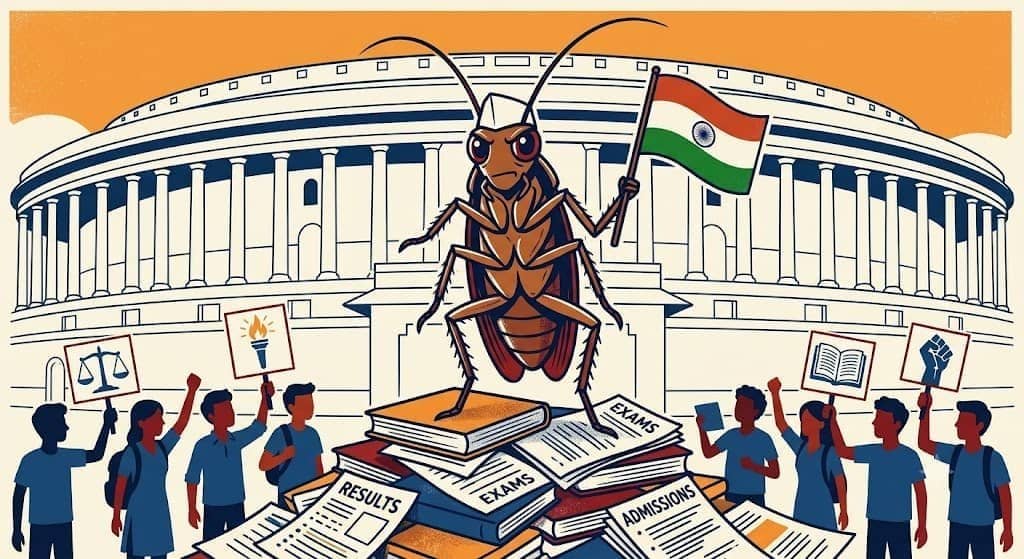
The nationwide student agitation that began at Jantar MantarHistoric Protest SiteAn 18th-century astronomical observatory in Delhi, India, that has become a prominent site for public demonstrations and protests. has emerged as one of the most fascinating youth movements in recent years. What started as an ironic response to the Hon’ble Chief Justice of India’s observation, referring to petitioners as “cockroaches,” unexpectedly transformed into a powerful symbol of democratic resistance. The creation of the Cockroach Janata PartySatirical Protest IdentityA symbolic and satirical political identity adopted by Indian student protesters, turning a perceived insult into a collective symbol of resistance. social media page by Abhijit Debke, followed by thousands of young people embracing the symbol, gave birth to an entirely new political language.
Indian politics has long witnessed symbols such as the broom, lantern, lotus, hand, and bicycle. Yet few could have imagined that an insect—the cockroach—would become the symbol of resilience, survival, and protest. That, perhaps, is the most remarkable aspect of this movement: its ability to convert a perceived insult into a collective political identity.
For nearly a month, beginning on 28 June 2026, students from across the country participated in demonstrations. Although Delhi remained the epicentre, significant mobilisations were witnessed in Maharashtra, Bihar, Karnataka, Hyderabad, Mumbai, Nagpur, and several other cities. This movement demonstrated that India’s Generation Z is not politically indifferent, as is often assumed. Rather, it is deeply concerned about fairness, accountability, and the future of education.
The temporary withdrawal of the protest following the reported acceptance of its three major demands has undoubtedly brought relief and optimism among many students. They have returned to their universities, hostels and homes with the hope that their voices have finally been heard.
However, several questions remain unanswered.
One of the most significant developments during the protest was the appeal made by some academics, intellectuals and civil society voices requesting that Muslim youth should not visibly lead the movement. Their concern was straightforward: if the movement were to be publicly identified with one religious community, there was a possibility that attention would shift away from the substantive issues towards communal narratives. Whether one agrees with this strategy or not, it reflected anxieties about how public movements are sometimes interpreted.
Subsequent reports on social media and in sections of the news raised concerns about police action involving some individuals associated with the protest, including those reportedly providing logistical support such as food distribution. There were also reports alleging heightened scrutiny of some Muslim students travelling to and from the protest site around Jamia Millia IslamiaCentral UniversityA public central university located in New Delhi, India, known for its academic and cultural contributions. and other locations. If such actions occurred without due process or on the basis of identity rather than evidence, they deserve careful legal and democratic scrutiny. At the same time, these claims should continue to be examined through verified facts and lawful investigation.
The larger concern remains the protection of equal citizenship and the principle that participation in peaceful democratic protest should not expose any individual or community to discriminatory treatment.
The second important question concerns educational reform.
The protests reflected accumulated frustrations over competitive examinations, transparency, recruitment processes, and educational opportunities. Young people repeatedly expressed a simple sentiment: “We voted, but we also expect better educational governance.” Whether this movement will translate into meaningful reforms in examinations such as NEETMedical Entrance ExamThe National Eligibility cum Entrance Test, an all-India pre-medical entrance examination for admission to undergraduate medical and dental courses in India., JEEEngineering Entrance ExamThe Joint Entrance Examination, an engineering entrance assessment conducted for admission to various undergraduate engineering and architecture courses in India. and other recruitment systems remains uncertain.
Real success will not be measured merely by the ending of the protest. It will be measured by policy reforms that restore public trust, strengthen institutional transparency, and reduce uncertainty faced by millions of students.
A third challenge now confronts the organisers of the Cockroach Janata Party itself.
If this platform continues as a broader youth movement, it must develop a thoughtful understanding of educational policy, employment, mental health, research funding, public universities, and youth aspirations. Symbolism can initiate a movement, but sustained credibility requires informed policy engagement and responsible democratic leadership. India’s Gen Z deserves not only representation but also well-articulated solutions.
Several issues therefore deserve continued public attention over the coming months:
- Whether the commitments made to the students are fully implemented.
- Whether pending legal cases and FIRsFirst Information ReportsA written document prepared by police when they receive information about the commission of a cognizable offence in India. connected with peaceful protesters are addressed in accordance with law and due process.
- Whether meaningful educational reforms are introduced.
- Whether transparent mechanisms of accountability are established.
Finally, this movement has once again reminded us of a fundamental democratic principle.
The State exists to serve its citizens. It should be student-friendly, youth-friendly, and citizen-centred. Democratic protest should never be viewed merely as a law-and-order problem; it is also a form of democratic communication through which citizens express aspirations, grievances, and demands.
Images circulated during the protests have generated public debate about policing and crowd management. These discussions underline the continuing importance of police reform, improved training in democratic engagement and effective accountability mechanisms whenever allegations of excessive force arise. Public confidence in law enforcement depends not only on maintaining order but also on protecting constitutional rights with fairness and restraint.
As the protest concludes—at least for now—we should remain hopeful but also vigilant.
The coming months will determine whether this movement marks the beginning of genuine educational reform or simply becomes another chapter in India’s long history of student mobilisations. The aspirations of India’s youth deserve more than promises. They deserve policies that inspire confidence, expand opportunities, and enable every young person to pursue their dreams with dignity and fairness.
Only time will tell whether those aspirations are honoured!
Jai Hind
Disclaimer:The views and opinions expressed in this article are those of the author(s) and do not necessarily reflect the official policy or position of The Rift.