Opening The Rift
therift
© 2026 The Rift. All Rights Reserved.
Veil of administrative secrecy versus Constitutional Liberties
When executive actions under a ‘cloak of secrecy’ threaten to fundamentally alter the relationship between the citizen and the State, judicial silence is not an option.

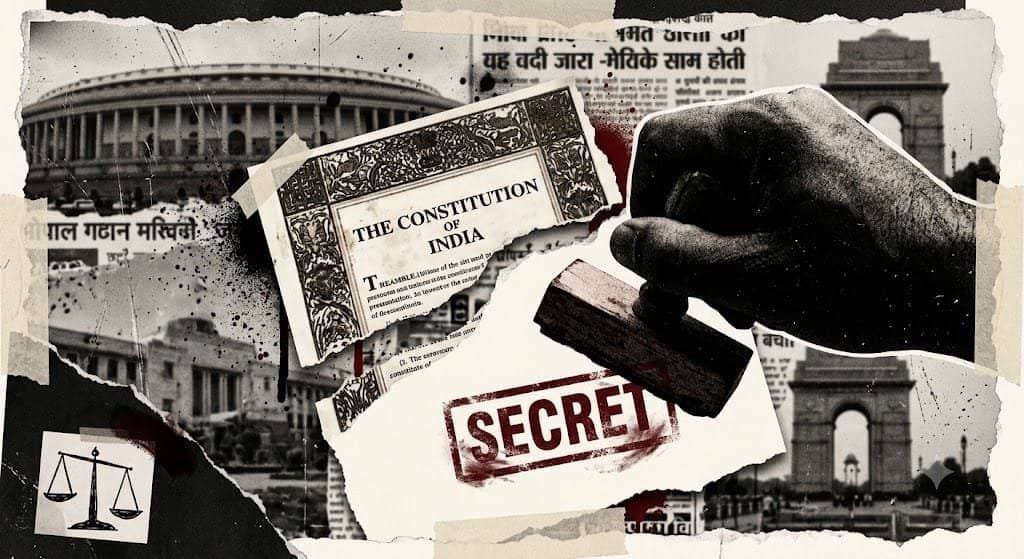
The delicate balance between secrecy and constitutional liberties is a longstanding debate in the pursuit of national security and individual freedoms (Representative Image)
Key Takeaways
1 of 3
Automatically generated. Read full article for complete context.
It appears that in a state on the Western coast a government has put out a circular and marked it “secret”. That is an overstatement. Let me say it has come to the notice of some people that there apparently exists a circular which has allegedly originated within the portals of the State executive and administration. It appears that this circular, allegedly secret, mandates profiling of people who have been “radicalised” (definition missing). So far so good; we don’t want “radicalised individuals” vitiating the atmosphere of communal harmony in the country.
Now, we don’t know what this circular says should be looked at to ascertain whether a person is “radicalised”. What we can say is that the boundaries of legitimate profiling start becoming blurred and assume unconstitutional overtones if and when the exercise is used as a cloak to cover up a secret, state-funded state-sponsored communally targeted exercise, which it can become, if it requires people to be labelled “radical” and identified as such on parameters like, for instance, the following.
One, whether they sport a beard or don’t. Two, whether they wear a typical cap associated with a certain religious identity or don’t. Three, whether they go to a Masjid, especially to stay there for the last 10 days of Ramzan, a practice known as itikaaf. Four, what events they attend. Five, what publications they subscribe to. Six, what charities doing what charitable work they are associated with. Seven, what charities they contribute to. Eight, which organisations they are members of. Nine, which WhatsApp groups they figure in. The list, which is not exhaustive, can go on.
Now it does not require great imagination to appreciate who is intended to be profiled in this manner using indicia like these, what the objective of the State can be in creating such a database, and against whom and for what purpose such a database is likely to be used, especially considering it is to be secret and ipso factoLatin PhraseBy the fact itself; by that very fact or act. not open to judicial or other scrutiny.
A completely unconnected video which I saw on a channel yesterday was about a Masjid in the immediate proximity of an international airport at Kolkata being barred for prayers on the ground that considering it is an international airport there are security concerns which cannot allow a religious place to exist within or in the immediate proximity of an international airport. One imagines that lives are lives, and people travelling on international flights would merit the same level of safety, security and protection that people travelling on flights within the country are entitled to, but what was stated on that channel by the ruling political party’s representative in the video did not suggest any such equivalence.
Is it then possible that what was not a security threat until a new party came to power in that state has suddenly now been perceived as a security threat, and if so why when there is nothing to suggest that anything has changed either within the Masjid or in the activities and worship that are carried out there and have been carried out in the decades past? Is there something which is specific to that Masjid and the activities thereat, or is it something connected with the perception of the people in power, which causes them to imagine that persons of a certain community are or are likely to be either hostile to their nation or “radicalised” or for some “secret” unstated false and imaginary reasons people to be subjected to discriminatory treatment violative of constitutional guarantees available to them? I do not know, but sometimes one has a pretty good idea without actually knowing.
Remember there was a hungama some years ago when there was an attempt to ascertain representation of various groups in the armed and paramilitary forces, despite the exercise being legitimate, to make them all more representative, to eliminate the scourge of the communal virus? This profiling too creates a database, but what is it for?
In law, intent is considered a mental fact capable of being proved. The proof of a mental fact (which resides within the mind which is situated within the brain which itself is situated within the skull) like “knowledge” or “intent” can be proved by external conduct which can include acts as well as speech. And perhaps the conduct of the State gives us citizens vital clues as to what its intent is, the question whether such intent is constitutional or unconstitutional being a matter for the Judiciary to pronounce upon… which it seems increasingly reluctant to do where it matters most to those being either profiled or subject to the discriminatory treatment.
Why is this profiling suddenly in fashion? What is so secret about it if it is a routine administrative exercise? Why is the exercise to stand protected from disclosure so as to merit it being labelled secret? What are the threshold parameters required to be met to have a document achieve the status of being labelled “secret” or “classified”? Who decides at what administrative level, as to what is to be secret and classified and what need not be?
In the evolving landscape of Indian governance, the invocation of the Official Secrets Act (OSA) to shield administrative circulars has created an increasingly opaque environment. Possible administrative directives, labelled as “Secret,” can institutionalize methods for monitoring citizens that challenge the bedrock of our constitutional democracy. When the state adopts internal protocols that essentially bypass legislative scrutiny, it necessitates a critical re-examination of the judiciary’s role in ensuring that administrative “secrecy” does not become a tool for constitutional erosion.
At the heart of this tension, this “Constitutional Collision”, lies the conflict between executive discretion and fundamental rights guaranteed under Articles 14, 19, and 21 of the Constitution. Administrative frameworks that categorize citizens based on behavioural and/or dress based and/or food preference indicators, religious observances, or social associations threaten the following protections :
Constitutional Articles Threatened by Secret Profiling
Article 14
Equality Before Law: Concerns regarding discriminatory profiling and arbitrary exercise of state power.
Article 19
Freedom of Expression and Association: Chills free speech and the right to form associations.
Article 21
Right to Life and Liberty: Infringes upon fundamental right to privacy and personal liberty.
Article 25
Freedom of Conscience and Religion: Poses an existential threat to the secular fabric and religious autonomy.
VISUALS BY THE RIFT
Article 14 (Equality Before Law): When administrative cells establish criteria for monitoring that disproportionately impact specific communities, it raises serious concerns regarding discriminatory profiling and the arbitrary exercise of state power.
Article 19 (Freedom of Expression and Association): The monitoring of social interactions, public discourse, and organizational affiliations chills the exercise of free speech and the right to form associations, which are essential for a vibrant, democratic society.
Article 21 (Right to Life and Liberty) : By establishing dossiers and surveillance mechanisms that intrude into private conduct, including religious practice, movement, and personal expression, the state risks infringing upon the fundamental right to privacy and personal liberty.
Article 25 (Freedom of Conscience and Religion) : Subjecting the practice, propagation, and internal management of religious institutions to state-led so-called “de-radicalization” programs poses an existential threat to the secular fabric of the state and the autonomy of religious practice.
The state’s use of the “Secret” label creates a circular legal trap, a Catch-22 legal deadlock. By classifying these operational methodologies as confidential, the state effectively prevents citizens from challenging these policies in court. A claimant is placed in an impossible position: to challenge the illegality of the profiling criteria, they must disclose the content of the document, thereby risking prosecution under the OSA for revealing “official secrets.” I recall being in the High Court one day when a State Government employee alleged discrimination, asking the Court to summon memos which would establish discriminatory treatment. The Court refused, saying you have no material for us to believe you. A few days later another employee came with the same grievance, but learning from his colleague’s experience he had filed copies of memos which established the discrimination complained of. The court declined again. Reason given: “These papers are not marked to you, so you did not have the right to access them!” Damned if you do, and damned if you don’t.
This administrative manoeuvre effectively pre-empts judicial review. If the policy itself is shielded from the public domain, the judiciary cannot evaluate its legality, and the public cannot hold the administration accountable for potential overreach. “No entry without permission”, reads the board. To get permission, only available indoors, you need to enter, but are barred ! Voila!
It is increasingly evident that administrative departments are operating outside the parameters of transparent governance, making out a very strong case for Judicial intervention. The current framework of these “Anti-Radicalisation” operations relies on subjective metrics (behavioural, dress-based, or food preference indicators, religious observances, or social associations) that lack any clear verifiable or known legislative basis and, despite that or for that very reason, are secretly required by the State to be shielded from external audits.
Given the gravity of the potential rights violations, it is high time for the higher judiciary to exercise its suo motu jurisdictionLegal TermThe power of a court to take cognizance of a matter on its own initiative, without a formal petition or application from any party.. When executive actions under a “cloak of secrecy” threaten to fundamentally alter the relationship between the citizen and the State, judicial silence is not an option. The courts must step in. They must step in because it is imperative for them to :
- Define the Boundaries of “Secret” : Clarify that administrative circulars defining the rights and surveillance of citizens cannot be hidden from the public eye under the OSA.
- Assert the Supremacy of the RTI Act : Reiterate that the Right to Information Act, 2005, operates notwithstanding the provisions of the OSA, and that public interest in constitutional compliance outweighs the administrative convenience of secrecy.
- Mandate Oversight : Ensure that any state mechanism involving surveillance and profiling is subject to independent, transparent, and constitutional review.
How is the corporate veil pierced when there is an attempt to evade the consequences of the law, where the competing claims are between private entities? Does not preservation of our constitutional republic depend on the ability and the willingness of the judiciary to pierce the veil of administrative secrecy that operates not for any legitimate purposes but to shield the State from having its unconstitutional conduct exposed? We cannot allow the State to redefine citizenship, privacy, and liberty behind closed doors, hidden from the light of constitutional scrutiny.
There is no harm done if everything marked secret is made available to the higher judiciary first, before it is sent ahead for being implemented. The path to redress for citizens facing the brunt of unchecked executive overreach is inherently obstructed by the state’s reliance on the “Secret” classification to insulate its actions from review. Why does it need to hide? What does it need to hide? If it hides that, whatever it is, from its own citizens who are sovereign and to whom it must ultimately answer, whose interests is it serving? Is it mimicking the agenda of another power which has been wreaking havoc on an occupied people elsewhere? Is there an occupied populace here within our own country for that mimicry to be resorted to?
When the administration adopts surveillance frameworks that bypass the legislative process, the individual is effectively rendered voiceless, unable to identify the source of their grievance without inadvertently triggering punitive measures under the Official Secrets Act. This creates an unconstitutional asymmetry of power, where the state acts with impunity behind a veil of operational secrecy, while the citizen is left to bear the silent burden of infringed liberties.
To rectify this, the legal framework must evolve to treat such “secret” policies not as untouchable administrative mandates, but as subject to the highest degree of judicial scrutiny when they touch upon the core protections afforded by the Constitution.
Therefore, the citizen’s ultimate recourse lies in the judiciary’s active intervention, demanding that all administrative protocols impacting fundamental rights be brought into the light of transparency. By invoking the principle of proportionalityLegal PrincipleA legal principle ensuring that the severity of a measure or action is appropriate to the legitimate aim pursued, and does not go beyond what is necessary to achieve that aim., the courts are uniquely positioned to declare that no policy, regardless of its “Secret” designation, can lawfully infringe upon Article 14, 19, or 21 without a clear, publicly vetted legislative foundation.
This paradigm shift requires the judiciary to treat the “cloak of secrecy” as a presumptive barrier to the rule of law, requiring the state to prove that its actions are not only necessary and non-discriminatory but also subject to meaningful, ongoing judicial or independent oversight.
Only by stripping away the arbitrary protection of the “Secret” label can the judiciary ensure that the State remains a servant of the Constitution, rather than an unanswerable architect of citizen monitoring eroding the rights guaranteed to them by the Constitution—the Constitution that the judiciary swore to uphold, and on which its members took their solemn oaths of office.
Jai Hind
Disclaimer:The views and opinions expressed in this article are those of the author(s) and do not necessarily reflect the official policy or position of The Rift.
*Constitutional LawFundamental RightsIndiaJudicial ReviewOfficial Secrets ActRTI ActState Surveillance