Opening The Rift
therift
© 2026 The Rift. All Rights Reserved.
Stability, Trust and Justice,Making Sense of Two Nobel Prizes
A peaceful, stable, and just world does not come about on its own; it has to be built through accurate information, transparent policies, and rules that apply equally to all.

Key Takeaways
1 of 3
Automatically generated. Read full article for complete context.
As this year’s Nobel season drew to a close, two prizes drew particular attention: one in economics and the other for peace. At first glance, they seem far apart. The first belongs to the intricate world of inflation, interest rates, and government policy; the second to the world of war, justice, and human rights. Yet, a single thread runs through both. Societies, markets and the world at large function on the basis of rules, expectations, and trust. When that foundation crumbles, the loss is not only in numbers and buildings but also in people’s futures.
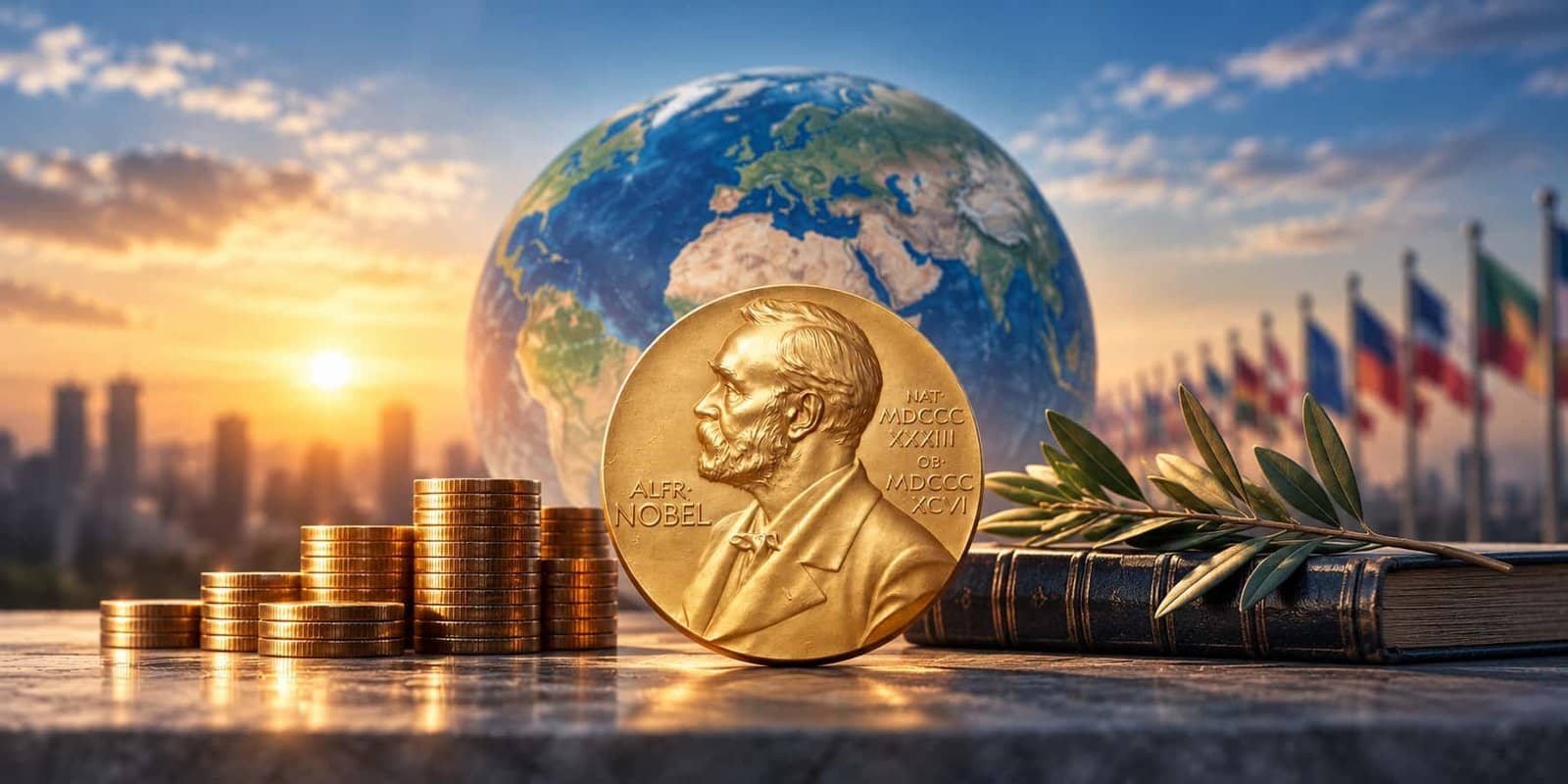
The Royal Swedish Academy of Sciences has announced the 2026 Nobel Memorial Prize in Economic Sciences for Robert E. Hall and Michael Woodford. Their research concerns the “microeconomic foundations of macroeconomic stabilisationEconomic TheoryThe idea that overall economic stability (macroeconomics) is built upon the collective decisions and behaviors of individual households and firms (microeconomics)..” The words sound difficult, but the idea behind them is simple. Keeping a country’s economy stable cannot rest solely on grand theories run from above. The economy can be kept in balance only by taking into account the many small and large decisions that millions of households and firms make every day; this is considered the core of their work. Hall, who is 83, is associated with Stanford University; Woodford, 70, teaches at Columbia University. The prize amounts to roughly 1.2 million US dollars. It was not among the five original prizes that Alfred Nobel named in his will in 1895; it was established later by Sweden’s central bank.
A simple example shows why this research matters. When a family decides whether to buy a new refrigerator, it does not look only at today’s salary. It wonders whether the job will last next year, whether the loan instalment will rise, and whether vegetables and fuel will become more expensive. A shopkeeper, too, estimates tomorrow’s costs and demand before deciding what price to charge for his goods. In other words, today’s decisions about spending and pricing rest on expectations about tomorrow. Giving this forward-looking side of the economy a firm footing, one that can be measured in hard numbers, became the hallmark of the two laureates’ work. The Nobel committee described their work as giving fresh strength to the policy of economic stability. According to the committee’s chair, John Hassler, the research has given a stable theoretical foundation to the models that central banks and governments around the world use today.
For a country like India, there are two distinct lessons here. The first comes from Hall’s work. His research allows governments to identify more precisely how many households live hand to mouth, with consumption wholly dependent on today’s income. Economic shocks hit such families hardest, which is why identifying them is decisive for policy. Today India provides free grain to more than 810 million people. The basis of this arrangement relies on estimates made some thirteen to fifteen years ago, and over the past decade and a half, the country’s population, urbanization, income structure, and nature of employment have changed considerably. In such circumstances, a scheme built on old estimates can fail to reach the truly needy, and in some places can even benefit those who do not need help. If modern data were used to identify who is genuinely in need, government spending on subsidies could be more precise and more effective. In an era of fiscal constraintsPublic FinanceLimitations or restrictions on government spending and revenue collection, often due to factors like budget deficits, high national debt, or economic downturns., this matters even more. Those who work in rural and tribal areas will feel this point especially close to home, because so often the person in real need is left off the lists while those who look comfortable on paper find their way in.
The second lesson comes from Woodford’s work. He showed clearly how much weight firms give to their expectations about the future when setting present prices. In India, the Purchasing Managers’ IndexEconomic Indicator (PMI)An economic indicator derived from monthly surveys of private sector companies, providing insights into current and future business conditions, including production, new orders, and employment., compiled from private-sector purchasing managers, does this job to some extent, measuring firms’ expectations for the next few months. Beyond that, however, there should be a government survey that consistently measures long-term expectations. Such information would be of great use to the central bank when it decides on interest rates and to the government when it confronts supply shocks.
The most political lesson of this research lies precisely here, and it concerns the communication of policy. People and firms behave according to how they think about the future. Therefore, clearly telling people what decisions the government has taken, what it intends to do next and which direction it is headed is itself a powerful instrument of policy. When there is clarity and certainty in medium-term policy, households and firms feel secure in making economic decisions. With a few rare exceptions, the Government of India’s record on this count has been weak, and the weakness showed repeatedly during the efforts to bring in the farm laws, the labour codes and the Citizenship (Amendment) Act. Even when a policy is sound, if it is not properly explained to the public, confusion, distrust and uncertainty grow. And uncertainty is the economy’s greatest enemy.
The same principle can be applied to the world’s present situation. The framework laid out by the Nobel laureates tells us that the war in West Asia is not limited to loss of life and destruction of property. When the future begins to look dim and uncertain, the effect is felt in today’s prices, today’s investment and today’s spending. Through fuel prices, freight costs and supply chains, the blow reaches the ordinary family’s kitchen. We feel the war is being fought somewhere far away, but its heat reaches our doorstep through the prices in our markets.
Now, let us turn to the second prize. On 9 October 2026, in Oslo, the Norwegian Nobel Committee announced the Nobel Peace Prize for the South African jurist Navanethem, better known as Navi Pillay. The honour is for her efforts to promote peace and international law. The committee said that a single common thread runs through her career, from defending Mandela and other anti-apartheid activists to serving as a judge in international judicial proceedings. The committee’s chair, Jørgen Watne Frydnes, called her one of the leading defenders of international legal principles. Looking at Pillay’s life, one realises how fitting the prize is. She was born in 1941 in Durban into a family of Indian Tamil descent, and grew up in apartheid South Africa. Under such a system, simply becoming a lawyer was a major challenge for a non-white girl. Even so, in the 1960s she set up her own law practice and fought the cases of many anti-apartheid political prisoners and activists, including Nelson Mandela, who was imprisoned on the notorious Robben Island. She became the first non-white woman to serve as a judge on South Africa’s High Court.
Her work later expanded to the international stage. She served on the International Criminal Tribunal for RwandaInternational Law (ICTR)A court established by the UN Security Council in 1994 to prosecute individuals responsible for genocide and other serious violations of international humanitarian law committed in Rwanda. and on the International Criminal CourtInternational Law (ICC)An intergovernmental organization and international tribunal that has the jurisdiction to prosecute individuals for international crimes of genocide, crimes against humanity, war crimes, and the crime of aggression., the ICC. In the Rwandan war crimes trials, she took part in writing the 1998 judgment against the local politician Jean-Paul Akayesu. That judgment established a historic principle: it recognized that rape and sexual violence can themselves constitute acts of genocide. It changed the way the law looks at atrocities committed against women in war. She later served as the United Nations High Commissioner for Human RightsInternational Office (UNHCHR)The principal UN official responsible for human rights, leading the UN’s human rights efforts and overseeing the Office of the High Commissioner for Human Rights (OHCHR). and chaired the UN’s independent international commission of inquiry on the Occupied Palestinian Territory. Last year, that commission concluded that Israel had committed genocide in Gaza, and Israel rejected the report as “scandalous.” The commission also noted that Prime Minister Benjamin Netanyahu and former Defence Minister Yoav Gallant had “incited genocide” through their speeches and statements.
The Nobel Peace Prize has always been controversial, as the original author reminds us. Barack Obama, who received it in 2009, bombed Libya two years later. The 2025 prize went to the Venezuelan opposition leader María Corina Machado, who supported the economic siege Washington imposed on Venezuela and the illegal attacks on boats in the Caribbean. Against this background, the author argues, Pillay’s selection restores credibility for the committee, and her record of standing with the victims of international crimes has remained spotless. It should be noted, however, that this is that author’s assessment. Such controversies are part of the prize’s history, and opinions on them can differ.
Reactions followed as soon as the prize was announced. Pillay said she dedicated the award to all survivors of international crimes. When those present applauded, she joked lightheartedly that if she got any more applause, she would share the prize with Trump. For his part, US President Trump wrote on social media that the committee had diminished the prize’s prestige by awarding it to Pillay. On the same day, the White House imposed further sanctions on the ICC. These two scenes expose the contradiction within a single event: on one side, joy at the honouring of the law; on the other, direct pressure on the institutions of the law.
Pillay’s honour comes at a time when there is a sense around the world that the law-based international order itself is under threat. Russia’s invasion of Ukraine challenges the fundamental principles of sovereignty and territorial integrity. Israel is bombing Gaza, Syria and Lebanon with impunity while tightening its grip on Palestinian territories. And the United States, under President Donald Trump, who considers himself deserving of the Nobel, began a war against Iran on 28 February and killed that country’s supreme leader. This is an open violation of international law and norms. Institutions such as the ICC have been fiercely attacked and even sanctioned. Opinions on these claims differ from country to country, but the reality of the pressure and sanctions on international institutions is evident in the developments that followed the prize as well.
What, then, is the larger meaning of all this? International laws and institutions keep the world from becoming a “Hobbesian junglePolitical PhilosophyA term derived from the philosophy of Thomas Hobbes, describing a state of nature where life is ‘solitary, poor, nasty, brutish, and short’ due to the absence of rules, laws, and a strong central authority..” The phrase comes from the thought of the seventeenth-century philosopher Thomas Hobbes: without rules and a shared authority, society becomes a place where the strongest do whatever they wish. Laws and institutions matter precisely because they hold even the powerful to account. They are not perfect, and their enforcement often shows limitations and double standards. But without them, weak nations and ordinary people are left with no other protection. This matters even more for a country like India, because our strength lies less in military dominance than in a rules-based order, in trade and in diplomacy.
Now let us return to the question we began with: what is the link between economics and peace? Hall and Woodford tell us that for an economy to remain stable, people need trust and clarity about the future. Pillay’s life tells us that for the world to remain stable, there must be trust that rules will apply equally to everyone. In both places, certainty, transparency and accountability are the lifeblood. When policies are imposed suddenly and without explanation, uncertainty grows in the market. When international rules are trampled by force, uncertainty grows in the world. In both cases the price is paid by ordinary people, sometimes in the form of inflation and sometimes in the form of war.
For India, this offers some concrete directions. To set the targets of social schemes, we need up-to-date and reliable data, so that help reaches those who truly need it. We need long-term surveys that measure expectations about the future. We need open and clear communication with the public before and after major policy changes. And we need a clear position of standing with the voices that strengthen the rule of law in the world.
The Peace Prize will be presented in Oslo on 10 December, the anniversary of Alfred Nobel’s death. What the world’s atmosphere will be like by then, no one can say today. But this year’s two prizes have made one thing clear: a peaceful, stable and just world does not come about on its own. It has to be built through accurate information, transparent policies and rules that apply equally to all. And that requires the contributions of everyone, from university researchers to judges who fight for the victims of war, as well as the watchful attention of ordinary citizens like us.
Disclaimer:The views and opinions expressed in this article are those of the author(s) and do not necessarily reflect the official policy or position of The Rift.