Opening The Rift
therift
© 2026 The Rift. All Rights Reserved.
Voices of Peace: US Leaders and Diplomats Who Saved Millions of Lives
This emphasizes the importance of at least some voices of peace existing in the top layers of those decision-makers.

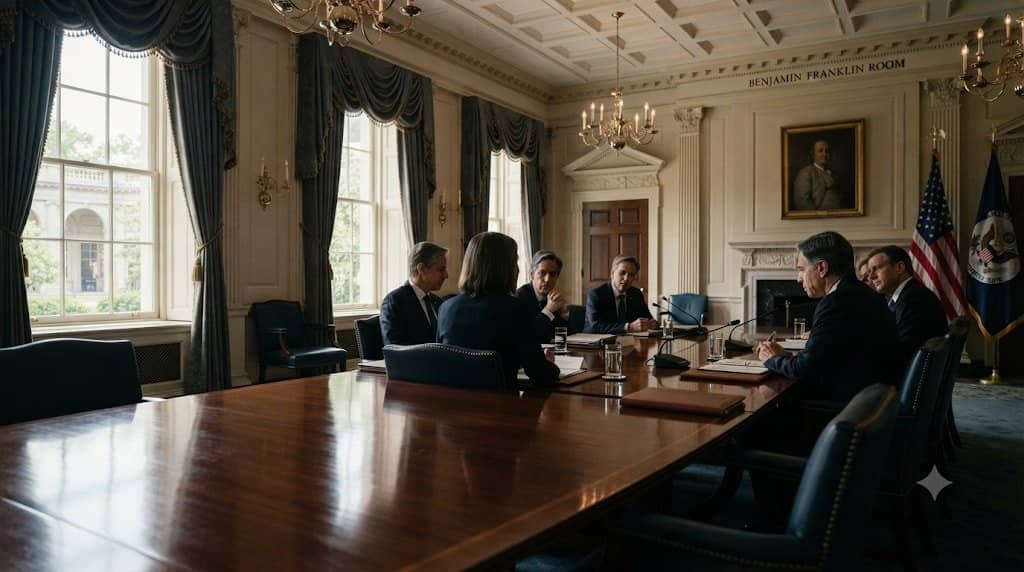
(Representative Image)
Key Takeaways
1 of 3
Automatically generated. Read full article for complete context.
Soon after the end of the Second World War there was a short period of about four years when the USA was the only country possessing nuclear weapons (before the Soviet Union got its first such weapon in 1949). During these four years 1945-1949 there were indications that the USA and its closest allies, recognizing that the Soviet Union was their main rival in the post-war architecture of the world and also that the Soviet Union would also have its nuclear weapons in due course, considered the possibility of a big pre-emptive nuclear weapon strike on the Soviet Union which, coming on top of the very heavy destruction caused earlier by Hitler’s invasion, could have effectively destroyed the country.
Even before the year 1945 ended, a list of about 66 strategic urban areas of the USSR which could be attacked was being circulated, in top classified documents which would be declassified only about three decades later in 1975. Towards this end, the requirement for fast-tracking the availability of nuclear weapons was being highlighted, mentioning numbers ranging from 123 to 466, with about 200 stated to be required for targeting the Soviet Union alone. Some powerful lobbyists emerged for such a strike. This possibility was raised and considered despite the fact that the Soviet Union was the close ally of the USA and Britain in saving the world from Hitler and all that the Nazi dictator stood for.
POST-WWII NUCLEAR PLANNING
Proposed Pre-emptive Strike on Soviet Union (1945-1949)
66
Strategic Urban Targets
200
Weapons for USSR Alone
123-466
Total Weapons Considered
VISUALS BY THE RIFT
Fortunately several senior persons in the USA recognized that soon after the extreme destruction of the Second World War, in which the Soviet Union had suffered the greatest loss of human life, it would be completely unethical to launch such an attack. So they opposed such a pre-emptive nuclear weapon strike on the Soviet Union, leading either to its complete cancellation at that time or its repeated postponement till a time came when the question of pre-emptive strike lost its relevance due to the Soviet Union also acquiring nuclear weapons.
All those who opposed the once seriously considered pre-emptive nuclear weapon strike and prevented this from becoming a reality deserve the enduring thanks of humanity as they saved millions of human lives. Apart from the persons who would have died immediately and directly in these attacks, many more even beyond the Soviet Union would have died in even more painful ways from the spread of radioactivity and related factors in subsequent months and years (there was much less comprehension of such longer-term impacts of nuclear weapons in those times compared to present times).
This also emphasizes the importance of at least some voices of peace existing in the top layers of those decision makers who are capable of unleashing the most destruction in our deeply troubled and threatened world.
In 1962 another threat of the loss of millions of human lives (as well as even higher loss of various other forms of life) emerged at the time of the Cuban missile crisis. Most of the advisors of President John Kennedy were pressurizing him to adopt a highly aggressive course of action which would have surely led to loss of millions of lives. Only very few of his close colleagues wanted him to adopt the course of preventing nuclear war. All credit goes to President Kennedy, who resisted immense pressure and brought the world back from the brink of disaster, saving millions of threatened human lives and also launching a short-lived but highly courageous new phase of peace and disarmament. In this case, it should be emphasized, the honors of saving millions of human lives were equally shared by the Soviet leader Nikita Khrushchev and his close colleagues.
In my studies of US wars and regime change operations I occasionally come across several courageous and highly principled examples of US diplomats and officials who were willing to risk their careers and much more to prevent massacres and genocides. One example is that of US diplomats in Dhaka (then Dacca), in what was then called East Pakistan (now Bangladesh), in early and mid-1971, who tried their best (supported by some of their colleagues in India) to stop the ongoing genocide by the Pakistani military and its local collaborators at an early date but did not succeed. I think that in all fairness we should honor not just those, like President John Kennedy, who succeeded in saving millions of human lives, but in addition also those who tried their best but could not. There are many such examples among US and western diplomats, and we should know more about them and honor them.
These are just a few examples of my ongoing work to highlight those known and unknown great men and women who saved a significant number of human lives, or at least tried to do so. In the context of China, I am studying the efforts of those courageous persons who tried to stop the Great Leap Forward disruptions of 1959-61, or around this time, at an early stage. They did not succeed in preventing millions of deaths in this man-made disaster, often ironically called ‘the great leap forward’, but for me all those who tried bravely are important, even if they do not succeed.
Another part of my work goes back to the days of colonialism to highlight those great persons of colonial powers who chose to help in the liberation and freedom movements. In the context of India I have tried to cover the work of such great activists as Meera Behan and Sarla Behan, (the names these great western adopted after settling in India) and the contributions they made while working with Mahatma Gandhi during the freedom movement of India, and later their continuing work for social causes in post-independence India.
The aim of this work I have taken up as an independent, unbiased peace writer and activist is to spread the awareness of uniting all those committed to peace and nonviolence, overcoming all narrow divisions. This is increasingly needed in a world which faces existential crisis at several levels.
Disclaimer:The views and opinions expressed in this article are those of the author(s) and do not necessarily reflect the official policy or position of The Rift.