Opening The Rift
therift
© 2026 The Rift. All Rights Reserved.
The Appearance of Siege: Law, Identity, and Indian Muslims
National integration cannot be made conditional on cultural forgetting.

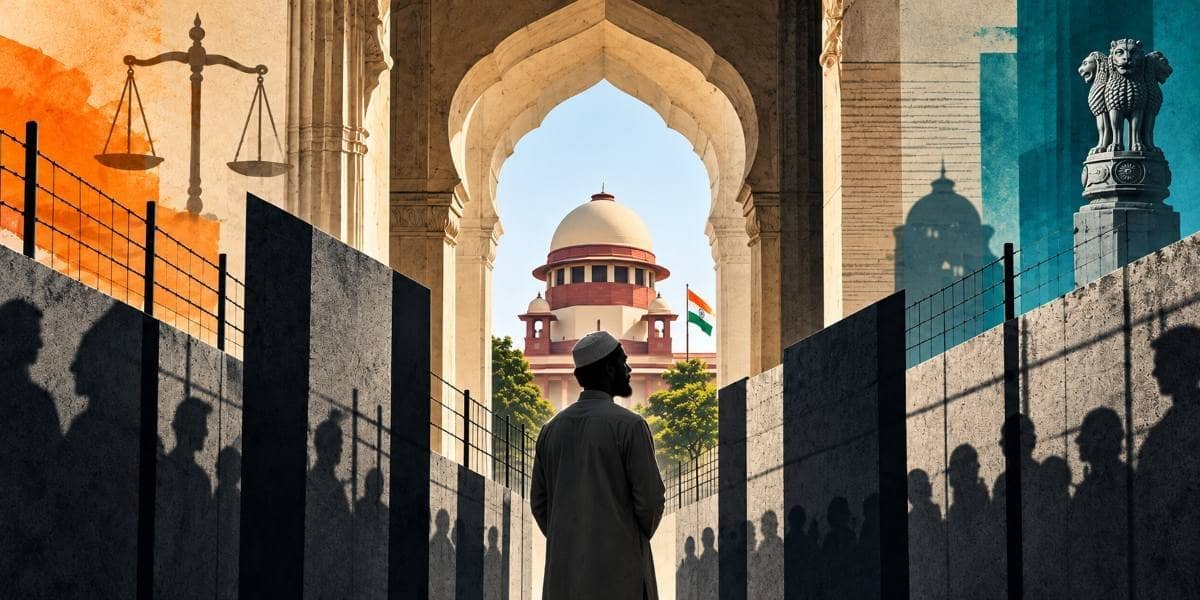
Key Takeaways
1 of 3
Automatically generated. Read full article for complete context.
Table of Contents
Disclaimer
- Nature of this work. This article is academic commentary on law and public policy. It sets out the author’s opinion and possible interpretation for scholarly discussion. It is not legal advice, and no one should act on it.
- Scope and metaphor. The article examines laws regulating religious conversion, the codification of family law, madrasa education, waqf administration, demolitions of mosques and attached madrasas, and related judicial decisions, as they stood on 16 October 2026, against Articles 14, 15, 21, 25, 26, 29 and 30 of the Constitution. Its description of their cumulative effect as a “siege” is a metaphor and a merely interpretive argument. It is not a statement of fact, and it does not purport to allege that any authority acted with any particular or ulterior intent or for any unlawful purpose.
- Historical comparison. The reference to Poland is a limited comparison of administrative and cultural methods. It does not equate India, its Governments or any public authority with any foreign or historical regime, and it expressly disclaims any comparison with the crimes of any occupying regime anywhere, including Nazi occupation.
- Lawful criticism only. The article attempts a legitimate criticism of some laws, policies and judicial reasoning with a view to suggest their alteration where legally possible by lawfully permissible means. It does not advocate disobedience to any law or order, violence, or disaffection towards the Government established by law. It affirms the sovereignty, unity and integrity of India, and it seeks change only through the courts and the legislature, only by means considered lawful and Constitutionally permissible.
- No community is targeted. The article addresses the State and its laws. It attributes no motive or conduct to any religious, linguistic, regional or other community, and is not intended directly or indirectly to promote disharmony, enmity, hatred or ill-will between any groups. Its intent is to invite lawful and healthy discussion to further national integration, mutual understanding and act as incentive to creation of an atmosphere conducive to national growth.
- No allegation against any person. Individuals, political parties and office-holders are not named or directly or indirectly identified. Institutions, places and public authorities are named only where the public record requires it. Nothing in the article is intended to impute wrongdoing to any person, political party and/or office-holder and/or institution, nor should be inferred.
- Pending proceedings. Where matters discussed are pending before courts, nothing in the article is intended to prejudice or comment on the merits of any pending proceeding, and the author expresses no view on how any of them may be, should be, or are likely to be, decided, or what issues may or may not be involved in the same, nor does it seek to, nor can it, directly or indirectly, influence the course of any of them.
- Sources and accuracy. So far as is reasonably possible, judgments and statutes cited have been checked against text or official record; however, the author lays no claim to infallibility. Where material could not be confirmed it has been advisedly left out. A few developments of 2026 whose texts were not readily available are described as reported, without citation. Events are described as reported by courts, public authorities or established news organisations, and allegations are identified as allegations that remain unproved unless a court has found otherwise, even these findings if any being subject to observations or findings as appellate fora may state or arrive at.
- Fact, effect and inference. The article distinguishes throughout between what a measure says, what it does, and what its critics infer it is for. Inferences are offered as possible arguments by critics, not as established fact.

THE FIRST OF THE THREE
I. A constitutional settlement and a question it faces
The Constitution made a promise to religious minorities in plain words. Article 25(1) provides that, “Subject to public order, morality and health and to the other provisions of this Part, all persons are equally entitled to freedom of conscience and the right freely to profess, practise and propagate religion.” Article 26 secures to every religious denomination the right to establish and maintain institutions for religious and charitable purposes, to manage its own affairs in matters of religion, and to own, acquire and administer property in accordance with law.
The cultural guarantees are as direct. Under Article 29(1), any section of citizens “having a distinct language, script or culture of its own shall have the right to conserve the same.” Under Article 30(1), “All minorities, whether based on religion or language, shall have the right to establish and administer educational institutions of their choice.” Articles 14 and 15 forbid arbitrary and religion-based discrimination, and Article 21 protects life and personal liberty, which the courts have read to include dignity, privacy and shelter.
Against these enforceable rights stands one Directive Principle. Article 44 asks the State to endeavour to secure a uniform civil code for citizens throughout India. By Article 37 the directives are not enforceable by any court. The placement invites a reading, pressed by minority critics since the Constituent Assembly, that uniformity was to be approached by persuasion and consent rather than imposed.
The settlement therefore rests on a balance. The State may regulate the secular activities associated with religion, reform social practice, and insist on public order, educational standards and the rule of law. It may not use those powers to dissolve the conditions in which a minority conserves its faith, culture and language.
The question. This article asks whether that balance is holding for India’s largest religious minority. Its claim is not that each measure examined below is unlawful. Several have been upheld; some have been struck down or stayed; many are pending. The claim is that measures enacted in different places, under different heads of legislative power and for different stated reasons, bear on the same small set of institutions, and that their combined weight deserves to be judged as a whole.
The article proceeds in the order the inquiry demands. Part II examines the two measures that frame the rest: laws on conversion, which govern who may enter the community, and the uniform civil code, which governs the legal meaning of belonging to it. Parts III to VI map madrasa regulation, demolitions of mosques with attached madrasas, action against Muslim institutions and the major legislative moves. Part VII reviews the judicial record, adverse and protective. Part VIII develops the siege thesis and the Polish comparison. Part IX states the strongest counter-arguments and the limits of the thesis, and Part X concludes. The annexures carry the full mapping tables.
II. Conversion laws and UCC
Two bodies of law frame everything that follows. Conversion statutes govern who may enter a religious community; a uniform civil code governs what it legally means to belong to one. Since 2017 both have been pressed forward with a speed and severity that has no precedent in the first seventy years of the Republic.
A. The conversion statutes
The doctrinal base. In Rev. Stainislaus v State of Madhya Pradesh, (1977) 1 SCC 677, the Supreme Court upheld the Orissa and Madhya Pradesh Acts, holding that “there is no fundamental right to convert another person to one’s own religion” and that Article 25 protects the right “to transmit or spread one’s religion by an exposition of its tenets”. It also said: “What is freedom for one, is freedom for the other, in equal measure.” That sentence is the measure against which the later statutes should be read.
Three generations of law. The first generation (Orissa 1967, Madhya Pradesh 1968, Arunachal Pradesh 1978) prohibited conversion by force, fraud or inducement and required intimation to the District Magistrate after the event. Attempts at a central law did not succeed: an Indian Converts (Regulation and Registration) Bill was introduced in the Lok Sabha on 24 December 1954, and a Freedom of Religion Bill on 22 December 1978. The second generation, early in this century, introduced prior permission: Gujarat’s 2003 Act requires the officiating priest to “take prior permission for such proposed conversion from the District Magistrate concerned”. Tamil Nadu enacted a similar law in 2002 and repealed it with effect from 18 May 2004.
The third generation, from 2017, is different in kind. Its principal features, each verified from the statute text, are set out below.
| State and Act | Advance declaration | Marriage provision | Burden of proof | Highest penalty |
| Jharkhand, Act 17 of 2017 | Prior DM permission (s.5) | None | Not reversed | 4 years |
| Uttarakhand, Act 28 of 2018 (am. 2022) | One month (s.8) | Void (s.6) | On convert and facilitator (s.13) | 10 years |
| Himachal Pradesh, Act 13 of 2019 | One month (s.7) | May be declared void (s.5) | On convert and facilitator (s.12) | 7 years |
| Uttar Pradesh, Act 3 of 2021 (am. Act 7 of 2024) | 60 days (s.8) | May be declared void (s.6) | On person causing conversion (s.12) | 20 years to life (s.5(3)) |
| Gujarat, Act 17 of 2021 (amending 2003 Act) | Prior DM permission | Void if for unlawful conversion (s.4B) | On person causing conversion (s.6A) | 10 years |
| Haryana, Act 16 of 2022 | Public notice, objections (s.9) | Void (s.5) | On the accused (s.15) | 10 years |
| Karnataka, Act 25 of 2022 | 30 days, objections invited (s.8) | Void (s.6) | On person causing conversion (s.12) | 10 years |
| Rajasthan, Act 21 of 2025 | 90 days (s.8) | Void, live-in included (s.6) | On person causing conversion (s.14) | 20 years to life; forfeiture and demolition (ss.12, 13) |
| Maharashtra, Act 47 of 2026 | 60 days (s.6) | Void (s.4) | On person causing conversion (s.13) | 10 years |
Madhya Pradesh enacted a 2021 Act of the same type, and Chhattisgarh’s 2026 Bill is reported to have received assent; neither is part of the tabulation because its text could not be verified.
The definitions have widened as the penalties have risen. Uttar Pradesh treats as “allurement” the offer of “free education in reputed school run by any religious body” and a “better lifestyle, divine displeasure or otherwise”. Karnataka and Rajasthan go further, treating as allurement the act of “portraying practice, rituals and ceremonies or any integral part of a religion in a detrimental way vis-à-vis another religion” and “glorifying one religion against another religion”. Since 2024, information of an offence under the Uttar Pradesh Act “may be given by any person”, and bail is subject to twin conditions on the model of the money-laundering law.
The direction of travel. The most revealing provisions are the exemptions. Several statutes exempt from their definition of conversion a return to one’s earlier faith:
- Uttar Pradesh, s.3(2): “If any person re-converts to his immediate previous religion, the same shall not be deemed to be a conversion under this Act.” Uttarakhand (s.3(2)) and Karnataka (proviso to s.3) are to the same effect.
- Himachal Pradesh, proviso to s.7(1): “Provided that no notice shall be required if a person re-converts to his parent religion.”
- Haryana, s.2(1)(c): conversion “does not include return of any person to the religion professed or being professed by, any one or both, the parents or grandparents of a person”.
- Rajasthan, s.3(4) and Explanation: re-conversion “to original religion i.e. ancestral religion” is not conversion, “ancestral religion” meaning the religion “in which forefathers/ancestors of the person had faith”.
In form, the first of these is neutral: it protects anyone who returns to the faith they last held. The later formulations are not. A test that looks to grandparents or to remote “forefathers” detaches the exemption from the person’s own life and attaches it to a presumed ancestral identity.
Under the Rajasthan formula a person may “return” to a faith he has never held, because some ancestor once held it. The practical result can be a one-way door: adopting a new faith carries notice, police inquiry, public objection and a reversed burden of proof, while a declared “return” to an ancestral faith carries none.
For a minority whose members are commonly said, in public debate, to descend from converts, the door is open in only one direction. Jharkhand, Gujarat, Odisha and Maharashtra contain no such exemption, which shows the asymmetry is a legislative choice, not a necessity of the form.
What the legislatures said, and what they did not. The Statement of Objects and Reasons of the Uttar Pradesh Bill states that “the individual right to freedom of conscience and religion cannot be extended to construe a collective right to proselytize”, and that the right “belongs equally to the person converting and the individual sought to be converted”.
Karnataka’s cites “many instants of conversion by means of ‘allurement’, ‘coercion’, ‘force’, fraudulent means” and the resulting disturbance of public order. Neither uses the vocabulary of “love jihad” or demographic change, which appears in political speech but not in the statutory record that could be checked. The argument of this article therefore does not rest on any declared legislative intention. It rests on what the statutes seem or appear to do.
The courts. The High Courts have restrained the marriage provisions at the interim stage. On 19 August 2021 the Gujarat High Court directed that the rigours of ss.3, 4, 4A to 4C, 5, 6 and 6A “shall not operate merely because a marriage is solemnised” between persons of different religions without force, allurement or fraud. However, “force, allurement or fraud” are matter of proof, which requires trial, and the twin requirements for bail can result, for those accused, in unintended consequences.
On 14 November 2022 the Madhya Pradesh High Court restrained prosecution of adults who “solemnize marriage on their own volition” and coercive action under s.10 of the 2021 Act; the Supreme Court issued notice on the State’s appeal without staying that order. In Salamat Ansari v State of U.P. (11 November 2020) the Allahabad High Court held that the “Right to choose a partner irrespective of caste, creed or religion, is inhered under right to life and personal liberty”.
In Rajendra Bihari Lal v State of U.P., 2025 INSC 1249, decided on 17 October 2025, the Supreme Court quashed multiple FIRs registered under the Uttar Pradesh Act. It recorded that “there is no challenge to the constitutional validity of the U.P. Conversion Act in the present batch of matters”, but observed that the pre- and post-conversion declarations “seem to introduce a very onerous procedure to be followed by an individual seeking to adopt a faith” and that their public disclosure “may require a deeper examination”.
The constitutional challenge to the third-generation statutes, Citizens for Justice and Peace v State of U.P., W.P.(Crl.) 428 of 2020, remains pending.
B. The uniform civil code
Article 44 provides: “The State shall endeavour to secure for the citizens a uniform civil code throughout the territory of India.” The Supreme Court has urged action more than once. In Sarla Mudgal v Union of India, (1995) 3 SCC 635, it requested the Government “to have a fresh look at Article 44”, reasoning that there is “no necessary connection between religion and personal law in a civilised society”. In Jose Paulo Coutinho v Maria Luiza Valentina Pereira (13 September 2019) it called Goa “a shining example of an Indian State which has a uniform civil code applicable to all”.
The expert body charged with the question reached the opposite view. In its Consultation Paper on Reform of Family Law of 31 August 2018, the Twenty-first Law Commission concluded that it was “providing a uniform civil code which is neither necessary nor desirable at this stage” and recommended reform within each personal law instead. The Twenty-second Law Commission invited views afresh in June 2023.
The States have since acted on their own. The Uniform Civil Code, Uttarakhand, 2024 (Act 3 of 2024) received the President’s assent on 11 March 2024 and came into force on 27 January 2025. Its second section deals with its application to Scheduled Tribes, who are excluded. As reported, it prohibits polygamy, bars the practice associated with remarriage after divorce, and makes registration of live-in relationships compulsory on pain of imprisonment. Challenges are pending in the High Court, which issued notice on 12 February 2025. Gujarat and Assam are reported to have enacted codes that received Presidential assent in September 2026, and Assam’s Assembly passed a separate bill prohibiting polygamy in November 2025 and repealed the colonial Muslim marriage registration law in August 2024.
Let us digress briefly here, to proceed on a tangent.
A. The Inseparability of Ethics, Accountability, and Religion
The core of Sarla Mudgal‘s critique relies on the premise that morality and ethics do not exist in a vacuum; they emanate from a sense of ultimate accountability.
- The Foundation of Obligation: Across authoritative theological and jurisprudential treatises (such as the Dharmashastras in Hindu tradition, Sharia in Islamic jurisprudence, or classical Natural Law theories in the West), the binding force of a moral obligation is historically tied to a higher spiritual authority or a cosmic order (or Divine Law).
- Accountability as a Divine Anchor: Without a metaphysical framework or religious anchor, accountability becomes merely a social contract, subject to the whims of political majorities or shifting cultural norms. Therefore, to claim that “personal law” (which governs intimate human relationships like marriage, succession, and duty) has no connection to religion ignores the very foundation upon which these duties were codified.
B. The Overreach of Judicial Secularism as Personal Opinion
The statement by the bench that there is “no necessary connection between religion and personal law” can be argued to be an ideological posture : specifically, a Eurocentric version of secularism : rather than a universally accepted legal axiom.
- Lack of Basis in Authoritative Treatises: Traditional Indian jurisprudence historically views Dharma not merely as “religion” in the Western, compartmentalized sense, but as a comprehensive guide to righteous living, which explicitly includes personal law. Classical texts do not separate the spiritual life of an individual from their familial duties.
- Judicial Subjectivity: By declaring no connection exists, the bench projected a modern, positivist legal philosophy onto a society whose foundational legal consciousness is deeply pluralistic and religiously rooted. Consequently, this assertion operates as a subjective, philosophical preference of the judges rather than a conclusion derived from authoritative constitutional or any other indigenous legal traditions.
C. The Civilization Argument Reversed
The Court amazingly used the phrase “in a civilized society” to seemingly imply that modernization requires the decoupling of law from religion. However, an alternative argument can be made from a traditionalist perspective, viz. :
- True Civilization Preserves Sacral Foundations: A society remains civilized precisely because it maintains a transcendent moral anchor for its laws, preventing them from degenerating into pure utilitarianism.
- Personal Law as an Expression of Conscience: For millions, laws governing marriage, adoption, and inheritance are not mere administrative rules; they are sacred sacraments. Forcing a division between these laws and religious belief strips the law of its moral legitimacy, reducing compliance to fear of state punishment rather than a conscientious duty to a higher accountability.
To state that religion and personal law have no connection is to ignore the historical evolution of jurisprudence, where morality is rooted in religion, and law is rooted in morality. By dismissing this link, the Court’s observation acts as a modern judicial opinion that lacks an independent, authoritative basis in the classical treatises that originally defined personal obligations and human accountability.
The judicial assertion in Sarla Mudgal that there is “no necessary connection between religion and personal law in a civilised society” directly conflicts with foundational jurisprudence across Western Natural Law, Hindu jurisprudence, and classical Islamic law.
By examining these traditions, the argument demonstrates that the bench’s remark relies on a distinct, modern positivist presumption rather than authoritative treatises on legal obligation and human accountability.
1. Western Natural Law Tradition : The Teleological Link
Western jurisprudence, particularly the scholastic natural law tradition, directly rejects the notion that civil and personal obligations can be severed from transcendent accountability.
Thomas Aquinas in Summa Theologiae categorizes law into a fourfold hierarchy: Eternal Law, Natural Law, Divine Law, and Human Law, where human positive law derives its normative validity strictly from Natural Law, which is humanity’s rational participation in Eternal Divine Law. Aquinas asserts an unjust positive enactment severed from moral order is an act of violence rather than valid law : Lex iniusta non est lex : an unjust law is not law. Matrimony is treated by Aquinas not as an arbitrary civil contract, but as a primary institution of natural law aimed at procreation and mutual fidelity, inherently anchored in sacred accountability.
Cicero argued that true law is “right reason in agreement with nature,” originating from divine providence. To claim that a “civilized” society divorces law from its ultimate religious anchor contradicts the classical Western canon, which considers a society civilized precisely because its laws align with transcendent justice.
2. Classical Hindu Jurisprudence : The Indivisibility of Dharma
In traditional Indian legal theory, the concept of a compartmentalized “personal law” distinct from spiritual duty is non-existent.
- The Scope of Dharmashastras: In authoritative texts like the Manusmriti etc., law is treated under Dharma, which encompasses ethics, civil administration, and expiation, familial duties, inheritance (Daya), and marriage (Vivaha) are not treated as independent administrative rules but are integrated into cosmic order.
- Marriage as a Sacrament (Samskara): Classical commentators of both schools, Dayabhaga and Mitakshara also apparently ground inheritance and matrimonial obligations in religious accountability, such as the capacity to offer spiritual oblations (Pinda) to ancestors. Marriage is a permanent metaphysical union, not a state-invented contract. Divorcing personal law from religious accountability requires discarding these classical treatises entirely in favour of modern statutory positivism.
3. Classical Islamic Jurisprudence : Sharia as Divine Accountability
Islamic legal theory (Usul al-Fiqh) treats personal obligations as direct applications of moral duty under divine oversight.
- The Unity of Legal and Moral Action: Jurists across classical schools of Abu Hanifa, Imam Malik structure obligations under the Ahkam al-Khamsa (the five moral-legal categories ranging from obligatory to forbidden). In this framework, marriage (Nikah), succession and support (Nafaqah) are governed not by civil convention, but by explicit Qur’anic injunctions and prophetic tradition.
- The Doctrine of Maqasid al-Shariah: In jurisprudence the preservation of religion (Din), family/lineage (Nasl), and wealth (Mal) are primary objectives of the law. Accountability before God (Akhirah) is the core mechanism that secures obedience to domestic duties. Claiming that personal status has no necessary connection to religion treats law as a purely secular tool, contravening fundamental treatises of Fiqh.
Comparison of Jurisprudential Traditions
| Dimension | Positivist Judicial View (Sarla Mudgal) | Natural Law (Aquinas / Cicero) | Hindu Jurisprudence (Smritis / Mitakshara) | Islamic Jurisprudence (Usul al-Fiqh) |
| Source of Legal Force | Sovereign state / statutory enactment | Eternal Reason and Divine Law | Veda, Smriti, and Sadachara (righteous conduct) | Revelation (Qur’an and Sunnah) |
| Role of Personal Law | Secular administrative regulation | Natural institution ordering the moral community | Sacramental duties preserving cosmic balance (Dharma) | Divine mandates ordering family, progeny, and property |
| Anchor of Accountability | State-enforced sanctions and legal compliance | Teleological moral judgment before God | Transcendent spiritual consequence (Karma and Pinda) | Divine accountability in this life and the hereafter (Akhirah) |
Because Western natural law, classical Hindu jurisprudence, and Islamic legal philosophy all root personal obligations in transcendent accountability, the bench’s claim in Sarla Mudgal lacks foundation in foundational legal treatises. By dismissing these connections, the Court applied a modern positivist assumption, rendering the claim (that religion and personal law are inherently unconnected) a subjective judicial perspective rather than an established principle of universal jurisprudence.
To evaluate the validity of the Sarla Mudgal bench’s observation, it is necessary to examine the primary counter-perspective: the modernist, social-reformist philosophy of the framers of the Constitution of India.
During the Constituent Assembly Debates, Dr. B.R. Ambedkar and other key architects fundamentally rejected the idea that personal law is an immutable, sacred sphere immune to state regulation. Their arguments during the drafting of Article 44 (Uniform Civil Code) provide the direct constitutional and philosophical basis for the Court’s eventual assertion that there is “no necessary connection between religion and personal law.”
1. Dr. B.R. Ambedkar: The Demarcation of Religious Sovereignty
Dr. Ambedkar, serving as the Chairman of the Drafting Committee, mounted a structural critique against the expansive definition of religion used by orthodox members. He argued that if “religion” is allowed to govern every aspect of human life from birth to death, the secular state becomes impossible.
- Confinement of Religion’s Jurisdiction: In his address to the Constituent Assembly on December 2, 1948, Ambedkar argued that the state must be empowered to legislate over social relations. He observed:
“The religious conceptions in this country are so vast that they cover every aspect of life, from birth to death… There is nothing which is not religion and if personal law is to be saved, I am sure about it that in social matters we will come to a standstill.”
- The “Civil Code” as an Instrument of Democracy: Ambedkar maintained that matters of marriage, inheritance, and succession are inherently civil actions governing property and bodily liberty. For him, grounding these laws in religious accountability meant perpetuating institutional inequalities, such as caste discrimination and the subjugation of women, under the guise of divine mandate. Therefore, separating civil regulation from religious doctrine was not a mere “personal opinion,” but a prerequisite for human rights and democracy.
2. K.M. Munshi: The Secularization of Citizenship
Alladi Krishnaswami Ayyar and K.M. Munshi strongly defended the Uniform Civil Code by arguing that a modern nation-state requires a single, secular standard of citizenship that supersedes religious categorization.
- Fragmentation of the Nation: Munshi directly challenged the idea that personal law is inextricably tied to religious conscience. He argued that under a secular democratic framework, personal law belongs to the domain of social welfare and reform, not theology. He stated:
“We are in a stage where we must secularise our social life… If the personal law of inheritance, succession etc. is really a part of their religion, then equality of women can never be achieved.”
- The European Precedent: Munshi pointed out that advanced, multi-religious societies had already decoupled personal law from religious authority without destroying religious freedom. He argued that a “civilized society” protects freedom of conscience, but restricts the outward regulation of property and civil rights to the statutory authority of the secular state.
3. Alladi Krishnaswami Ayyar: The Constitutional Imperative of Unity
Ayyar approached the issue through the lens of national integration and constitutional cohesion, dismissing the claim that isolating personal law violated religious identity.
- The Fallacy of Eternal Personal Law: Ayyar noted that personal laws were not static or divinely insulated. He pointed out that during British rule, the Indian Penal Code and the Code of Civil Procedure overrode massive swathes of traditional Hindu and Islamic jurisprudence in favour of uniform, secular statutes.
- Article 25(2) as the Enabling Clause: Ayyar argued that the Constitution itself explicitly provides for this separation. While Article 25 guarantees freedom of religion, clause (2)(a) explicitly permits the state to regulate or restrict any “economic, financial, political or other secular activity which may be associated with religious practice.” In the framers’ view, personal law fell squarely under this “secular activity.”
Analytical Synthesis: The Clash of Foundational Paradigms
The tension between your original jurisprudential argument and the view of the framers stems from two completely different definitions of law:
| Dimension | The Classical Jurisprudential Paradigm | The Framers’ Modernist Paradigm |
| Foundational Premise | Law is an expression of transcendent morality. Personal status is an extension of spiritual duty and cosmic accountability. | Law is an instrument of social engineering. Personal status is a civic contract defining rights, equality, and state protection. |
| Definition of Religion | A holistic, all-encompassing guide to righteous living (Dharma / Sharia) that cannot be compartmentalized. | A localized freedom of conscience, worship, and belief, distinctly separate from public governance and civic property. |
| Source of Authority | Divine revelation, sacred tradition, and classical treatises. | The sovereign will of the people as articulated through the democratic legislature. |
Conclusion
When the Supreme Court in Sarla Mudgal claimed that there is “no necessary connection between religion and personal law,” it was not operating in an academic vacuum, nor was it inventing an isolated personal opinion. The bench was actively channeling the specific, documented political philosophy of Messieurs Ambedkar, Munshi, and Ayyar.
While the statement remains deeply contested when viewed through the lenses of classical natural law or indigenous traditions, it possesses a clear, authoritative, and direct lineage within the constitutional history of the Indian Republic.
Uniform for whom? A code that exempts Scheduled Tribes, whose customary laws are in many respects as distinct as any religious personal law, is not uniform. It removes some differences and preserves others. The difference it preserves is the one that commands political consent; the difference it removes is, in practice, chiefly the uncodified personal law of Muslims, since Hindu, Sikh, Jain and Buddhist family law was codified in the 1950s and Christian and Parsi law by separate statutes. This is not an argument that gender justice within Muslim personal law is unnecessary. The Law Commission’s own route, reform within each personal law with the participation of the community concerned, would have secured it. The choice of the other route is what carries the message.
The combination. Read together, the two bodies of law operate at both ends of religious identity. Conversion statutes regulate entry, and do so asymmetrically. A uniform code regulates the meaning of membership, and does so selectively. A community that cannot freely receive and whose distinctive law of family life is being displaced is not thereby abolished. But the conditions of its continuity would have been narrowed by law, before any building is touched.
Is what is happening inadvertent? Or is it by design? We shall wait for an answer.
Jai Hind
THE SECOND OF THE THREE
III. Madrasas: from regulation to dissolution
Between 2020 and 2026, two States dismantled the statutory frameworks that recognised madrasas, a third tried and was stopped by the Supreme Court, and a national child-rights body asked every State to follow. The pattern runs in four steps: survey, suspicion, withdrawal of recognition or funding, and closure.
Assam
The Assam Repealing Act, 2020 converted the State’s provincialised, State-funded madrasas, about 400 institutions, into general schools. The Gauhati High Court upheld the law in February 2022, reasoning that madrasas staffed by government servants were not institutions established or administered by a minority. A special leave petition against that judgment was admitted by the Supreme Court on 1 November 2022 and remains pending. This is the measure with the firmest constitutional footing: Article 28(1) bars religious instruction in institutions wholly maintained out of State funds. Its significance lies less in its legality than in its direction, the removal of the only State-supported tier of Islamic education in the State.
Uttar Pradesh
A 2022 survey identified 8,449 madrasas not recognised by the State Madrasa Board, enrolling about 7.5 lakh children. A special investigation team later reportedly recommended closure of about 13,000 madrasas in border districts, alleging foreign funding; the report was described in the press through unnamed sources and its text has not been published. On 22 March 2024, in Anshuman Singh Rathore v Union of India, the Allahabad High Court declared the UP Board of Madarsa Education Act, 2004 unconstitutional as violating secularism and directed that madrasa students be moved into the formal system. The Supreme Court stayed that judgment on 5 April 2024, noting that it would affect about 17 lakh students.
On 5 November 2024, in Anjum Kadari v Union of India, 2024 INSC 831, a three-judge bench set the High Court judgment aside. It held that a statute can be struck down only for violating Part III or for want of legislative competence, that the Act fell within Entry 25 of List III, and that only the provisions regulating the higher degrees of fazil and kamil were invalid, for conflict with the University Grants Commission Act. The decision is the most important protective precedent in this field : regulation of minority education is permitted, abolition of the framework through which it is recognised is not compelled by secularism.
The national push
By letters of 7 and 25 June 2024 the National Commission for Protection of Child Rights asked States to act against unrecognised madrasas and to move children out of them; Uttar Pradesh (26 June 2024), the Union (10 July 2024) and Tripura (28 August 2024) issued consequential directions.
A further letter of 11 October 2024 recommended stopping State funding of madrasas and winding up madrasa boards altogether. On 21 October 2024, in Jamiat Ulama-i-Hind v NCPCR, W.P.(C) 660 of 2024, the Supreme Court directed that these communications and the consequential orders “shall not be acted upon”, and on 4 August 2025 extended interim protection to madrasas whose recognition had been withdrawn.
Madhya Pradesh had meanwhile notified, in August 2024, that grants and registration would be cancelled where non-Muslim children were found enrolled, and in September 2025 the National Human Rights Commission issued notice to that State on a complaint alleging enrolment of Hindu children in unrecognised madrasas.
Uttarakhand
In 2025 district administrations sealed 136 madrasas as unrecognised. The High Court ordered interim unsealing of one that had been sealed without notice or hearing, and the Supreme Court tagged the challenge to the sealing drive with the NCPCR petition on 3 April 2025.
The State then enacted the Uttarakhand Minority Education Act, 2025, under which the Uttarakhand Madrasa Education Board Act, 2016 and the 2019 recognition rules ceased to operate on 1 July 2026 and a single Minority Education Authority took over recognition for all minorities. By August 2026 seven madrasas had been accredited under the new framework, and in September 2026 a further 20 unrecognised madrasas in two districts were halted.
What the sequence shows
No single step abolishes religious education. Each is defended on a legitimate ground: Article 28(1), child rights, audit of funds, educational standards, or security. Yet the steps are cumulative. A madrasa that is first surveyed, then associated in public reports with foreign money, then stripped of its board and finally sealed for want of recognition has been closed without any law that says madrasas are to be closed. Anjum Kadari answers the first premise of that sequence, that religious education and secular governance are incompatible; the interim orders in the NCPCR matter hold the line while the rest is argued.
IV. Demolitions
From August 2022 to October 2026 the public record shows at least nine demolitions in which a mosque or mosque complex was removed together with an attached madrasa, and a larger number of mosques removed in whole or part for roads and encroachment drives. In almost every case the stated ground was land law, not religion. In almost every case the institution lost in court or never reached it. The full list is in Annexure B.
Demolitions following security allegations
In August and September 2022 district authorities in Assam demolished madrasas at Moirabari (Morigaon), in Barpeta district and at Kabaitari (Bongaigaon) after arrests of persons associated with them on allegations of links to banned groups. The grounds recorded were disaster-management powers, absence of building permission and structural unsafety. A fourth, in Goalpara, was razed by local residents. The allegations concerned individuals; the buildings, and the education they housed, bore the consequence.
Demolitions for encroachment on public, forest or water-body land.
Mehrauli, Delhi, 30 January 2024:
- The development authority demolished the Akhoondji mosque, the Bahrul Uloom madrasa and graves on the recommendation of a religious committee; the Delhi High Court thereafter ordered status quo on the land. Status quo, ex post facto, does not undo damage.
Banbhoolpura, Haldwani, 8 February 2024:
- A madrasa and the mosque in its complex were demolished as encroachments after the High Court declined relief; the violence that followed left six dead.
Bet Dwarka, Gujarat, January 2025:
- A dargah and a madrasa on graveyard land were among about 406 structures removed; the High Court dismissed the community trust’s petitions.
Sambhal, Uttar Pradesh, 2 October 2025:
- A mosque with an attached madrasa was demolished as an encroachment on pond land, after the High Court declined interim protection; and on 3 January 2026 a mosque and madrasa at Hajipur were removed as encroachments on government land.
Guwahati:
- The Azanpeer mosque and an adjacent madrasa were demolished by the municipal corporation on the ground that the site was landslide-prone.
Kutch, Gujarat:
- Six madrasas were demolished at Khawda in January 2023; in June 2026 about 30 structures including three mosques were demolished in an encroachment drive, and the Mohamadi Masjid near Bhuj was demolished on 21 June 2026, two days after a revenue order. The Gujarat High Court has called for the Collector’s affidavit.
Saharanpur, Uttar Pradesh, September 2026:
- A mosque inside the Collectorate premises was demolished after a challenge to an order declaring it an illegal occupation of government land was rejected.
Demolitions for roads and pilgrimage infrastructure.
- A portion of the Noori Masjid at Fatehpur was demolished on 10 December 2024 for highway widening.
- On 1 July 2026 five mosques in Dal Mandi, Varanasi were partly demolished to widen the approach to a major temple.
- In Ujjain, after the Madhya Pradesh High Court dismissed the waqf committee’s petition on 10 September 2026, holding that the affected portion was under ten per cent and no rights under Articles 14, 25, 26 or 300A were breached, part of the Shahi Masjid was removed for a road serving the 2028 Simhastha; about 80 religious places of all faiths were affected.
Demolitions after communal violence.
- Amnesty International’s February 2024 report documented 128 properties demolished after violence or protests between April and June 2022, affecting at least 617 people, and alleged that Muslim homes and businesses were disproportionately targeted.
- On 7 August 2023, halting a demolition drive in Nuh after communal clashes, the Punjab and Haryana High Court asked, as reproduced in the press, whether “an exercise of ethnic cleansing is being conducted by the State” ().
The judicial response and its gap
On 13 November 2024, in In Re: Directions in the Matter of Demolition of Structures, 2024 INSC 866, the Supreme Court held that the executive cannot punish by demolition and laid down pan-India safeguards: a show-cause notice returnable within the period under local law or 15 days, whichever is later; a personal hearing; a reasoned order; a further 15 days before execution; video-recording; and personal liability of officials who disobey. The Court has since issued contempt notice where a mosque at Kushinagar was partly demolished in February 2025 (), though it refused status quo for demolitions at Gir Somnath in October 2024 ().
The safeguards, however, exclude unauthorised structures in public places such as roads, footpaths, railway lines and water bodies, and demolitions ordered by a court. Those exclusions describe most of the cases above. Old mosques and madrasas frequently stand on land whose title was never perfected in revenue records, on village commons, beside ponds, or on roads that have since been widened around them. A rule framed for the general case thus leaves the religious institution, which is the most likely to be old and the least likely to hold modern title, with the least protection.
The constitutional test is selectivity
A State may remove an encroachment. The question is whether like encroachments are treated alike. The evidence on that question is incomplete, and this article does not claim more than it shows. One data point is suggestive: a press compilation of Uttarakhand’s 2023 drives recorded about 465 mazars removed against about 45 temples in the same period. A systematic, district-wise comparison of religious structures on public land, and of which were removed, is the evidence that would settle the question either way.
V. Action against Muslim institutions
The institutions through which a community educates its children, supports its scholars, feeds itself and remembers its past have each been narrowed since 2017, mostly by executive decision rather than statute. The waqf reforms, the largest single measure, are taken up with the other legislation in Part VI.
Universities
In Aligarh Muslim University v Naresh Agarwal, decided on 8 November 2024 by a seven-judge bench (4:3), the Supreme Court overruled S. Azeez Basha v Union of India (1967), laid down tests for minority status under Article 30, and sent the University’s own status to a regular bench. That is, on the law, a protective outcome. The Union’s position, however, has moved the other way. In March 2018 it withdrew, by a revised affidavit in the Delhi High Court, its earlier support for the minority status of Jamia Millia Islamia, relying on the very precedent since overruled. That matter remains pending.
Scholarships and educational support
The Maulana Azad National Fellowship for minority research scholars and the Padho Pardesh scheme were “discontinued from 2022-23”, according to the Government’s answer in the Lok Sabha (Unstarred Question 720, 7 December 2023). From 2022-23 the pre-matric scholarship was confined to Classes IX and X, on the ground that the Right to Education Act already covers the earlier classes. In July 2026 the Ministry informed Parliament that the pre-matric, post-matric and merit-cum-means scholarships had not been approved for continuation beyond 2021-22. The Maulana Azad Education Foundation was dissolved by ministerial order of 7 February 2024, and the Delhi High Court dismissed a challenge to the dissolution. Each decision has an administrative rationale. Together they withdraw much of the public scaffolding that had been built specifically for minority education.
Organisations
The proscription power under the Unlawful Activities (Prevention) Act has been exercised against several Muslim organisations: the Students Islamic Movement of India (banned since 2001, last extended in January 2024 and upheld by the Supreme Court in July 2025), the Islamic Research Foundation (2016, renewed 2021), and the Popular Front of India with eight affiliates (September 2022, confirmed by the statutory tribunal; a writ remains pending in the Delhi High Court) (; ). This article takes no position on the merits of any proscription, each of which has passed statutory scrutiny. Its point is narrower. The proscription of an organisation is followed by investigation of persons and institutions associated with it, and that investigation reaches seminaries and charities. In December 2025, for example, the Enforcement Directorate searched twelve premises linked to a large seminary-and-hospital trust in Maharashtra in a money-laundering case founded on alleged foreign-contribution violations. The allegations are unproved and the investigation continues.
Food, trade and the marketplace
Uttar Pradesh banned the manufacture and sale of halal-certified food for the domestic market on 18 November 2023; the Supreme Court issued notice but declined interim protection.
In July 2024 directives requiring eateries on a pilgrimage route to display the names of their owners and staff were stayed by the Supreme Court, which permitted only a display of the type of food served .
Cattle-preservation laws have been made progressively more severe:
- Gujarat raised the maximum for cow slaughter to life imprisonment in 2017
- Karnataka banned the slaughter of all cattle in 2020
- and Assam’s Cabinet decided in December 2024 to bar serving beef in restaurants and public places.
- The Bombay High Court, however, struck down Maharashtra’s reverse-burden and possession provisions in 2016.
Residence, reservation and public order
- Amendments to Gujarat’s Disturbed Areas Act allow the Collector to refuse property transfers on grounds of “polarisation” and “improper clustering”; the High Court has restrained fresh notifications.
- Karnataka withdrew the 4 per cent backward-class quota for Muslims in March 2023 and, on the State’s assurance before the Supreme Court, it has not been acted on pending hearing ().
- In Uttar Pradesh, recovery notices issued to persons who had protested against the citizenship amendment were withdrawn in February 2022 after the Supreme Court’s criticism, and recoveries were refunded ().
Worship and religious routine
- The Assam Assembly ended its two-hour Friday prayer break in August 2024 and repealed the Assam Moslem Marriages and Divorces Registration Act, 1935 the same month.
- The Haj subsidy ended in January 2018; that step, it should be recorded, was directed by the Supreme Court in Union of India v Rafique Shaikh Bhikan (2012), which required the subsidy to be eliminated within ten years.
- At Sanjauli in Shimla, after sustained public agitation, municipal and civil courts declared floors of a mosque unauthorised and the High Court ordered the upper three removed in December 2025, preserving the lower two pending hearing.
Memory and language
The NCERT’s 2022 rationalisation dropped the Class 12 chapter on the Mughal courts, and its new Class 7 textbook of April 2025 omits the Delhi Sultanate and the Mughals, while the Class 8 book of July 2025 carries a “Note on Some Darker Periods in History”.
On language, the courts have been protective: a Constitution Bench upheld Urdu as the second official language of Uttar Pradesh in U.P. Hindi Sahitya Sammelan v State of U.P. (4 September 2014), and in Varshatai v State of Maharashtra, 2025 INSC 486, the Supreme Court upheld the use of Urdu on a municipal signboard, holding that the official-language law does not bar an additional language.
In the same spirit, the Supreme Court in February 2023 dismissed a petition for a commission to rename places associated with medieval rulers.
How much is intended, and how much just a fall-out, is also to be seen.
Jai Hind
THE LAST OF THE THREE
VI. Major legislative moves affecting Muslim rights
Four Acts of Parliament since 2019 bear directly on Muslims as Muslims: one names them by exclusion, one criminalises a practice of their personal law, one dissolved the constitutional status of the only Muslim-majority State, and one restructures the administration of their religious endowments. Each was defended on a ground the Constitution recognises. Each has drawn a constitutional challenge, and only one of those challenges has been decided.
Citizenship (Amendment) Act, 2019 (Act 47 of 2019).
The Act provides that “any person belonging to Hindu, Sikh, Buddhist, Jain, Parsi or Christian community from Afghanistan, Bangladesh or Pakistan, who entered into India on or before the 31st day of December, 2014” and who is exempted under the passport and foreigners laws “shall not be treated as illegal migrant” (). It is the first time religion has been written into the statutory test of who may become a citizen. The State’s case is that it protects minorities persecuted in three neighbouring theocratic States. The objection is that the list is closed on religious lines, so that persecuted Muslim sects from the same countries, and persecuted minorities from other neighbours, are left out. The challenge, Indian Union Muslim League v Union of India, W.P.(C) 1470 of 2019 and connected petitions, was listed for final hearing in May 2026 and is reported to be pending.
Muslim Women (Protection of Rights on Marriage) Act, 2019 (Act 20 of 2019)
After Shayara Bano v Union of India, (2017) 9 SCC 1, in which “by a majority of 3:2 the practice of ‘talaq-e-biddat’ – triple talaq is set aside”, Parliament declared such a pronouncement “void and illegal” (s.3) and made it punishable “with imprisonment for a term which may extend to three years” (s.4). The objection is not to the protection of women but to the instrument. A pronouncement the Supreme Court had already held to be of no legal effect is made a crime, and a matrimonial wrong is punished with imprisonment for Muslim husbands alone, while desertion by husbands of other faiths remains a civil wrong.
Jammu and Kashmir
On 5 August 2019 the President issued C.O. 272, and Parliament enacted the Jammu and Kashmir Reorganisation Act, 2019 (Act 34 of 2019), dividing the State into two Union Territories. In In Re: Article 370 of the Constitution, 2023 INSC 1058, decided on 11 December 2023, the Supreme Court upheld the President’s power, holding that “CO 273 is valid”, and directed that Assembly elections be held “by 30 September 2024”. Lawful as it has been held to be, the change ended the constitutional autonomy of the only State in which Muslims were a majority. The Supreme Court has also held, in Javed Ahmad Hajam v State of Maharashtra, 2024 INSC 187, that “Every citizen of India has a right to be critical of the action of abrogation of Article 370 and the change of status of Jammu and Kashmir”.
Waqf (Amendment) Act, 2025 (Act 14 of 2025)
Assented to on 5 April 2025 and in force from 8 April 2025, the Act renames the Waqf Act, 1995 the “Unified Waqf Management, Empowerment, Efficiency and Development” Act and makes five structural changes :
- Only a person “showing or demonstrating that he is practising Islam for at least five years” may create a waqf (s.3(r)).
- Waqf by user, the doctrine under which long religious use made property waqf without a deed, is omitted for the future, with a saving for registered properties that are not disputed and not government property.
- Where property is claimed by the Government, a designated officer above the rank of Collector inquires, and government property identified as waqf ceases to be treated as waqf (s.3C).
- Non-Muslims may be members of the Central Waqf Council and the State Waqf Boards.
- The Limitation Act, 1963 now applies to waqf claims (s.107), and protected monuments and Scheduled Tribe land in Scheduled Areas cannot be waqf (ss.3D, 3E).
On 15 September 2025, in In Re: The Waqf (Amendment) Act, 2025, W.P.(C) 276 of 2025, the Supreme Court declined to stay the Act as a whole. It stayed the five-year condition until rules are framed, stayed the provisions allowing the designated officer to decide the status of government land and correct revenue records, directed that no waqf be dispossessed and no third-party rights be created until the Waqf Tribunal decides title, and capped non-Muslim members at four of twenty-two on the Central Council and three of eleven on each State Board. The final hearing has been listed for 4 November 2026. Meanwhile every waqf must register on a central portal within a fixed window; the Supreme Court refused a blanket extension in December 2025 and left mutawallis to apply to the Tribunals.
The waqf reform is the measure most directly addressed to institutional continuity. Many of India’s mosques, graveyards and dargahs, and the madrasas housed in them, stand on land dedicated by usage centuries ago and never recorded in modern deeds. The omission of waqf by user, the application of limitation, the exclusion of land claimed by the Government and a compulsory registration deadline each, by itself, has an administrative rationale. Together they convert a property regime built on dedication and use into one that depends on paper, and paper is precisely what the oldest institutions lack.
The pattern of the four Acts
The citizenship amendment separates Muslims from other communities in law. The triple talaq Act criminalises conduct only when a Muslim commits it. The reorganisation of Jammu and Kashmir ended the one constitutional arrangement in which Muslims were the majority. The waqf amendment transfers to the State a larger measure of control over Muslim religious property. Its defenders point out that Hindu endowments in several States have long been under statutory administration; its critics answer that those regimes are administered by members of the same faith, while the new waqf law opens Muslim boards to members of other faiths. None of these is unconstitutional merely because it concerns Muslims. But a legislative record in which so much of the decade’s most consequential law singles out one community calls for an explanation that goes beyond the separate justification of each Act.
VII. The judicial record: Supreme Court and High Courts
The courts have not been either uniform or adverse, and an honest account must say so. The pattern is more precise and, for that reason, more troubling : Muslim claimants have tended to win on procedure and lose on substance. Where the question is whether the State followed due process, the courts have often intervened. Where the question is what Islam requires, what a mosque is, what dress is justified, or whose a site is, the claims have mostly failed.
A. Where Muslim claims failed
The essential-practices test
The single most consequential doctrine is the requirement that a practice be “essential” to the religion before Article 25 protects it. Applied to Islam, it has repeatedly been answered against the claimant.
- In Mohd. Hanif Quareshi v State of Bihar, AIR 1958 SC 731, the Court found “no material on the record” to say that cow sacrifice on Bakr Id “is an obligatory overt act for a Mussalman to exhibit his religious belief and idea”. In State of Gujarat v Mirzapur Moti Kureshi Kassab Jamat, (2005) 8 SCC 534, a seven-judge bench went further and upheld a total ban on the slaughter of cow progeny.
- In Dr M. Ismail Faruqui v Union of India (24 October 1994), the Court held that “A mosque is not an essential part of the practice of the religion of Islam”, so that a mosque enjoys no immunity from acquisition unless worship at that particular place is itself integral to the faith.
- In Javed v State of Haryana, (2003) 8 SCC 369, upholding a two-child disqualification for panchayat office, the Court said: “What is permitted or not prohibited by a religion does not become a religious practise or a positive tenet of a religion”.
- In Resham v State of Karnataka (15 March 2022) a Full Bench of the Karnataka High Court upheld the State’s uniform order excluding the headscarf from classrooms, reasoning that “What is not religiously made obligatory therefore cannot be made a quintessential aspect of the religion” (). On appeal, in Aishat Shifa v State of Karnataka (13 October 2022), the Supreme Court divided: one judge upheld the order, holding that uniformity “necessarily excludes all religious symbols visible to naked eye” (para 56), and the other would have allowed the appeals (). No larger bench appears to have been constituted, so the High Court’s judgment stands.
The test asks a secular court to decide what a faith requires, and it permits a religion’s practices to be dismissed one at a time as inessential. A faith whose daily life is a web of practices that are recommended rather than mandated is peculiarly exposed to that method. The question whether the test is right is now before a nine-judge bench in the Sabarimala reference, which expressly includes the entry of Muslim women to mosques.
Sites of worship
In M. Siddiq v Mahant Suresh Das, (2020) 1 SCC 1, decided on 9 November 2019, the Supreme Court decreed the disputed site at Ayodhya for the construction of a temple, while recording that on 6 December 1992 “A large crowd destroyed the mosque” (para 23), that “The destruction of the mosque and the obliteration of the Islamic structure was an egregious violation of the rule of law”, and directing that “a suitable plot of land admeasuring 5 acres shall be handed over to the Sunni Central Waqf Board”. The finding of a grave wrong and the award of the site sit in the same judgment; the remedy for the wrong was alternative land, not restoration.
The Places of Worship (Special Provisions) Act, 1991 declares that “the religious character of a place of worship existing on the 15th day of August, 1947 shall continue to be the same as it existed on that day” (s.4(1)) and abates proceedings to the contrary (s.4(2)) (). That bar has since been narrowed by interpretation. On 4 August 2023 the Supreme Court allowed a non-invasive scientific survey of the Gyanvapi mosque (2023 INSC 702, para 17). On 19 December 2023 the Allahabad High Court held that the bar “cannot be decided solely on the basis of provisions of Section 4 of the Act of 1991” but requires evidence (para 132), and that the structure “cannot be said to have religious character of a “Mosque”, at this stage” (para 134). On 26 February 2024 it upheld orders under which, as it recorded, “the worship and rituals have already started from 01.02.2024” in a cellar of the mosque (para 130). The Madhya Pradesh High Court ordered a scientific survey of the Bhojshala-Kamal Maula complex on 11 March 2024 and, by its judgment of 15 May 2026, is reported to have held the site to be a temple and ended the Friday prayer arrangement. If the character of a mosque must be proved afresh by evidence in each case, the statute meant to end such suits becomes a defence to be tried rather than a bar to trial.
Other adverse outcomes
The proscription of the Students Islamic Movement of India was upheld by the Supreme Court in July 2025. On 15 October 2026 the Supreme Court is reported to have dismissed Tamil Nadu’s appeal against a Madras High Court ruling that a convert to Islam cannot claim the State’s backward-class Muslim quota.
B. Where the courts protected
Due process and institutional survival
The protective decisions of the last three years are substantial: Anjum Kadari (madrasa law upheld, “only the provisions which pertain to Fazil and Kamil are unconstitutional, and the Madarsa Act otherwise remains valid”; the demolition judgment of 13 November 2024; the stay of the child-rights commission’s letters on madrasas (21 October 2024); the stay of the pilgrimage-route name-display directives (22 July 2024); the interim protection of waqf property (15 September 2025); and the multiple-FIR ruling under the conversion law in Rajendra Bihari Lal (17 October 2025), all discussed above.
Places of worship
On 29 November 2024, after deaths at Sambhal following a survey order, the Supreme Court directed that the trial court “will not proceed with the matter” and that the survey report “will be kept in a sealed cover and will not be opened”, adding: “In the meanwhile, peace and harmony must be maintained”. On 12 December 2024, hearing the challenge to the 1991 Act, a special bench directed that “while suits may be filed, no suits would be registered and proceedings undertaken till further orders of this Court”, and that courts “would not pass any effective interim orders or final orders, including orders of survey”.
Women, family and community
Danial Latifi v Union of India, (2001) 7 SCC 740, saved the 1986 Act by reading into it a “reasonable and fair provision for the future of the divorced wife”, and Mohd. Abdul Samad v State of Telangana, 2024 INSC 506, held that “a destitute Muslim woman has the right to seek maintenance under Section 125 of the CrPC despite the enactment of the 1986 Act”. These are protective of Muslim women, and their place in this account is a reminder that the interests of a community and of its members are not always the same. Vishwa Lochan Madan v Union of India (7 July 2014) declined to ban community dispute-resolution bodies, holding only that their rulings have “no legal sanction and cannot be enforced by any legal process”.
Language and memory
The Urdu decisions of 2014 and 2025 and the 2023 dismissal of the renaming petition, discussed in Part V, belong here.
C. What the record shows
Three features stand out. First, the protective decisions are mostly interim or procedural: a stay, a sealed cover, a notice period, a direction not to register suits. They slow the siege without lifting it, and several await final hearing in November 2026 or later. Second, the adverse decisions are mostly substantive and final: they decide what Islam requires, what a mosque is, and who owns a site. Third, the most important open questions (citizenship, places of worship, conversion, waqf, the essential-practices test and the headscarf) are all pending at once. The constitutional position of Indian Muslims in the next decade will be settled less by any new law than by how those pending cases are decided.
VIII. The siege thesis and the Polish analogy
The measures mapped in Parts II to VII are usually discussed one at a time, each in its own litigation and under its own head of power. Read one at a time, almost every one has a defensible rationale. This Part argues that they should be read together, because together they bear on every line by which a religious community sustains itself across generations. That is what a siege does.
A. The five lines of supply to a faith
| Line of supply | What sustains it | Measures bearing on it | Judicial position (October 2026) |
| Entry | Freedom of others to join the faith, including through marriage | Third-generation conversion statutes; reconversion exemptions; marriage-void provisions | Validity pending; interim relief in Gujarat and Madhya Pradesh; multiple FIRs quashed |
| Family law | A distinct law of marriage, divorce and inheritance | Triple talaq Act; State uniform codes; Assam polygamy and registration laws | Triple talaq Act in force; uniform code challenges pending |
| Transmission | Madrasas, scholarships, language, history taught in schools | Repeal and abolition of madrasa boards; sealing drives; scholarship and fellowship withdrawals; textbook revision | UP Act upheld; NCPCR letters stayed; Uttarakhand sealing pending |
| Ground | Mosques, graveyards, endowments, historic sites | Demolitions; waqf amendment; surveys and suits against mosques | Demolition safeguards with wide exceptions; waqf partly stayed; new suits frozen pending decision |
| Voice | Organisations, protest, political autonomy | Proscriptions; recovery notices; citizenship amendment; Jammu and Kashmir | Proscriptions upheld; notices withdrawn; citizenship challenge pending; Article 370 upheld |
A siege is not a battle. It wins by attrition, and its effect is measured not by any single action but by what is left inside the walls after a long time. The question it poses for constitutional law is whether the guarantees in Articles 25 to 30 protect only against the assault, the law that says in terms that a mosque shall be closed or a faith may not be taught, or also against the encirclement, a set of lawful measures whose combined effect is that the faith becomes progressively harder to teach, practise, house and join.
B. Example Poland: three ways of conquering a nation
Poland’s experience is instructive because it shows conquest pursued by three different methods over 150 years, and because the methods that lasted longest were not the most violent.
The partitions, 1795 to 1918. After the third partition “the state of Poland ceased to exist”. It was restored only after 123 years of partitions. For most of that time the partitioning powers did not seek to kill Poles : they only sought to make them into something else. I am not drawing any parallels.
In the Prussian partition, “In March 1872 all religious schools became subject to state inspection”, and the May Laws of 1873 “placed strict state controls over religious training and even over ecclesiastical appointments”.
By an order of 27 October 1873 German became the language of instruction in the elementary schools of the Poznań region, and in April 1874 Polish was removed from the higher schools. The Archbishop of Gniezno and Poznań was imprisoned in February 1874.
A Royal Settlement Commission was established in 1886 to settle Germans on Polish land. On 20 May 1901, at Września, fourteen children refused to learn a religious song in German; a court called it rebellion, their parents were punished with imprisonment and fines, and by 1906 about 75,000 children in nearly 800 schools were on strike. Any similarities are mere coincidences.
In the Russian partition, the Warsaw Main School was closed in 1869 and replaced by a university with “the Russian language as the language of instruction”. In schools Russian was compulsory and speaking Polish was forbidden.
The Greek Catholic Church in the Kingdom of Poland was liquidated in 1875 and its parishes absorbed into the State church. The nation answered with secret classes and, from 1885, a clandestine “Flying University” that met in private flats.
The occupation, 1939 to 1945. The Nazi occupation added extermination to assimilation. On 6 November 1939 the occupying authorities “arrested 183 staff members” of the Jagiellonian University and sent them to Sachsenhausen. The occupiers “closed or destroyed universities, schools, museums, libraries, and scientific laboratories”, “demolished hundreds of monuments to national heroes”, renamed cities (Lodz became Litzmannstadt) and killed an estimated 3,000 clergy. Again, nothing at all is implied by me.
A memorandum of 25 May 1940 proposed that the education of the conquered be limited to “simple arithmetic–up to five hundred at the most; writing one’s name; the doctrine that it is a divine law to obey”. Raphael Lemkin, defining genocide in 1944, described its first phase as the “destruction of the national pattern of the oppressed group”, and noted that “especially in Poland, were national monuments destroyed”.
The captive mind, after 1945. The third method needed no camps. In The Captive Mind (1953), Czesław Miłosz “condemned the accommodation of many Polish intellectuals to communism”, which would eliminate “both anxiety and the will to resist”, and “a form of protective schizophrenia which allowed them outwardly to profess complete allegiance”. The mind is conquered not when it is forced but when it concludes that conformity is the sensible price of a quiet life.
C. Which Poland, and what it teaches
The comparison must be made with care, and the care is part of the argument. Nothing in contemporary India resembles the second method. There are no extermination camps, no closure of all higher education, no killing of the intelligentsia, and to suggest otherwise would be false and would trivialise what is actually progressing. The comparison is with the first and third methods: the administrative assimilation of the partition era, and the self-censoring accommodation that Miłosz described.
| Partition-era instrument | Contemporary Indian measure | The difference that matters |
| State inspection of religious schools (Prussia, 1872) | Surveys, de-recognition and sealing of madrasas; abolition of madrasa boards | Indian measures are reviewable, and the Supreme Court has upheld the madrasa law |
| State control of religious training and appointments (May Laws, 1873) | Non-Muslim members on waqf boards, presently stayed; registration of all waqf | Interim caps imposed by the Supreme Court; final decision pending |
| Language of instruction changed (Poznań, 1873; Warsaw, 1869) | “Revision” of history taught in schools, exclusion of chapters on Muslim rule; withdrawal of minority scholarships and fellowships | No prohibition of Urdu; courts have upheld its official use |
| Settlement of land by the dominant group (Settlement Commission, 1886) | Restrictions on property transfers in “disturbed areas”; evictions from public land | Indian measures are framed in neutral terms and partly restrained by courts; application is sometimes not consistent with neutral frame |
| Absorption of a minority church (1875) | Conversion laws exempting “return” to an ancestral faith | No compulsory conversion; the asymmetry is of cost, not of command |
| Secret classes, Flying University (1885) | Unrecognised madrasas sealed for want of recognition | Recognition regimes are lawful in principle; the question is proportion : troubling issue : will children out of sealed madrasas, unable to attend regular schools, be on the streets? Is it likely that in State schools they will be indoctrinated away from Islam? |
The right-hand column is not a footnote. It is the reason the constitutional argument can still be won. Prussia and Russia were empires without a bill of rights; India has one, and its courts have, in the cases noted, enforced it. But the middle column shows that the instruments chosen bear a familiar resemblance to those by which nineteenth-century empires tried to turn a nation into a population.
D. Conquering minds in a democracy
A community can be weakened by direct coercion. It can also be weakened when attention is moved from the State’s conduct to the supposed deficiencies of those who object to it : their motives, their sources of money, their foreign vocabulary, their maturity. Each such shift is plausible on its own. The cumulative result is that the original grievance is no longer discussed, while those who raised it argue about their own legitimacy.
The Indian record shows this mechanism at work on Muslim institutions.
A madrasa is discussed less as a school than as a possible conduit for foreign money.
A mosque is discussed less as a place of prayer than as a possible encroachment or a possible temple.
An interfaith marriage is discussed less as a choice of two adults than as a possible conversion offence.
The essential-practices doctrine tells believers, through the courts, which parts of their faith are dispensable.
The textbook tells their children which parts of their history were dark.
None of this compels anyone to abandon anything.
It makes visible identity costly and invisible identity safe.
That is the façade wearing constitutional form: not a command to give up the faith, but a steady inducement to keep it private, quiet and unassertive, until the next generation finds little left to keep.
This is what is meant here by weaning a community from its moorings. The cultural mooring is the madrasa and the endowment that keeps it; the linguistic mooring is Urdu and the scholarship that kept it alive; the religious mooring is the mosque, the family law and the freedom to receive those who choose the faith. Each is being loosened by a different instrument, and the community is invited, at every step, to treat the loosening as reasonable.
E. The apprehension of conversion
Why would a State pursue such a course? The view advanced here is that the conversion statutes supply the key, and that they supply it in their own words rather than in any political speech.
First, the statutes treat the attractiveness of a faith as a form of inducement. Uttar Pradesh treats as “allurement” the offer of “free education in reputed school run by any religious body” and a “better lifestyle, divine displeasure or otherwise”. Karnataka and Rajasthan treat as allurement “glorifying one religion against another religion”. A law aimed only at force and fraud would not need these words. These words reach persuasion itself : the school, the promise of blessing, the claim that one’s faith is true and better.
Second, the statutes regulate conversion in one direction more heavily than the other, through the reconversion exemptions set out in Part II.
Third, the penalties have risen from one year (Odisha, 1967) to twenty years to life (Uttar Pradesh, 2024; Rajasthan, 2025), with “mass conversion” singled out for the heaviest punishment. A State that fears coercion of individuals punishes coercion. A State that punishes the number of persons converted at once is concerned with something else: the scale at which a faith may grow.
Fourth, the institutions that would explain a faith to an inquirer, the madrasa, the seminary, the religious charity, are the institutions most heavily regulated in Parts III and V.
Read together, these features support an inference that the legislative project is driven by apprehension that a faith which can teach, persuade and receive will grow, and that the chosen response is to raise the cost of joining it and to narrow the institutions through which it explains itself. The inference is not limited to Islam. The same statutes reach Christian institutions: Rajendra Bihari Lal itself arose from prosecutions of the officers of a Christian-run university. This article does not claim that Muslims are the sole object. It claims that Muslims, as the largest religious minority, bear a large share of a burden that falls on every faith that teaches, persuades and receives.
The inference is an inference. The Statements of Objects and Reasons speak of coercion, fraud and public order, and do not mention demographic change. The strongest form of this argument therefore does not depend on proof of motive. It depends on design and effect: on what the statutes say, on whom they fall, and on what they leave a community able to do.
IX. Counter-readings, limits of the argument and the constitutional way forward
An argument of this kind is only as strong as its answer to the best case against it. That case is substantial, and it is set out here in the form its proponents would give it.
A. The strongest counter-arguments
| The State’s case | The answer this article suggests may apply |
| Conversion laws protect vulnerable persons from force, fraud and inducement, as Stainislaus permits. | Preventing coercion is legitimate. Treating persuasion, schooling and the claim that one’s faith is better as “allurement”, reversing the burden of proof and exempting one direction of travel go beyond coercion. |
| A uniform civil code advances gender justice and equal citizenship, as the Supreme Court urged in Sarla Mudgal. | Gender justice is a constitutional value. The Law Commission’s own route, reform within each personal law, would secure it without a code that exempts some communities and not others. treating differently placed individuals with different responsibilities differently is not discrimination. It is reasonable classification. |
| Triple talaq was struck down by the Supreme Court; Parliament merely gave the judgment teeth. | The protection of women is not in question. Criminalisation of an act already void, for one community only, is a choice of instrument that has to be justified separately. |
| Demolitions enforce land law; temples and other shrines are removed too (about 80 religious places of all faiths at Ujjain). | Enforcement must be even-handed. The evidence of comparative enforcement is incomplete, and some data points suggest disparity. The safeguards exclude public land, where old religious structures most often stand. |
| Madrasa regulation secures children’s right to education under the RTE Act and Article 21A. | Regulation is legitimate, and Anjum Kadari says so. Abolition of the recognition framework and sealing for want of recognition go further than regulation requires. |
| Waqf reform targets fraud, encroachment and mismanagement, and benefits poor Muslims. | Accountability is legitimate. Executive determination of title, abolition of waqf by user and non-Muslim membership go further, and the Supreme Court has stayed part of the first. |
| The courts have protected Muslim rights repeatedly; there is no siege where the courts are open. | The protective decisions are real but mostly interim and procedural. The substantive questions are decided against or remain pending. Open courts make the siege resistible, not absent. |
Two further objections deserve direct answers.
The first is that the thesis infers a purpose from a pattern, and patterns can be coincidental. That is correct, and this article has tried not to overclaim. Its argument does not depend on a single coordinating intention. Constitutional rights are infringed by effect as well as by design, and the cumulative effect of lawful measures on a protected group is a proper object of constitutional scrutiny even where no one intended it.
The second is that the Polish comparison is overheated. The comparison has been confined to the administrative methods of the partition era and to the psychology of accommodation described by Miłosz, and the differences have been stated alongside the similarities.
International law itself drew a line here : the proposal to include cultural destruction in the 1948 Genocide Convention was deleted by 25 votes to 16 with 4 abstentions.
The argument of this article is not that India is committing anything improper. It is that a democracy can, through lawful means and without violence, produce some of the cultural effects that empires once sought by decree, and that its Constitution was written to prevent exactly that.
B. The evidence that would settle the question
The claims would be confirmed or refuted by evidence that no public body as yet collects. Six registers would be needed: every central and State enactment on conversion, family law, religious education, waqf and places of worship, with its judicial status; every demolition or sealing of a religious or educational structure, by authority, legal basis, notice and outcome; changes in recognition, funding and enrolment of minority institutions; every judgment and interim order, with its holding; comparable enforcement against institutions of other faiths; and official statements and budget data. A comparative-enforcement register in particular would turn the question of selectivity from assertion into fact, in either direction.
C. A note on the freedom to make this argument
This article criticises laws and policies; it does not advocate disobedience to any of them. The Supreme Court has long held that “A citizen has a right to say or write whatever he likes about the Government, or its measures by way of criticism or comment, so long as he does not incite people to violence against the Government established by law or with the intention of creating public disorder” (Kedar Nath Singh v State of Bihar, AIR 1962 SC 955). It has reaffirmed that “The right to dissent in a legitimate and lawful manner is an integral part of the rights guaranteed under Article 19(1)(a)” (Javed Ahmad Hajam, 2024 INSC 187, para 10). The Explanation to section 152 of the Bharatiya Nyaya Sanhita, 2023, as reproduced by the Allahabad High Court, provides that “Comments expressing disapprobation of the measures, or administrative or other action of the Government with a view to obtain their alteration by lawful means” do not constitute an offence under that section. And offences of promoting enmity require that “at least two such groups or communities should be involved” (Bilal Ahmed Kaloo v State of A.P., (1997) 7 SCC 431); this article addresses the State, not any community, and seeks alteration only through the law courts and the legislature.
D. The constitutional way forward
- Cumulative review. Courts hearing the pending challenges on citizenship, places of worship, conversion and waqf should be invited to consider the combined effect of the measures on the rights in Articles 25 to 30, not only each measure in isolation.
- The essential-practices test. The nine-judge bench should be urged to replace a test that asks courts what a faith requires with one that asks whether the State has a proportionate justification for burdening a sincerely held practice.
- The 1991 Act. The Places of Worship Act should be upheld and applied as a bar to trial, not a defence to be proved on evidence in every suit.
- Demolition safeguards. The exceptions in the November 2024 guidelines should be narrowed for structures of religious or educational use that have stood for a defined period, with a duty to consider regularisation or relocation before demolition.
- Conversion statutes. Advance declarations, public objection procedures, reverse burdens and one-directional exemptions should be tested against privacy and equality, as Rajendra Bihari Lal has already suggested.
- Personal-law reform. Not reform, reinterpretation, may proceed, as the Law Commission advised in 2018, within each personal law and with consensual participation of the stakeholder community concerned.
- Data. The Union and the States should publish the comparative-enforcement data described above.
Note
Between 2017 and October 2026, Indian law came to regulate every line by which a religious minority renews itself. Joining the faith is now hedged with notice, objection, a reversed burden and penalties up to life imprisonment, while a declared return to an ancestral faith is exempt. The faith’s law of the family is being displaced by codes that exempt others. Its schools have been surveyed, de-recognised, sealed or deprived of their boards. Its mosques have been demolished under exceptions that fit old religious buildings better than any other kind. Its endowments are being moved from a regime of dedication and use to one of paper and executive inquiry. Its scholars have lost fellowships, its children scholarships, and its history its pages.
Each step has a reason. The sum of them has something else : a direction.
Poland’s nation outlived 123 years without a State, carried through them by secret classes, a forbidden language and a faith the partitioning powers tried to manage. The lesson of the partitions is not that conquest succeeds but that it fails where the institutions of memory survive. The lesson of Miłosz is subtler : the most effective conquest is the one the conquered agree to, one small accommodation at a time.
India is not Prussia, and its Constitution is not the Tsar’s decree. Articles 25 to 30 were written by people who understood that a minority’s freedom of religion means little if it cannot build, teach, endow and receive. The courts have shown, in Anjum Kadari, in the demolition guidelines, in the waqf and madrasa stays and in the free-speech cases, that those guarantees still have force. The pending cases will decide whether that force is applied to the measures one at a time, or to the siege as a whole.
Annexures: mapping tables
Annexure A
the third-generation conversion statutes, is set out in Part II. The tables below complete the map. Each entry was checked against the source linked in the relevant Part; entries are newest first.
Annexure B: Demolitions : 2022 to 2026
| Date | Place | Structure | Stated ground | Litigation outcome | Madrasa |
| Sep 2026 | Ujjain, MP | Part of Shahi Masjid | Road for 2028 Simhastha | MP HC dismissed petition, 10 Sep 2026 | No |
| Sep 2026 | Saharanpur, UP | Mosque in Collectorate premises | Illegal occupation of government land | Challenge rejected before demolition | No |
| 1 Jul 2026 | Dal Mandi, Varanasi | Five mosques, partly | Road widening | Sixth mosque’s case pending | No |
| 21 Jun 2026 | Bhuj, Kutch | Mohamadi Masjid | Encroachment, Land Revenue Code s.61 | Gujarat HC called for Collector’s affidavit | No |
| Jun 2026 | Kutch | About 30 structures incl. three mosques | Encroachment drive | Not known | No |
| 3 Jan 2026 | Hajipur, Sambhal | Mosque and madrasa | Government land | None reported | Yes |
| 2 Oct 2025 | Rayee Buzurg, Sambhal | Mosque with attached madrasa | Pond land | Allahabad HC declined interim protection | Yes |
| Date not confirmed | Guwahati | Azanpeer mosque and madrasa | Landslide risk | None reported | Yes |
| 9 Feb 2025 | Kushinagar, UP | Madni Masjid, partly | Beyond sanctioned plan | SC contempt notice, further demolition stayed | No |
| Jan 2025 | Bet Dwarka, Gujarat | Dargah and madrasa among about 406 structures | Government land | Gujarat HC dismissed petitions | Yes |
| 10 Dec 2024 | Fatehpur, UP | Noori Masjid, partly | Highway widening | Writ filed; outcome not known | No |
| 28 Sep 2024 | Gir Somnath, Gujarat | Dargahs, mosques and homes | Government land | SC refused status quo | No |
| 8 Feb 2024 | Banbhoolpura, Haldwani | Madrasa and mosque | Encroachment | HC declined relief; six deaths in violence | Yes |
| 30 Jan 2024 | Mehrauli, Delhi | Akhoondji mosque, Bahrul Uloom madrasa, graves | Religious committee recommendation | Delhi HC ordered status quo on land | Yes |
| Apr 2023 | Bengali Market, Delhi | Wall and part of mosque premises | Encroachment | Not known | Madrasa said untouched |
| Jan 2023 | Khawda, Kutch | Six madrasas | Illegal construction | None reported | Yes |
| Aug to Sep 2022 | Morigaon, Barpeta, Bongaigaon, Goalpara (Assam) | Four madrasas | Security allegations; building violations; one razed by residents | None reported | Yes |
Annexure C: Measures affecting madrasas and Muslim institutions
| Date | Authority | Measure | Status |
| 1 Jul 2026 | Uttarakhand | Madrasa Board Act, 2016 ceases; Minority Education Authority takes over | In force |
| Jul 2026 | Union | Minority scholarships not continued beyond 2021-22 (reply in Parliament) | In force |
| 1 Dec 2025 | Enforcement Directorate | Searches of a seminary-and-hospital trust, Maharashtra | Investigation continuing |
| Sep 2025 | NHRC | Notice to MP on Hindu children in madrasas | Not known |
| 15 Sep 2025 | Supreme Court | Waqf Amendment Act partly stayed | Final hearing 4 Nov 2026 |
| 8 Apr 2025 | Union | Waqf (Amendment) Act, 2025 in force | Partly stayed |
| 2025 | Uttarakhand | 136 madrasas sealed | Challenge tagged in SC |
| 11 Oct 2024 | NCPCR | Letter recommending end of madrasa funding and boards | Stayed, 21 Oct 2024 |
| Aug 2024 | Assam | Friday prayer break ended; 1935 Muslim marriage registration Act repealed | In force |
| Aug 2024 | Madhya Pradesh | Grants to be cancelled where non-Muslim children enrolled | Not known |
| Jul 2024 | UP, Uttarakhand | Name display on pilgrimage route eateries | Stayed by SC |
| 7 Feb 2024 | Union | Maulana Azad Education Foundation dissolved | Upheld by Delhi HC |
| 29 Jan 2024 | Union | SIMI proscription extended | Upheld by SC, Jul 2025 |
| 18 Nov 2023 | Uttar Pradesh | Ban on halal-certified food for domestic sale | SC notice, no interim protection |
| Mar 2023 | Karnataka | 4 per cent backward-class quota for Muslims withdrawn | Not acted on, pending SC |
| 29 Nov 2022 | Union | Pre-matric scholarship confined to Classes IX and X | In force |
| 2022-23 | Union | Maulana Azad National Fellowship and Padho Pardesh discontinued | In force |
| 28 Sep 2022 | Union | Popular Front of India and affiliates proscribed | Confirmed by tribunal; writ pending |
| 2022 | Uttar Pradesh | Survey identifies 8,449 unrecognised madrasas | Completed |
| 2020 | Assam | About 400 provincialised madrasas converted to general schools | Upheld by Gauhati HC; SLP pending |
| 2019-20 | Gujarat | Disturbed Areas Act amendments | New notifications restrained by HC |
| Mar 2018 | Union | Support for Jamia Millia Islamia’s minority status withdrawn | Pending in Delhi HC |
| Jan 2018 | Union | Haj subsidy ended, as directed by SC in 2012 | Completed |
Annexure D: Ledger of judgments
| Date | Court | Case | Effect on the Muslim claim |
| 15 Oct 2026 | SC (reported) | Tamil Nadu appeal on BC(Muslim) quota for converts | Adverse |
| 10 Sep 2026 | MP HC | Shahi Masjid, Ujjain | Adverse |
| 15 May 2026 | MP HC (reported) | Bhojshala-Kamal Maula | Adverse |
| 17 Oct 2025 | SC | Rajendra Bihari Lal, 2025 INSC 1249 | Protective (procedural) |
| 15 Sep 2025 | SC | In Re: Waqf (Amendment) Act, 2025 | Partly protective (interim) |
| 17 Feb 2025 | SC | Kushinagar contempt notice | Protective (interim) |
| 12 Dec 2024 | SC | Places of Worship Act challenge, interim | Protective (interim) |
| 29 Nov 2024 | SC | Sambhal Shahi Jama Masjid | Protective (interim) |
| 13 Nov 2024 | SC | In Re: Demolition of Structures, 2024 INSC 866 | Protective, with exceptions |
| 8 Nov 2024 | SC | AMU v Naresh Agarwal | Protective (Azeez Basha overruled) |
| 5 Nov 2024 | SC | Anjum Kadari, 2024 INSC 831 | Protective |
| 21 Oct 2024 | SC | Jamiat Ulama-i-Hind v NCPCR | Protective (interim) |
| 22 Jul 2024 | SC | Pilgrimage-route name display | Protective (interim) |
| 10 Jul 2024 | SC | Mohd. Abdul Samad, 2024 INSC 506 | Protective of Muslim women |
| 11 Mar 2024 | MP HC | Bhojshala survey | Adverse |
| 7 Mar 2024 | SC | Javed Ahmad Hajam, 2024 INSC 187 | Protective of speech |
| 26 Feb 2024 | Allahabad HC | Gyanvapi cellar worship upheld | Adverse |
| 19 Dec 2023 | Allahabad HC | Gyanvapi suit not barred at threshold | Adverse |
| 11 Dec 2023 | SC | In Re: Article 370, 2023 INSC 1058 | Adverse |
| 4 Aug 2023 | SC | Gyanvapi survey, 2023 INSC 702 | Adverse |
| 7 Aug 2023 | P&H HC | Nuh demolitions halted | Protective (interim) |
| 13 Oct 2022 | SC | Aishat Shifa (split) | Unresolved; HC ruling stands |
| 14 Nov 2022 | MP HC | Conversion Act s.10, interim | Protective (interim) |
| 15 Mar 2022 | Karnataka HC | Resham | Adverse |
| 19 Aug 2021 | Gujarat HC | Conversion Act marriage provisions, interim | Protective (interim) |
| 11 Nov 2020 | Allahabad HC | Salamat Ansari | Protective |
| 9 Nov 2019 | SC | M. Siddiq, (2020) 1 SCC 1 | Adverse, with findings of wrong |
| 22 Aug 2017 | SC | Shayara Bano, (2017) 9 SCC 1 | Adverse to personal-law claim; protective of women |
| 7 Jul 2014 | SC | Vishwa Lochan Madan | Mixed |
| 2012 | SC | Rafique Shaikh Bhikan | Haj subsidy to end |
| 26 Oct 2005 | SC | Mirzapur Moti Kureshi, (2005) 8 SCC 534 | Adverse |
| 30 Jul 2003 | SC | Javed v State of Haryana, (2003) 8 SCC 369 | Adverse |
| 28 Sep 2001 | SC | Danial Latifi, (2001) 7 SCC 740 | Protective of women; Act upheld |
| 24 Oct 1994 | SC | Ismail Faruqui | Adverse |
| 17 Jan 1977 | SC | Rev. Stainislaus, (1977) 1 SCC 677 | Adverse to proselytising faiths |
| 23 Apr 1958 | SC | Mohd. Hanif Quareshi, AIR 1958 SC 731 | Adverse |
Pending before the Supreme Court: the citizenship amendment challenge; the Places of Worship Act challenge; the conversion statutes batch; the waqf amendment (final hearing 4 November 2026); the essential-practices reference; and the special leave petition against the Assam madrasa judgment.
Note
Between 2017 and October 2026, Indian law came to regulate every line by which a religious minority renews itself. Joining the faith is now hedged with notice, objection, a reversed burden and penalties up to life imprisonment, while a declared return to an ancestral faith is exempt. The faith’s law of the family is being displaced by codes that exempt others. Its schools have been surveyed, de-recognised, sealed or deprived of their boards. Its mosques have been demolished under exceptions that fit old religious buildings better than any other kind. Its endowments are being moved from a regime of dedication and use to one of paper and executive inquiry. Its scholars have lost fellowships, its children scholarships, and its history its pages.
Each step has a reason. The sum of them has something else : a direction.
The constitutional principle is simple. National integration cannot be made conditional on cultural forgetting. A plural Republic may require its citizens to obey common laws. It may not, by laws that are common in form but particular in effect, ask one community to become less itself as the price of being left in peace.
In Law, we learn conduct reveals intent. Is what is happening a deliberated, well-designed pattern evolving, or is it a series of acts of inadvertence, accident, or unintended coincidence? Needs some thinking, right? Well, let us think.
Parliamentarians, legislators, law-makers, authorities all are presumed to act in good faith, as they should. Obviously, they must have a clear intent behind every act. If the adverse consequences on Muslims and Christians are intended, the actions become suspect, like “with malice aforethought” and therefore unconstitutional, liable to be struck down. If the adverse consequences on Muslims and Christians are unintended, the actions become suspect, as the work of incompetence, without application of mind to what the consequences would be. In that case too, as acts done without application of mind, and therefore unconstitutional, acts liable to be struck down.
Jai Hind
Disclaimer:The views and opinions expressed in this article are those of the author(s) and do not necessarily reflect the official policy or position of The Rift.