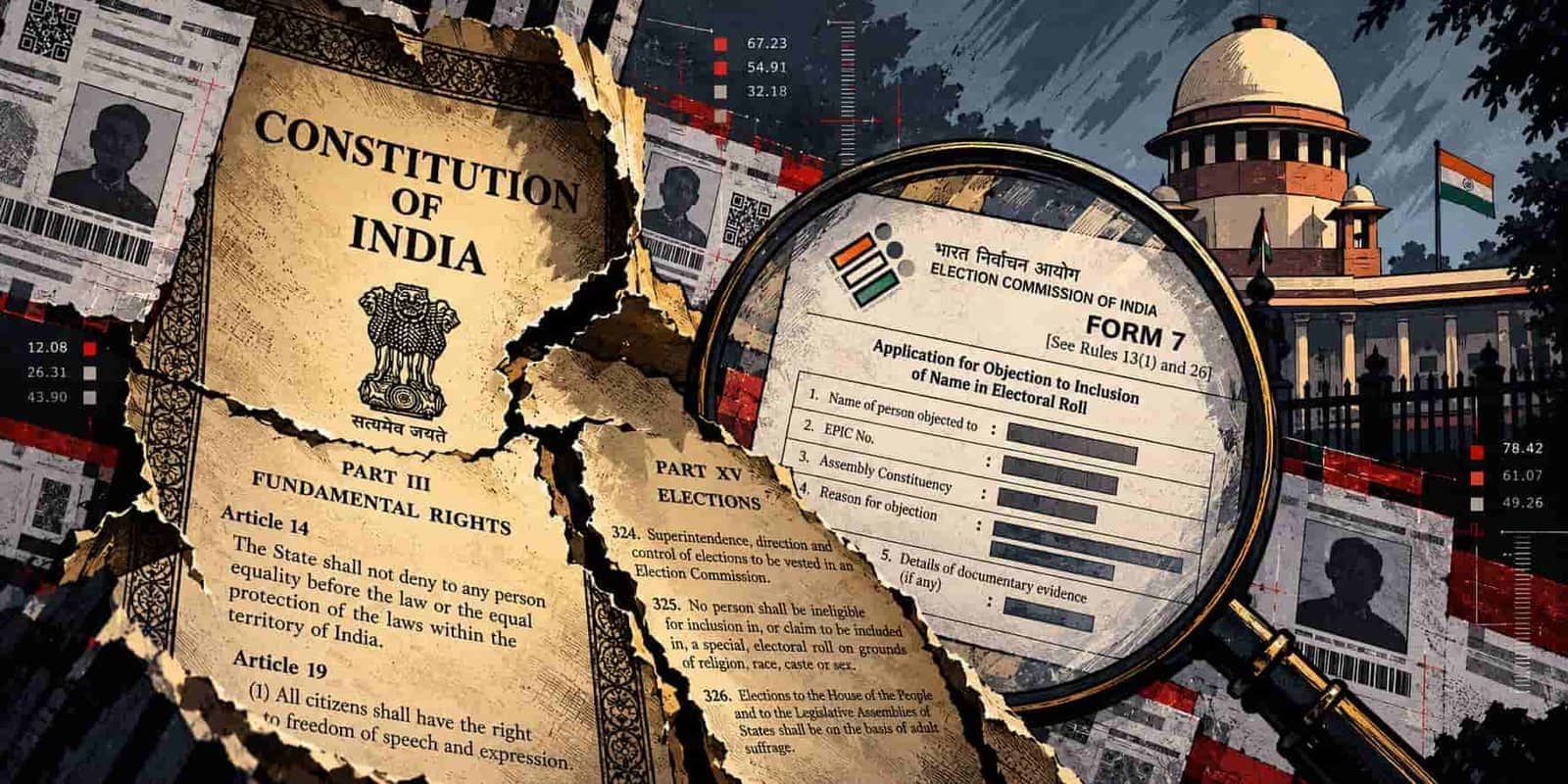
Opening The Rift
therift
© 2026 The Rift. All Rights Reserved.
The Supreme Court’s piecemeal UAPA bails are no substitute for systemic reform.
While recent murmurs from the bench reaffirm that bail is the rule, the refusal to dismantle the statutory embargo leaves personal liberty at the mercy of a judicial lottery.

Key Takeaways
1 of 3
Automatically generated. Read full article for complete context.
Recently, the Delhi High Court granted former Jawaharlal Nehru University student Umar Khalid a fleeting three-day interim bail to visit his ailing mother. Khalid has been incarcerated since September 2020 under the Unlawful Activities (Prevention) Act. Earlier this year, the Supreme Court unequivocally denied his plea for regular bail. Yet, just weeks before his brief release, the highest court granted six months of interim relief to co-accused Khalid Saifi and Tasleem Ahmad, citing the sheer impossibility of concluding their trials anytime soon.
This paradox captures the current crisis in India’s anti-terror jurisprudence. The judiciary is exhibiting a profound, visible discomfort with the prolonged pretrial incarceration of citizens under terror charges. However, instead of systematically correcting the law that enables this injustice, constitutional courts are settling for piecemeal relief, reducing the fundamental right to liberty to a game of chance.
The root of this crisis lies in Section 43D(5)Section 43D(5) of UAPANotwithstanding anything contained in the Code, no person accused of an offence punishable under Chapters IV and VI of this Act shall, if in custody, be released on bail or on his own bond unless the Public Prosecutor has been given an opportunity of being heard on the application for such release.. This provision flips the traditional principles of criminal justice, requiring the accused to practically prove their innocence at the bail stage without a full trial. For years, the state has weaponized this threshold to keep activists, journalists, and dissenters locked away indefinitely.
In 2021, the Supreme Court attempted to carve a constitutional escape route in the landmark K.A. NajeebUnion of India v. K.A. NajeebA 2021 Supreme Court judgment holding that prolonged incarceration and delayed trials can override the strict bail restrictions of the UAPA. judgment. The ruling declared that statutory restrictions cannot permanently eclipse Article 21Article 21The constitutional guarantee of the right to life and personal liberty, which cannot be deprived except according to procedure established by law.. It established that excessive delays and prolonged custody could melt down the harsh embargo on bail.
Yet, five years later, the application of this principle remains alarmingly inconsistent. The jurisprudence depends almost entirely on which bench hears the petition.
In January 2026, a Supreme Court benchGulfisha Fatima v. State (2026)A key ruling involving several Delhi riots accused where the Court held that delay in trial cannot automatically act as a trump card against UAPA’s strict bail provisions. took a regressive stance by refusing bail to several Delhi riots accused. That ruling boldly stated that Article 21 cannot be treated as a trump card to bypass the statutory bar, effectively prioritizing the black letter of the UAPA over constitutional liberty.
However, by May 2026, a different bench comprising Justices B.V. Nagarathna and Ujjal Bhuyan pushed back forcefully. While granting bail in a narco-terror case, they expressed serious reservations about the January ruling. They reiterated that bail is the rule and jail is the exception, emphasizing that constitutional courts must not allow harsh statutes to render personal liberty obsolete.
This internal friction finally prompted the Supreme Court to refer the entire conflict to a larger Bench on May 22, 2026. The referral aims to ensure parity, consistency, and institutional fidelity in how bail is handled when trials are interminably delayed.
While referring the matter to a larger bench is a necessary procedural step, it reveals a troubling reluctance to tackle the monster head-on. The state continues to rely on the strategy of the process being the punishment. By generating massive, unmanageable volumes of chargesheets and naming hundreds of witnesses, the prosecution guarantees that a trial cannot be completed swiftly. When the trial drags on for years, Section 43D(5) ensures the accused rots in prison.
Supporters of the stringent bail conditions argue that terror offenses require exceptional preventive measures. They contend that softening the bail threshold could compromise national security and allow dangerous actors to tamper with evidence.
This argument ignores a fundamental reality. Reaffirming the constitutional right to bail does not mean releasing proven terrorists into the streets: it means refusing to treat the unconvicted as guilty by default. When the state takes six years just to frame charges, the national security argument rings hollow. The prolonged incarceration of unconvicted citizens looks less like justice and more like preventive detention disguised as criminal procedure.
The judiciary’s recent willingness to grant bail to figures like Saifi, Ahmad, and others based on trial delays is a welcome relief. It is a sign that the conscience of the court is finally rejecting the normalization of endless imprisonment. But until the Supreme Court comprehensively reads down the draconian burden of Section 43D(5), these bails will remain exceptional acts of judicial grace rather than the enforcement of a fundamental right.
A democracy cannot function when personal liberty depends on the luck of the draw. The upcoming larger bench has a historical responsibility. It must clarify once and for all that no statute, no matter how stringent, can outrank the Constitution. Anything less will be a failure of institutional duty.