Opening The Rift
therift
© 2026 The Rift. All Rights Reserved.
Adani FCI Silo Contracts: How Removing an Anti-Monopoly Clause Enabled a Duopoly
The strategic deletion of a single restrictive clause transformed India’s ₹20,000 crore grain storage modernisation into a consolidated corporate enterprise.

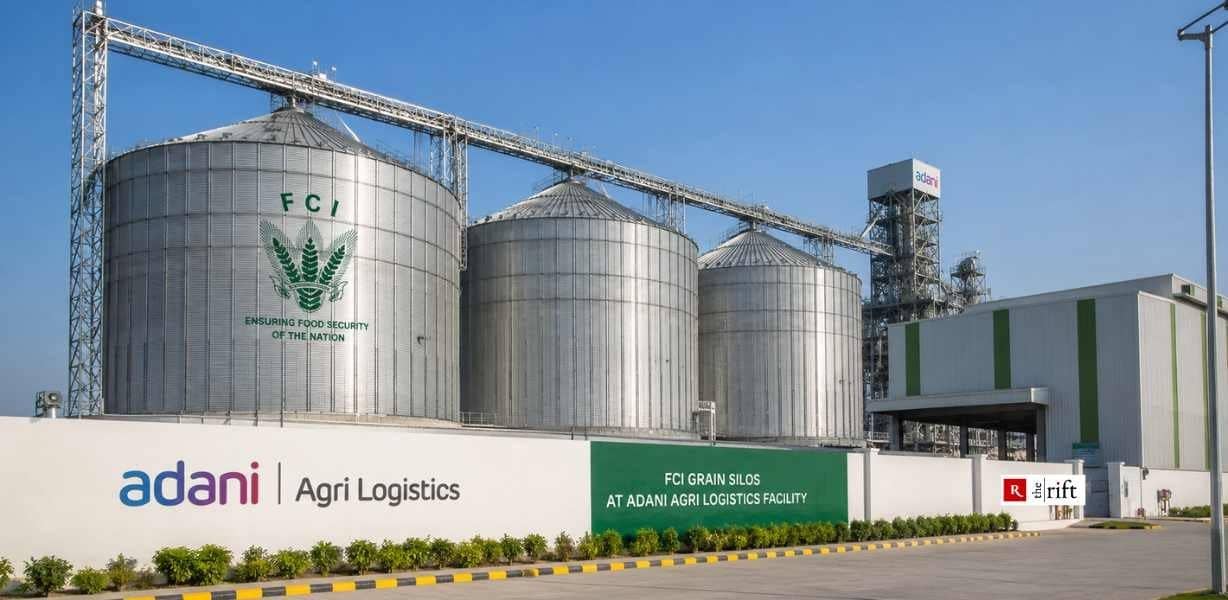
Image | Representative Only
Key Takeaways
1 of 3
Automatically generated. Read full article for complete context.
Adani getting the FCI silo contracts is impossible to ignore. The Food Corporation of India (FCI) has awarded the lion’s share of its ambitious storage modernisation programme. The ₹20,000 crore “Hub and Spoke”Hub and Spoke ModelA logistics system where a central ‘hub’ handles bulk storage, and ‘spokes’ act as distribution centers. initiative was designed to transition India’s crucial grain storage from archaic warehouses to modern steel silos. It was meant to reduce massive transit losses and thereby secure the food supply of the nation.
But what appears to be an ostensibly technical infrastructure upgrade is turning into a masterclass in market concentration. Following this anti-monopoly safeguard removal, only two companies, Adani Agri Logistics Ltd and Leap India Food & Logistics Pvt Ltd, were able to secure 110 out of the 134 awarded projects.
This level of consolidation cannot happen by accident. According to media reports, FCI had originally proposed an “anti-monopoly” clause a few years back to prevent such concentration of the national food security infrastructure. That clause if not removed would have functioned as a structural safeguard and would have ensured diverse participation across the sector.
As per Newslaundry report, during a Public Private Partnership Appraisal Committee (PPPAC)PPPACThe central body responsible for appraising and approving major public-private infrastructure projects. meeting in May 2022, this safeguard was quietly removed after the department of economic affairs and NITI AayogNITI AayogThe premier public policy think tank of the Government of India. opposed it. Both argued for a market-friendly approach.
By removing the ceiling on how many contracts a single entity could win, the government effectively paved the way for massive conglomerates to dominate the bidding process.
The Open Market Claim
The FCI has come out vehemently rejecting the allegations of favouritism and cronyism. In a public statement issued, the agency claimed that the tendering process was transparent and open to all.
The FCI’s defense rests on the fact that other bidders succeeded in the subsequent phases and that Adani did not sweep every single round. The agency still maintains the claim that the decision to scrap the anti-monopoly clause was a collective policy choice aimed to encourage sectoral growth.
However this defense is apparently flawed as it relies on a fundamental misunderstanding of how monopolies actually function in the real world. The sheer scale of the tender bundles effectively ensured that the smaller players could not compete against the giant private players. This inherently excluded smaller domestic firms, public sector undertakings, and agricultural cooperatives.
In simple terms, when a project requires immense capital expenditure before even starting the operations, the “open market” simply becomes an arena where only the most heavily capitalized conglomerates can compete. The All India Kisan Sabha (AIKS) has rightly warned about this. They argue that handing over critical food security infrastructure to private monopolies would make both the state and the farmer deeply vulnerable to corporate leverage.
A Systemic Pattern of Consolidation
The controversy over the FCI silos is not an isolated incident. It is just part of the ongoing broader institutional pattern where regulatory frameworks are systematically streamlined in such a way that it only benefits the most dominant players in the market.
This pattern is consistent across all major sectors of the economy. Whether in ports, airports, or now agricultural logistics, the formula is the same.
The concern is not that smaller firms were technically barred from submitting bids, but that the sheer scale of the tender bundles inherently excluded smaller domestic firms.
The true cost of this duopoly will not be immediately felt. Its impact will be seen in the coming years. The state will slowly lose its sovereign capacity to govern its own resources. It will become dependent on private players to store and transport the very grain that sustains hundreds of millions of citizens.
The removal of the anti-monopoly clause was not a bureaucratic oversight. It was a calculated move that placed the logic of capital concentration over the security of the public.