Opening The Rift
therift
© 2026 The Rift. All Rights Reserved.
BDA’s “Deceptive” Response to CMO Grievance Cell Raises Questions Over Non-Implementation of OHRC Rehabilitation Recommendation
The BDA’s selective disclosure created a deceptive impression, avoiding implementation of urgent humanitarian relief despite OHRC’s interim recommendation.


Key Takeaways
1 of 3
Automatically generated. Read full article for complete context.
Bhubaneswar, Odisha : The Bhubaneswar Development Authority’s (BDA) response to the Chief Minister’s Grievance Cell has drawn criticism as being deceptive, with the author, who is also the complainant in the matter, stating that the Authority failed to disclose a crucial aspect of the proceedings before the Chief Minister and the Higher Authorities of Government of Odisha.
While the BDA, through Letter No. 152285 dated 14 July 2026, informed the Chief Minister’s Grievance Cell only that the matter was “sub judice” before the Odisha Human Rights Commission (OHRC), it did not mention that the Commission had already issued an interim recommendation directing the BDA to provide temporary rehabilitation to the evicted families by arranging shelter with basic amenities such as drinking water, electricity, and toilet facilities. A detailed report on the matter was published earlier by The Rift and can be accessed here: Bhubaneswar Slum Evictions Amid Severe Heatwave: OHRC Directs BDA to Provide Temporary Rehabilitation
The recommendation was issued after the OHRC recorded a prima facie finding that the eviction appeared to have been carried out without following due process of law and without issuing prior notice. However, this crucial observation of the Commission was also not disclosed in the communication to the Grievance Cell. This selective disclosure and omission of material facts created a deceptive impression that no immediate action was required, despite the OHRC having already recommended urgent humanitarian relief as an interim measure pending final adjudication of the case.
Thus, the Bhubaneswar Development Authority (BDA) adopted an anti-people and anti-poor attitude and deliberately placed incomplete and incorrect facts before the Chief Minister’s Office (CMO), while merely citing the registration numbers of the grievances filed before the Office of the Chief Secretary of Odisha and the Additional Chief Secretary to the Government, Housing and Urban Development Department, Govt. of Odisha, with the apparent intention of avoiding the implementation of any interim rehabilitation programme for the affected families.
When an executing public authority places incomplete and incorrect facts before the Hon’ble Chief Minister, the Chief Secretary, and the head of its own administrative department, resulting in non-compliance with the recommendations of a statutory human rights institution, serious concerns arise regarding the ability of such an authority to effectively safeguard the rights and provide essential services to urban poor communities residing in slums. Further, the same authority did not come forward with any appropriate response or proposal regarding interim relief or rehabilitation, despite the OHRC providing ample opportunities for it to do so.
This indicates a hide-and-seek approach by the executive authority, BDA, with the CMO, State authorities, and statutory authorities such as the OHRC, while keeping them unaware of the complete facts of the matter.
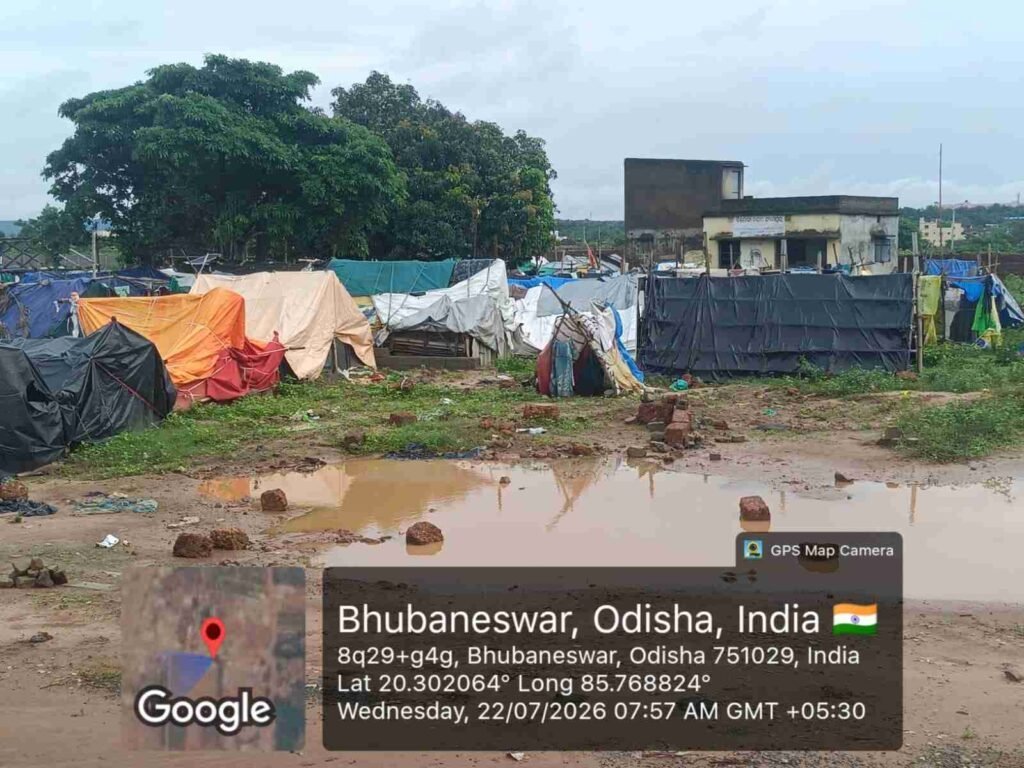
More than one and a half months after the Odisha Human Rights Commission (OHRC) recommended temporary rehabilitation for families displaced during the demolition of the Vinoba Nagar (Subarnapur) Sampur Bhoodan Slum, hundreds of evicted families continue to live under makeshift polythene shelters, raising serious questions regarding compliance with the Commission’s interim directions.
Documents accessed by the author, including the OHRC’s order dated 2 June 2026 in Subhashree Pradhan vs. State of Odisha (OHRC Case No. 1611 of 2026) and correspondence exchanged through the Chief Minister’s Grievance Cell, indicate a significant gap between the Commission’s recommendation and the continuing ground reality faced by the affected families.
OHRC’s Prima Facie Findings
The affected families approached the Odisha Human Rights Commission alleging illegal demolition and denial of basic human rights.
After hearing both sides, the Commission made strong prima facie observations in its order dated 2 June 2026.
The Commission recorded:
“Prima facie, it appears that the houses of the complainants were demolished without following due process of law and without issuing any prior notice.”
The Commission further observed:
“The affected families are presently living in extreme distress under polythene sheets in the scorching summer and rain, without access to basic facilities.”
Notably, the OHRC also recorded:
“Despite sufficient opportunity having been given, the B.D.A. has not come forward with any appropriate response or proposal regarding interim relief/rehabilitation.“
As an interim measure, the Commission recommended:
“This Commission recommends to the B.D.A. to provide temporary rehabilitation to the evicted families (except those who have already approached the Hon’ble High Court or any Civil Court in this matter), for a period of at least one month, by arranging shelter there or in nearby suitable places with basic amenities such as water, electricity and toilet facilities.”
To avoid any future legal complications or misunderstanding regarding land rights, Commission clarified :
“However, such arrangement of shelter, shall not ensure to the benefit of the persons evicted to establish their right on the land where from they are evicted or place they are rehabilitated in any manner. The aforesaid is only a temporary arrangement. This arrangement be made unless any contrary order has been passed by any other competent authority or court. With the above direction, the cases are adjourned to 23.07.2026.”
Through this clarification, the Commission made it clear that providing temporary shelter and basic amenities would neither create nor recognize any legal, ownership, possessory, or tenancy rights over the land from which the families were evicted or the place of temporary rehabilitation. The recommendation was intended solely as an interim humanitarian relief measure until further orders of the Commission or any competent court.
From the above, it is clear that pending final adjudication, the Commission recommended that the BDA provide temporary rehabilitation for at least one month by arranging shelter at the site or nearby with drinking water, electricity and toilet facilities. It clarified that such temporary accommodation would not create any legal right over the land.
Recommendation Remains Unimplemented?
Nearly seven weeks after the OHRC’s recommendation, the conditions described by the Commission reportedly remain unchanged.
During the first week of July, approximately one month after the OHRC issued its recommendation, incessant and heavy monsoon rains further exposed the vulnerability of the displaced families, worsening their already difficult living conditions.
Local news outlet The Odisha Reporter, in a report titled “Flattened rice is only source of sustenance,” documented rainwater flooding cooking areas, mud-filled living spaces and leaking plastic-sheet shelters. The report further reinforced concerns that no meaningful temporary rehabilitation had been provided despite the Commission’s recommendations, indicating that the humanitarian crisis continued to persist.
A detailed report on the matter was published earlier by The Rift and can be accessed here: Humanitarian Crisis Deepens for Evicted Families Amid Incessant Rain and Continued Non-implementation of OHRC Order
Grievances Reach the Chief Minister’s Office
Seeking implementation of the OHRC’s recommendation, the author, being a concerned citizen, submitted grievances to the Hon’ble Chief Minister of Odisha, the Chief Secretary, Government of Odisha, and the Additional Chief Secretary, Housing and Urban Development Department, Government of Odisha.
Official records show that the grievances were forwarded to the Vice-Chairman of the Bhubaneswar Development Authority for appropriate action.
According to documents received from the Bhubaneswar Development Authority (BDA), the Authority, through Letter No. 152285 dated 14 July 2026, informed the Chief Minister’s Grievance Cell:
“The grievance submitted by Sri Prakash Kumar Samantsinghar regarding temporary rehabilitation of evicted families by providing shelter either at eviction site or at near by suitable locations along with basic amenities. The matter is presently sub judice before the Hon’ble Odisha Human Rights Commission. The next date has been fixed for 23.07.2026.”
The response, however, reportedly did not explain why the Commission’s interim recommendation for temporary rehabilitation had not been implemented.
This has raised an important administrative question: Can a public authority decline to act on an interim recommendation of a statutory human rights body merely because the main proceedings remain pending, particularly when the recommendation itself was intended to provide immediate humanitarian relief?
Larger Questions of Accountability
The case has now evolved beyond a dispute over eviction.
It raises broader questions regarding compliance with recommendations issued by statutory human rights institutions and the responsibility of public authorities to provide humanitarian assistance while legal proceedings are pending.
Legal experts note that although recommendations of human rights commissions may not always carry the same enforceability as court decrees, public authorities are generally expected to respond transparently, especially where interim relief concerns basic human rights such as shelter, sanitation and access to essential services.
Whether the BDA had valid legal reasons for not implementing the OHRC’s recommendation remains unclear from the correspondence presently available. The absence of a detailed explanation has become a central point of contention.
The matter is scheduled for further consideration before the Odisha Human Rights Commission on 23 July 2026. The Commission’s next proceedings are expected to examine the status of compliance with its interim recommendation and the continuing conditions faced by the displaced families.
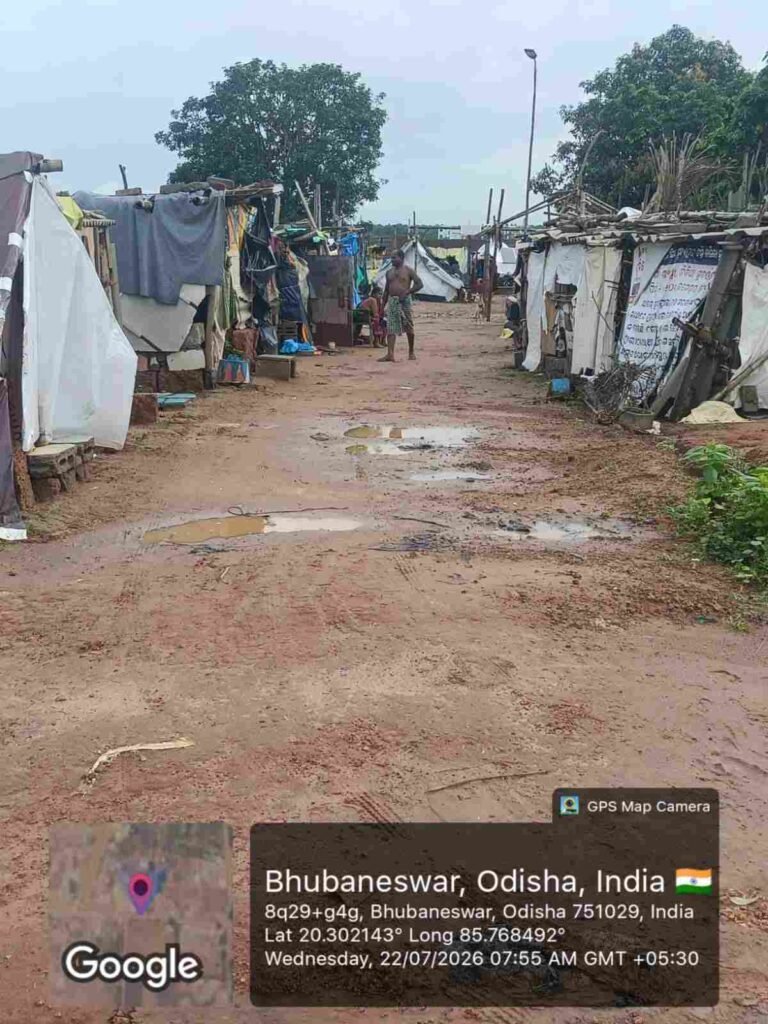
Until then, hundreds of families remain under plastic-sheet shelters, waiting not only for a final legal decision but also for immediate relief that the Commission had recommended weeks earlier.
Also read earlier two articles published on same issue :
Disclaimer:The views and opinions expressed in this article are those of the author(s) and do not necessarily reflect the official policy or position of The Rift.