Opening The Rift
therift
© 2026 The Rift. All Rights Reserved.
Aruna Roy’s Many-Sided Contributions
However the call of social activism beckoned and she became one of the very few IAS officers to leave this prestigious government service at a very early stage.


Aruna Roy
Key Takeaways
1 of 3
Automatically generated. Read full article for complete context.
Aruna Roy, the famous activist and author, has said that she prefers to observe her 80th birthday this month quietly at her home, but her colleagues and companions of highly eventful journeys on the path of meaningful social change, justice and democracy would certainly like to use this time to remember her many-sided contributions and learnings from them.
Aruna Roy the activist started her ‘career’ in a very different way, in fact as an IAS officer. However, the call of social activism beckoned, and she became one of the very few IAS officers to leave this prestigious government service at a very early stage. She then went to work in villages of Ajmer district in Rajasthan, where along with her husband Bunker Roy and with their other colleagues and villagers they took up several pioneering initiatives at the Barefoot College (SWRC)Barefoot CollegeA grassroots organization in Tilonia, Rajasthan, empowering rural communities through education and skill-building. of Tilonia. Here Aruna Roy’s contribution particularly to the mahila sangathan or the women’s organizations was very important and the women’s movement here got widespread appreciation for its many-sided contributions. One aspect of this movement here that I found particularly heartwarming was the great commitment shown by several elderly women who also associated themselves with its initiatives and they could be seen at various solidarity and protest sites.
While the contribution of Aruna to the women’s movement here is widely appreciated, less well-known is the quiet but significant contribution she made to some other aspects of the Barefoot College like the beautiful work done in the crafts section. To the children growing up in Tilonia, Aruna subsequently became an inspiration figure and on my frequent visits here I found many of them calling her naani or maternal grandmother. Children grow up fast, and soon I saw them emerging in responsible positions to help Aruna in her office and mobilization work.
Work at Tilonia and Barefoot College was interesting and meaningful, as beyond its various projects this related also to the wider need of creating a non-discriminative society based on constitutional precepts of social equality. However, after some time Aruna was yearning for a wider role in social change which would be more along the lines of a people’s movement, and would overcome some of the limitations of a formally organized NGO. It was around this time that along with Shankar, a great communicator with the Barefoot College team, and young Nikhil Dey, a boyish activist who was reflecting and thinking much beyond his age, Aruna Roy moved towards forming the Mazdoor Kisan Shakti Sangathan (MKSS)MKSSA grassroots organization formed to empower workers and farmers, instrumental in India’s Right to Information movement. or organization for empowerment of workers and farmers.
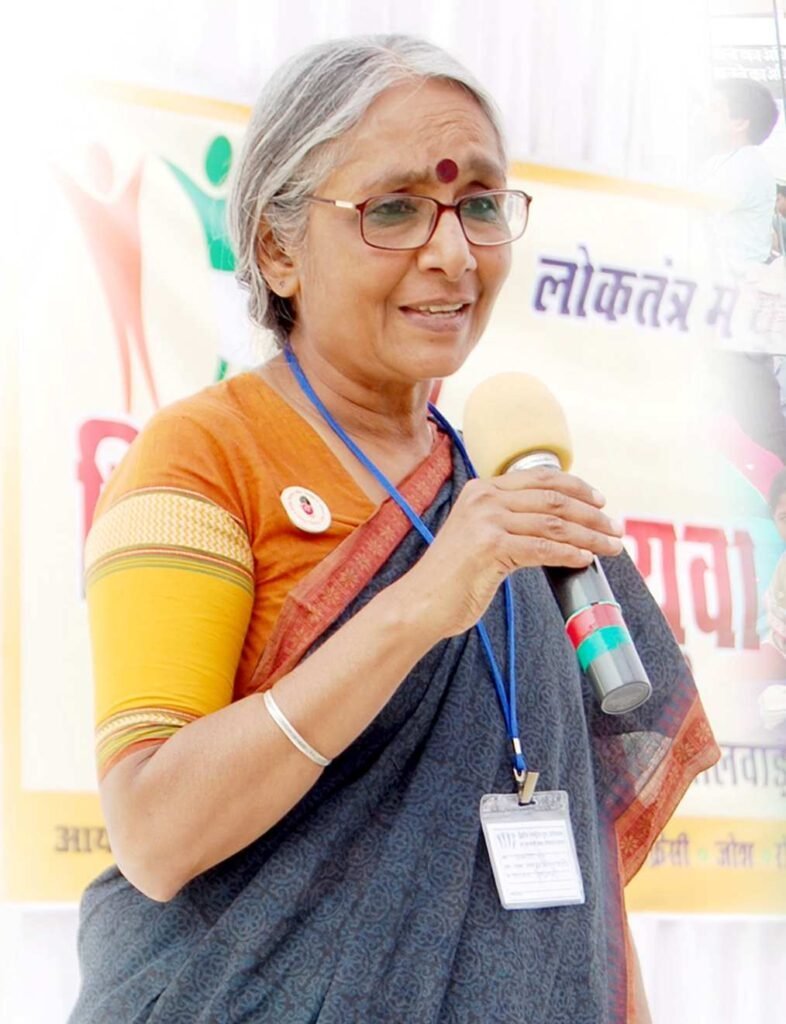
Thus at an age when many social activists would be thinking in terms of consolidating the previous work or moving towards somewhat less strenuous life, Aruna instead chose the path towards new and more difficult challenges, moving with her new colleagues to a hut in a village. As the new team had no institutional support, they had to struggle to meet essential expenses. At one stage I found them discussing which seasonal vegetable was the cheapest, and as the consensus was on ghiya or bottle gourd, they could look forward to many days of subsisting on this.
The new organization was soon in the thick of a struggle which antagonized the biggest feudal lord of the area for whom using violence to crush any upstarts would have been quite acceptable. The new team and their rural supporters managed to not only survive but could also start their journey with a victory. Soon they were in the middle of another struggle for minimum wages for drought relief and rural employment works. In this struggle Nikhil and some new MKSS members went on a protest fast.
This struggle in turn led to wider struggle again misuse of rural development funds, then to a struggle for greater transparency and finally for right to information. Several protest sit-ins or dharnas helped to take the message all over Rajasthan. All this involved a lot of hard work, and at one of the dharnas Aruna fainted from exhaustion and heat.
The next stage was to take the struggle to a national level and form a national campaign committee. The beautiful way in which local struggles were related to a national campaign was a great learning experience.
While so far my involvement had been more as an independent journalist covering these movements and initiatives, this soon increased as I was selected to be the first convener of this national campaign for right to information and also as chairperson of a Trust set up with the support of Aruna Roy to provide support to social activists. I fulfilled both responsibilities in honorary capacity to the best of my ability for some years, and in the course of this I had more chances of interactions with Aruna, Nikhil and Shankar.
What I noticed in their work was that along with any ongoing struggles, the MKSS was constantly making efforts for inter-faith harmony and national integration. Their efforts for helping silicosis victims also brought good results. Aruna Roy and her colleagues took another important initiative by starting the School for DemocracySchool for DemocracyAn institution initiated by Aruna Roy to educate and train citizens in democratic rights and participatory governance. which with its many-sided educational and training programs as well as fellowships has made many important contributions. In addition Aruna has made an important contribution in the form of her writings for newspapers and also as an author of books, particularly her very well-received memoir titled ‘The Personal is Political’. Many friends, well-wishers and those inspired by her many-sided contributions hope that Aruna will continue to make her contributions for a better world for many, many more years.
Disclaimer:The views and opinions expressed in this article are those of the author(s) and do not necessarily reflect the official policy or position of The Rift.