Opening The Rift
therift
© 2026 The Rift. All Rights Reserved.
Eviction Notices to Mosques, Madrasas and Dargahs in Fifty Kilometres along India-Pakistan Border : Constitutional Critique
Constitutional rights do not disappear at the border, nor does judicial scrutiny become unnecessary merely because the State invokes national security.

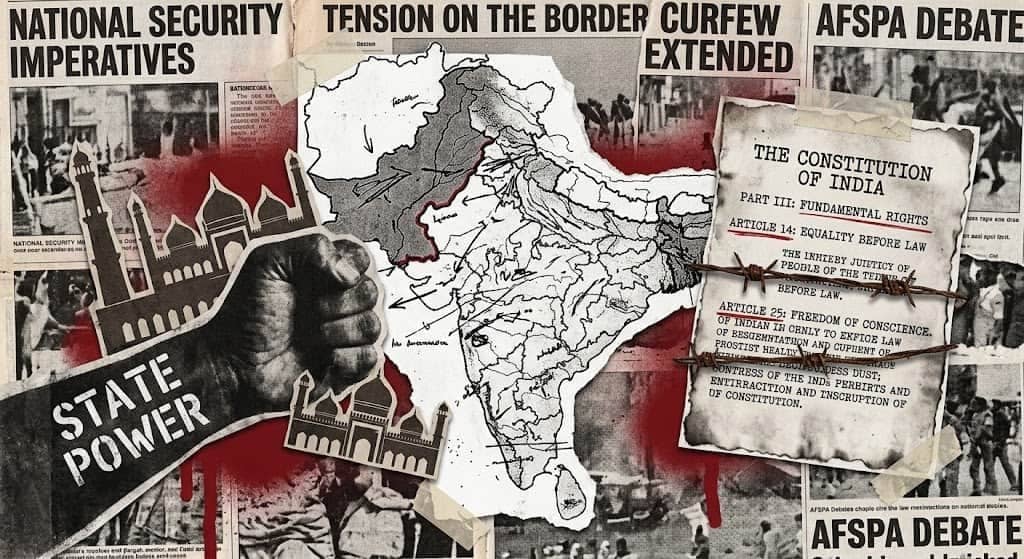
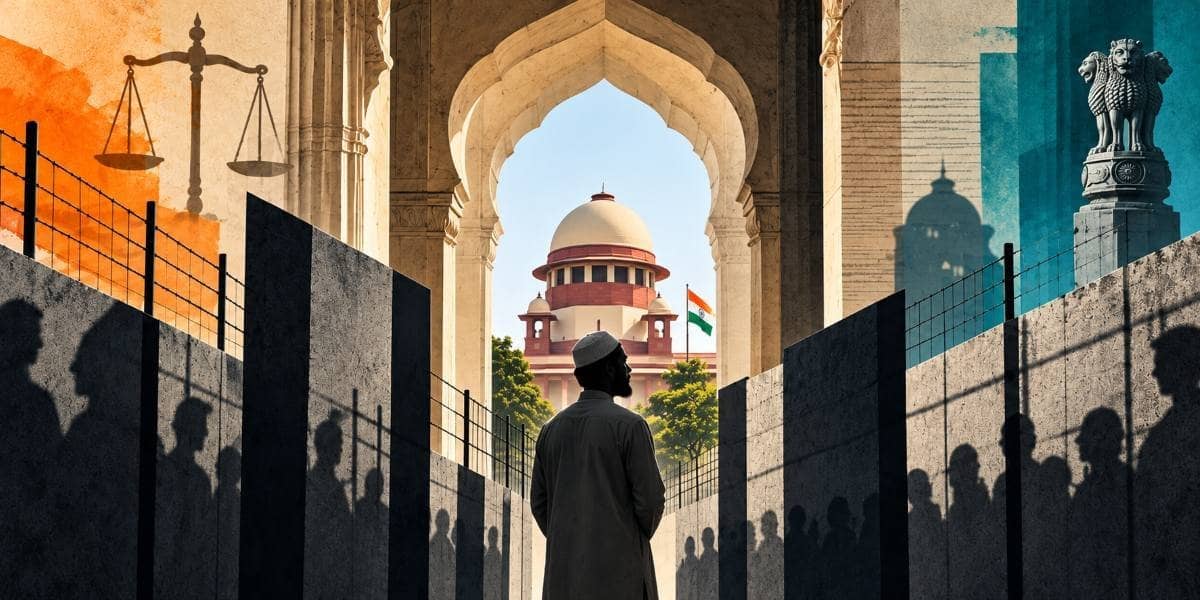
Eviction notices served to mosques, madrasas and dargahs near India-Pakistan border, raising constitutional concerns (Representative Image)
Key Takeaways
1 of 3
Automatically generated. Read full article for complete context.
The Rajasthan High Court has upheld the issuance of show-cause and eviction notices to mosques, madrasas and dargahs situated within fifty kilometres of the India-Pakistan international border, observing that the matter concerns national security and does not amount to religious discrimination. The importance of national security is beyond dispute. Equally beyond dispute is the constitutional principle that every action of the State, including one professedly taken in the interest of national security, must conform to the guarantees contained in Part III of the ConstitutionFundamental RightsThis part of the Constitution of India enshrines the fundamental rights of its citizens, including rights to equality, freedom, and protection against exploitation..
Constitutional rights do not disappear at the border, nor does judicial scrutiny become unnecessary merely because the State invokes national security.
The principal constitutional concern arising from the judgment is that it appears to accept the State’s justification without adequately examining whether the action satisfies the guarantees of equality under Article 14Equality Before LawA fundamental right in the Indian Constitution that guarantees equality before the law and equal protection of the laws to all persons within the territory of India. and religious freedom under Article 25Freedom of ReligionA fundamental right in the Indian Constitution that guarantees freedom of conscience and the right to freely profess, practice, and propagate religion, subject to public order, morality, and health..
Article 14 embodies both equality before the law and equal protection of the laws. It prohibits not only discriminatory legislation but also discriminatory executive action.
The State cannot select one class of citizens or one religious community for adverse treatment unless the classification rests upon an intelligible differentiaReasonable Classification BasisA legal term referring to a discernible and rational basis for classifying persons or things for legislative or executive action, distinguishing them from others. having a rational nexusLogical ConnectionA legal term indicating a logical and reasonable connection between the classification made (the intelligible differentia) and the object sought to be achieved by the law or action. with the object sought to be achieved.
Even then, the classification must withstand scrutiny on the touchstone of fairness, reasonableness and non-arbitrariness.
If the impugned notices have been issued exclusively to mosques, madrasas and dargahs situated within the prescribed border belt, while temples, ashramsHindu Spiritual RetreatsHermitages, monasteries, or spiritual retreats in Indian religions, particularly Hinduism, where gurus and their disciples live and practice spiritual disciplines., derasReligious/Spiritual CentersA term used in India for various religious or spiritual centers, particularly in Sikhism and some Hindu sects, often led by a spiritual leader., samadhisMemorials/TombsMemorials or tombs, often for revered saints, spiritual leaders, or important individuals, particularly in Hinduism, marking their final resting place or place of spiritual attainment. and other religious institutions similarly situated have not been subjected to corresponding proceedings, the constitutional question is immediate and unavoidable.
The distinction is then drawn not upon the basis of location or legality of occupation but on religious identity. Such selective enforcement strikes at the heart of Article 14.
The State cannot presume that institutions belonging to one religion present a greater security concern merely because they belong to that religion.
Constitutional governance requires that every institution be assessed on the basis of objective facts and individual circumstances.
Suspicion cannot become a substitute for evidence, nor can religion become a proxy for risk assessment.
This concern assumes even greater significance when viewed against the undisputed historical existence of many of these institutions. Numerous mosques, dargahs and madrasas situated along the border are reported to have existed continuously for nearly seventy-five years after Independence. Some are considerably older. Throughout this period, successive governments, irrespective of political affiliation, permitted their continued existence. Revenue authorities, police authorities, district administrations and border agencies functioned with full knowledge of these institutions. Their existence was neither clandestine nor concealed.
Long existence does not by itself create legal title against the State. Encroachments do not become lawful merely because they have remained unchallenged for decades.
However, prolonged governmental acquiescence is constitutionally relevant. It substantially weakens any assertion that the mere existence of such institutions suddenly constitutes a threat to national security.
Where institutions have existed openly for several decades without any demonstrated security incident attributable to them, the State bears a correspondingly greater burden of establishing what has changed.
It must disclose the factual basis that necessitates action at this stage. It must explain why each individual institution presents a security concern.
It must also explain why comparable institutions belonging to other faiths have not been subjected to similar proceedings, if indeed that is the factual position.
A general assertion of national security cannot relieve the State of its constitutional obligation to justify differential treatment.
Constitutional adjudication demands scrutiny of facts rather than acceptance of generalised assumptions.
Article 25 guarantees to every person the freedom of conscience and the right freely to profess, practise and propagate religion, subject to public order, morality, health and the other provisions of Part III.
Religious structures are not merely buildings. They are places through which religious belief finds public expression and collective practice. While Article 25 does not confer immunity from valid land laws, restrictions on religious institutions must nevertheless satisfy the constitutional requirements of legality, necessity and proportionalityLegal Principle for Rights RestrictionA legal principle requiring that any restriction on a fundamental right must be necessary, suitable, and not excessive in relation to the legitimate aim pursued by the State..
The principle of proportionality has become an integral feature of Indian constitutional law.
Whenever the State seeks to restrict a fundamental right, it must demonstrate not only that the objective is legitimate but also that the chosen measure bears a rational relationship to that objective, impairs the right no more than necessary and maintains an appropriate balance between public interest and individual rights.
The apparent absence of any institution-specific assessment raises serious constitutional concerns. If every mosque, madrasa and dargah within a defined geographical zone is treated alike without regard to its location, history, management, activities or security profile, the action assumes the character of collective treatment based on religious identity rather than individual assessment based upon evidence.
Such an approach is difficult to reconcile with the secular character of the Constitution and smacks of Islamophobic hostile discrimination.
Indian constitutionalism rejects the notion of collective guilt. Rights are individual. Liability is individual. Administrative action must therefore proceed upon individual facts rather than communal presumptions.
The Supreme Court has consistently held that arbitrariness is antithetical to equality, that State action affecting fundamental rights must be fair, just and reasonable, and that restrictions upon constitutional freedoms are subject to judicial review even where the State invokes compelling public interests.
National security undoubtedly deserves judicial respect, but constitutional courts are equally obliged to examine whether its invocation is supported by objective material and whether the resulting restrictions satisfy constitutional standards.
The constitutional concern is therefore not with the legitimacy of protecting the nation’s borders. That objective is unquestionably valid.
The concern lies in whether the constitutional guarantees of equality and religious freedom have received the rigorous consideration that they demand. If institutions belonging to one religious community alone have been selected for coercive action while similarly situated institutions of other communities remain unaffected, the resulting disparity calls for careful constitutional examination.
Equality before the law requires that like cases be treated alike. Secularism requires that the State remain neutral among religions. National security requires vigilance.
Constitutional governance requires that such vigilance be exercised without abandoning the guarantees that distinguish a constitutional democracy from an unreviewable exercise of executive power.
The enduring strength of the Indian Constitution lies precisely in its insistence that the protection of national security and the protection of fundamental rights are not competing constitutional values. They are complementary obligations.
The legitimacy of one cannot be secured by diminishing the other. A constitutional democracy is tested not by the manner in which it protects rights in ordinary times but by its willingness to preserve those rights when faced with genuine concerns of security and public order. In the cited instance, first, the State Executive seems to have failed the citizens. Then, the judgement falls short of expectations from a constitutional court. Possibly, there will be light when the Supreme Court examines the issue. In the meanwhile, as I have often pointed out, a State Executive’s intent stands revealed by its conduct.
Jai Hind
Disclaimer:The views and opinions expressed in this article are those of the author(s) and do not necessarily reflect the official policy or position of The Rift.
*Constitutional LawArticle 14Article 25Border SecurityIndiaNational SecurityRajasthan High CourtReligious Freedom