Opening The Rift
therift
© 2026 The Rift. All Rights Reserved.
Pakistan’s Reassurance Regime and its Love Letters of Loyalty
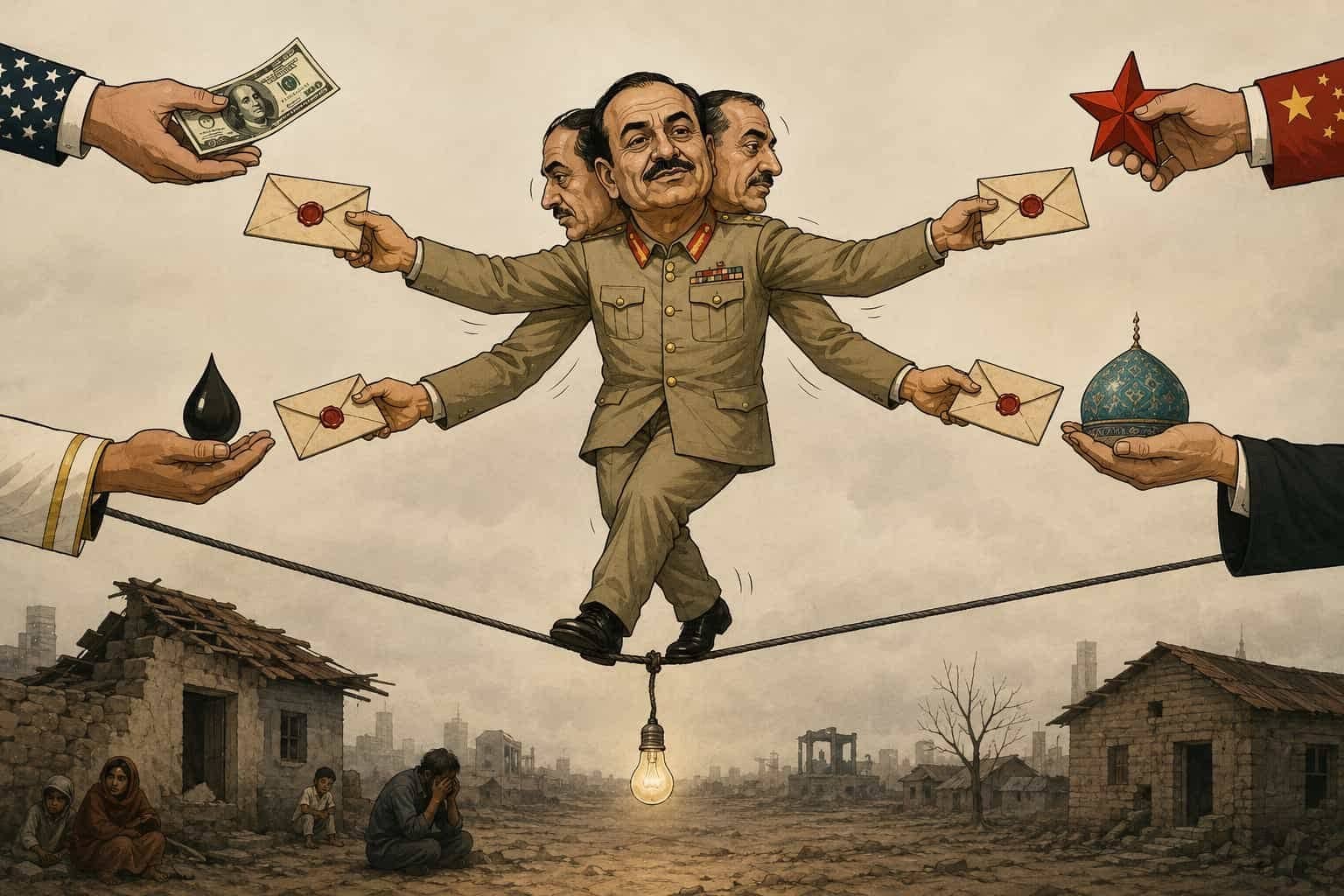
Pakistan’s establishment wants the prestige of choosing without ever paying the price of choice, engaging in geopolitical polygamy where every spouse believes she is the favorite.

Key Takeaways
1 of 3
Automatically generated. Read full article for complete context.
There is an old line about politics: “When a clown moves into the palace, the clown does not become a king. The palace becomes a circus.”
Modern geopolitics has improved the formula. It has produced the travelling circus.
At its center stands Pakistan’s current ruling establishment, with Field Marshal Asim Munir as its most visible travelling representative, shuttling between Washington, Tehran, Riyadh and Beijing with the peculiar burden of convincing every capital that Pakistan is, despite appearances, secretly on its side.
Washington must be assured that Islamabad understands American priorities. Tehran must be assured that Washington’s threats should not be taken too seriously. Riyadh must be assured of Pakistan’s military reliability. Beijing must be assured that none of this compromises the supposedly indestructible “iron brotherhood.”
One begins to wonder whether Pakistan has a foreign policy at all, or merely a filing cabinet full of differently addressed love letters.
The regime’s diplomacy toward Iran exposes the farce. Munir speaks to Trump, then travels to Tehran preaching fraternity, restraint and regional stability. Pakistan presents itself to Washington as the Muslim power capable of influencing Iran, and to Iran as the Muslim neighbor capable of restraining Washington.
This is sold as sophistication.
It looks increasingly like geopolitical double-speak.
There is, of course, nothing disreputable about mediation. Serious states mediate. Intelligent diplomacy requires talking to adversaries.
But mediation requires more than access. It requires credibility.
And credibility is precisely what incessant reassurance consumes.
A trusted friend does not need to arrive every few weeks carrying fresh certificates of loyalty. The insecure friend does. He is forever explaining himself: ignore whom I met yesterday, ignore what I promised elsewhere, ignore the military arrangement I signed with your rival. You know that you are the one I truly value.
Perhaps Munir himself is not personally insecure at all. That would be the charitable interpretation. The deeper problem is institutional: Pakistan’s ruling establishment has accumulated so many contradictory dependencies that its most powerful officials must continuously travel abroad explaining why none of them supposedly contradicts the others.
This is not Strategic autonomyInternational Relations ConceptThe capacity of a state to pursue its national interests and make its own foreign policy decisions independently, without being unduly influenced or constrained by other powers..
It is geopolitical customer service.
- To Washington: reliability.
- To Tehran: fraternity.
- To Riyadh: security.
- To Beijing: brotherhood.
The regime becomes whatever the room requires.
One admires the theatrical range. The strategic coherence is harder to locate.
Trump makes the problem worse because he lacks the manners an empire once used to conceal its demands. He threatens loudly, bargains publicly and treats loyalty as a commodity to be repriced between breakfast and dinner. His diplomacy has all the delicacy of a casino owner disputing a contractor’s invoice.
Pakistan’s establishment traditionally survives through ambiguity: tell Washington one thing, regional partners another, and the Pakistani public something sufficiently foggy to resemble both.
Trump says the quiet part through a megaphone.
The regime then dispatches its representatives to translate the noise.
They explain Trump to Tehran, Tehran to Washington, Pakistan to Riyadh — and, increasingly, Pakistan to itself.
The comedy conceals something grimmer.
Pakistan is a heavily indebted developing country with enormous domestic needs, institutional dysfunction and chronic economic vulnerability. Precisely because its resources are limited, strategic discipline should be ruthless.
Instead, Islamabad’s rulers behave as though proximity to powerful men is itself a form of power.
It is not.
Access is not influence. Carrying messages is not writing them. Being useful to another state’s strategy does not mean possessing one of your own.
Pakistan’s establishment has repeatedly confused rented geopolitical importance with sovereign strength. Washington rediscovers Pakistan when it needs Afghanistan managed, terrorism contained, India pressured or Iran contacted. Pakistani elites celebrate the rediscovery as proof of indispensability. Then priorities change, attention evaporates, resentment follows — and the cycle begins again.
Everyone benefits except, conspicuously, the ordinary Pakistani.
Washington obtains cooperation. Gulf monarchies obtain security. Pakistan’s ruling elites obtain photo opportunities, ceremonial importance and the intoxicating sensation of being needed.
The public receives speeches.
This is the deeper obscenity: a country still struggling to furnish its citizens with the elementary infrastructure of a modern future has developed an establishment permanently preoccupied with managing the anxieties of richer states.
Pakistan may struggle to guarantee electricity to its own citizens, but its rulers appear determined to guarantee strategic reassurance to everybody else.
Iran therefore has every reason to ask a brutally simple question: what happens when friendship becomes expensive?
When Washington demands pressure on Tehran, what happens?
When Saudi security commitments collide with Iranian interests, what happens?
When Beijing’s priorities diverge from Washington’s, what happens?
That is where foreign policy stops being theatre and becomes choice.
Pakistan’s establishment wants the prestige of choosing without ever paying the price of choice. It wants to be Washington’s indispensable partner, Beijing’s iron brother, Riyadh’s security guarantor, Tehran’s trusted neighbor and the Muslim world’s sovereign voice — all simultaneously, indefinitely and preferably without anybody comparing notes.
This is less grand strategy than geopolitical polygamyMetaphorical TermA metaphor used in the article to describe a foreign policy where a state attempts to maintain close, exclusive-seeming relationships with multiple major powers simultaneously, often with conflicting interests., conducted on the assumption that every spouse believes she is the favorite.
Perhaps the performance can continue for a while.
But sophisticated balancing conceals contradictions. It does not require a regime to keep dispatching its most powerful officials abroad to apologize for them.
A confident power makes its interests understood.
An insecure regime endlessly explains its intentions.
A client explains its loyalty.
And a ruling establishment that tells every capital that it is secretly its favorite may eventually encounter the oldest occupational hazard of the confidence manFigurative TermAn individual who gains the trust of others to defraud them. In the article, it’s used metaphorically to describe a regime that promises loyalty to multiple parties, risking exposure when those parties compare notes: the customers meet.
Then the palace does not merely become a circus.
Everyone discovers that the same collection of clowns has been selling tickets at every door.
Disclaimer:The views and opinions expressed in this article are those of the author(s) and do not necessarily reflect the official policy or position of The Rift.