Opening The Rift
therift
© 2026 The Rift. All Rights Reserved.
The Republic They Envisioned Was Built on Equal Citizenship, Not Shared Grievances
The Constitution was therefore not merely a legal settlement. It was an act of collective faith. It represented a wager that constitutional identity could prove stronger than communal memory.


Key Takeaways
1 of 3
Automatically generated. Read full article for complete context.
Part 2
The constitutional answer to the politics of inherited grievance is neither obscure nor difficult to discover. It lies in the circumstances in which the Republic itself was conceived.
One of the great ironies of contemporary India is that the Constitution is frequently invoked while the conditions of its birth are forgotten. The Constitution was not drafted in an age of tranquillity. It emerged amidst refugee camps, communal massacres, forced migrations and the collapse of centuries-old patterns of coexistence.
The framers were not idealists insulated from the realities of sectarian conflict. They had witnessed those realities in their most brutal form. Their constitutional choices were therefore not abstractions. They were deliberate responses to a civilisation-threatening catastrophe.
To understand the significance of those choices, it is necessary to recall the political atmosphere in which the Constituent AssemblyConstituent AssemblyThe sovereign body of elected representatives that assembled between 1946 and 1949 to draft the Constitution of India. met.
The Assembly first convened in December 1946. The subcontinent had not yet been formally divided, but the possibility of Partition already loomed over public life. Communal tensions had intensified. Confidence between communities had deteriorated. The proposition that religion constituted the basis of nationhood had acquired unprecedented political force.
It was in this climate that Jawaharlal Nehru introduced the Objectives ResolutionObjectives ResolutionA historic resolution moved by Jawaharlal Nehru in 1946 that laid down the fundamental philosophical principles of the Indian Constitution. on 13 December 1946. The Resolution remains among the most important constitutional documents in Indian history. It provided the philosophical foundation upon which the Constitution itself would later be built. Nehru declared that the Constituent Assembly was determined to establish an independent sovereign republic and that all authority would derive from the people themselves. He promised justice, liberty and equality. He promised freedom of thought, expression, belief, faith and worship. He promised adequate safeguards for minorities and disadvantaged groups. Most importantly, he articulated a vision of political membership that transcended communal identity.
Nehru’s speech deserves great attention. He repeatedly emphasised that the constitutional project belonged to all Indians regardless of religion or community. The principles embodied in the Resolution were not intended to serve one section of society. They were intended to provide a common political home for all.
At the moment when religious nationalism was redrawing the map of the subcontinent, Nehru proposed a historically different organising principle. The future Republic would derive legitimacy not from religious affiliation but from citizenship. This distinction was not merely administrative. It was civilisational.
The logic underlying Partition was straightforward. If religious communities constituted distinct nations, political organisation should reflect that reality. The Constitution’s framers consciously rejected that proposition within India. The Republic would not belong to Hindus, Muslims, Sikhs, Christians, Parsis or any other community. It would belong equally to citizens.
The constitutional significance of that choice cannot be overstated. The Constitution therefore stands not merely as a legal document but as a repudiation of the theory that faith determines political belonging. Every provision guaranteeing equality, religious freedom and non-discrimination reflects that foundational commitment.
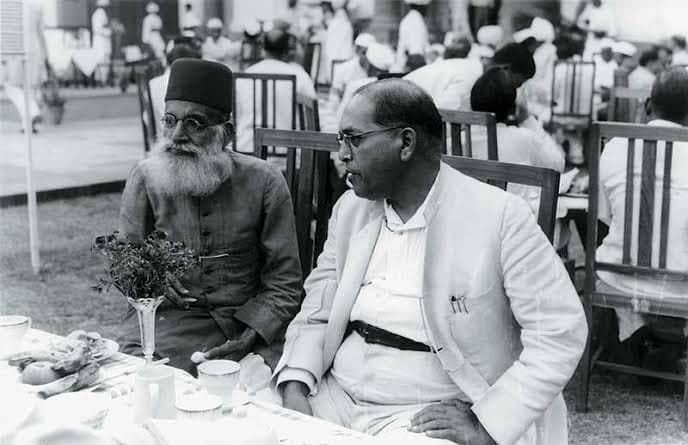
Long before independence, Maulana Abul Kalam AzadMaulana Abul Kalam AzadA senior leader of the independence movement, prominent scholar, and India’s first Education Minister, who fiercely opposed the partition of India on religious lines. emerged as perhaps the most powerful intellectual critic of communal nationalism. He rejected the suggestion that Indian Muslims constituted a separate nation whose destiny could be detached from the destiny of India itself. For Azad, such a proposition represented not historical realism but historical amnesia. (As Irfan Habib recalls in an interview, he was all but booed when he addressed AMU as a guest at the Convocation of the time.)
His argument was rooted in a sophisticated understanding of Indian civilisation. Over centuries, communities had lived together, traded together, governed together, spoken shared languages, developed common cultural practices and contributed jointly to the civilisation that eventually became India. The resulting culture was neither exclusively Hindu nor exclusively Muslim. It was composite.
Azad observed that history had brought the communities of India together in such intimate association that separating them into distinct historical entities required an act of artificial dismemberment. He regarded attempts to divide Indians into permanently antagonistic religious blocs as fundamentally inconsistent with the actual experience of the subcontinent.
The importance of his thought lies not merely in its defence of pluralism but in its understanding of memory. He recognised that historical grievances existed. He did not deny conflict, but the proposition that conflict constituted the totality of historical experience. Communities could not be reduced to their moments of hostility. The reality of India was far richer than any narrative organised around communal separation. That insight remains profoundly relevant today.
Historical memory often functions selectively. It remembers injuries and forgets coexistence. It remembers violence and neglects centuries of ordinary human interaction. Yet the constitutional project envisioned by Azad required precisely the opposite. It required citizens to recognise that shared history is larger than shared grievance.
If Nehru provided the constitutional framework and Azad supplied the civilisational vision, it was Dr. B. R. Ambedkar who supplied the deepest theoretical account of the dangers confronting the new Republic.
No figure in the Constituent Assembly understood more clearly the fragility of democratic institutions. On 4 November 1948, while introducing the Draft Constitution, Ambedkar articulated a concept that has become increasingly important in constitutional jurisprudence across the world : constitutional moralityConstitutional moralityA principle articulated by B.R. Ambedkar emphasizing that democracy requires citizens and institutions to actively respect constitutional values, not just its formal laws.. Ambedkar explained that constitutional democracy depends upon more than formal institutions. It requires habits of conduct. It requires respect for constitutional procedures. It requires fidelity to constitutional values. Most importantly, it requires citizens and institutions willing to subordinate immediate passions to enduring principles.
Ambedkar’s warning remains remarkably relevant : “Constitutional morality is not a natural sentiment,” he declared. “It has to be cultivated.” A constitution may establish courts, legislatures and executive institutions. It may enumerate rights and define powers. Yet none of these mechanisms can preserve democracy if society itself becomes indifferent to constitutional values.
Constitutions do not survive merely because they are written. They survive because they are internalised.
Ambedkar’s warning acquired even greater force in his final speech to the Constituent Assembly on 25 November 1949. He began by warning against abandoning constitutional methods in favour of extra-constitutional mobilisation. Having secured democratic institutions, citizens could no longer justify political action that bypassed constitutional processes.
His second warning concerned hero worship. In language that has lost none of its relevance, Ambedkar cautioned against placing liberty at the feet of even the most admired political leaders. Democracy required institutions stronger than personalities. The concentration of public loyalty in individuals rather than constitutional principles represented a permanent danger.
His final warning was the most profound. Ambedkar observed that India was entering what he described as a “life of contradictions.” Political equality had been achieved through universal citizenship and democratic participation. Yet profound social and economic inequalities remained.
Unless those inequalities were addressed, he warned, democracy itself would be endangered. His solution was neither purely economic nor purely political. “Political democracy cannot last unless there lies at the base of it social democracySocial democracyDefined by Ambedkar as a way of life that recognizes liberty, equality, and fraternity as an indivisible trinity essential for a lasting political democracy..” He then defined social democracy as a way of life founded upon liberty, equality and fraternity.
The significance of that formulation is important. Ambedkar did not treat liberty, equality and fraternity as independent values. He regarded them as an indivisible trinity. Liberty without equality would permit domination. Equality without liberty would extinguish freedom. Without fraternity, neither could survive.
Fraternity occupied a particularly important place in his thought. Unlike liberty and equality, fraternity concerns the emotional foundations of political community. It asks whether citizens recognise one another as members of a common civic enterprise. It asks whether political disagreements can occur without dissolving social solidarity. It asks whether the nation is held together by something stronger than temporary calculations of interest.
For Ambedkar, democracy ultimately depended upon fraternity. This insight brings us back to the problem of inherited grievance. A political culture organised around perpetual communal suspicion is fundamentally incompatible with fraternity. A society that encourages citizens to view one another primarily through the lens of historical injury gradually corrodes the moral foundations upon which constitutional democracy depends.
Ambedkar understood this danger because he had witnessed its consequences. The Constitution therefore sought to create a form of political association larger than inherited divisions. Citizenship was intended to become the primary basis of political belonging. Religious identity remained protected. It was not erased. But it was not permitted to define access to constitutional rights.
The Constitution’s guarantees of equality before law, non-discrimination, religious freedom and minority protection were all manifestations of the same principle. The state would deal with citizens as citizens. This was the Republic the framers envisioned.
It was not a republic of forgetfulness. The framers did not ask Indians to erase history. They had experienced too much suffering to indulge in such fantasies. Nor was it a republic of imposed uniformity. India would remain religiously, linguistically and culturally diverse. Instead, it was a republic founded upon a more ambitious proposition : that a society traumatised by division could nevertheless build a political community based upon equal citizenship.
The Constitution was therefore not merely a legal settlement. It was an act of collective faith. It represented a wager that constitutional identity could prove stronger than communal memory.
Whether that wager succeeds remains the defining constitutional question of modern India.
The responsibility for answering that question did not rest solely with the framers. It eventually passed to the courts.
The final stage of the constitutional story belongs to the judiciary, which was called upon to determine whether the promise of equal citizenship would remain a mere philosophical aspiration or become an enforceable constitutional reality. That chapter of our evolving constitutional reality, which the judiciary is today in the process of writing, shall be addressed next.
Jai Hind
Disclaimer:The views and opinions expressed in this article are those of the author(s) and do not necessarily reflect the official policy or position of The Rift.