Opening The Rift
therift
© 2026 The Rift. All Rights Reserved.
Women’s Resistance and Mobilization in Kashmir during the Tribal Invasion of 1947
Rather than remaining passive observers of the crisis, women organized themselves into a disciplined body dedicated to military training, political education, and social service.

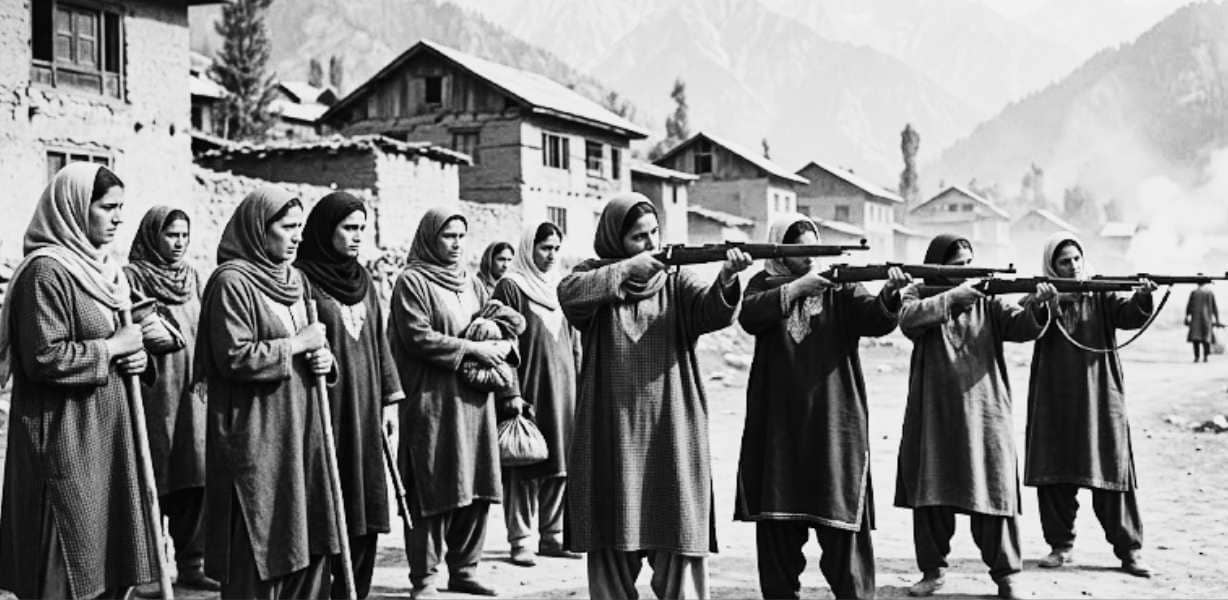
Image | Only Representative
Key Takeaways
1 of 3
Automatically generated. Read full article for complete context.
The tribal invasion of Jammu and Kashmir in October 1947 marked one of the most critical and traumatic episodes in the history of the region. Following the partition of British India, the princely state of Jammu and Kashmir became the focus of competing political and military claims by the newly created states of India and Pakistan. The invasion by tribal irregulars from Pakistan’s North-West Frontier plunged the state into a period of uncertainty, violence, and displacement.
While the military and political dimensions of the conflict have received considerable scholarly attention, the role played by Kashmiri women during this crisis has remained comparatively understudied. Yet, the events of 1947 witnessed an unprecedented mobilization of women who stepped beyond traditional social roles to participate in the defence, political education, and social welfare activities that became essential to the survival of the Valley during the emergency.
By November 1947, the situation in Kashmir had become increasingly precarious. With winter approaching rapidly, the Valley appeared vulnerable to both military encirclement and geographical isolation. Kashmir’s connection with the outside world depended largely upon routes that were threatened by conflict and soon to be obstructed by heavy snowfall. The population lived under the constant fear that the Valley might be cut off from friendly assistance at a moment of grave danger.
The advancing tribal forces left behind stories of violence and destruction that spread rapidly among the inhabitants of Srinagar and surrounding areas. Refugees arriving from Muzaffarabad, Baramulla, and neighbouring regions brought disturbing accounts of killings, looting, abductions, and the suffering endured by civilians. Particularly alarming were reports concerning women, who were often among the most vulnerable victims of wartime violence. News of atrocities committed in Baramulla and other occupied areas generated widespread anxiety among the population. These accounts, whether conveyed through refugees, official reports, or personal testimony, created a deep sense of urgency within Kashmiri society and contributed significantly to the mobilization of both men and women in support of the defence effort.
It was under these extraordinary circumstances that the Women’s Self-Defence Corps emerged as one of the most remarkable initiatives of the period. The organization represented an innovative response to the challenges posed by the invasion and reflected the growing political consciousness of Kashmiri women during the late colonial and early postcolonial era. Rather than remaining passive observers of the crisis, women organized themselves into a disciplined body dedicated to military training, political education, and social service.
Timeline: The Mobilization of Kashmiri Women (1947)
October 1947
Tribal invasion begins; reports of widespread violence and abductions reach Srinagar.
Oct-Nov 1947
Formation of the Women’s Self-Defence Corps (WSDC) led by Zenab Begum.
Winter 1947
Extensive military instruction (.303 rifles, sten guns) and political education for WSDC members.
Post-Emergency
WSDC shifts focus to community outreach, political education, and hospital relief work.
VISUALS BY THE RIFT
The formation of the Women’s Self-Defence Corps in 1947 was closely associated with women activists linked to the National ConferenceNational ConferenceThe dominant political organization in Kashmir, led by Sheikh Abdullah., the dominant political organization in Kashmir under the leadership of Sheikh Mohammad Abdullah. Among the leading figures were Zenab Begum, a veteran participant in the Quit Kashmir movementQuit Kashmir movementA 1946 political campaign against the Dogra monarchy in Jammu and Kashmir. of 1946, and sister of Ghulam Mohammad Sadiq, who later became a prominent political leader in the state. She was joined by several influential women, including Miss Mahmud, Principal of the Girls’ High School in Srinagar; Miss Uma Razdan, known for her work among students; Mrs. Mehraj Qureshi, Inspectress of Schools; and Mrs. Sumitra Inder Mohan.
Together, these women provided the leadership necessary to transform public anxiety into organized action. The movement quickly attracted support from women belonging to different religious and social backgrounds in Srinagar. Its appeal transcended communal divisions at a time when communal violence was engulfing many parts of the subcontinent. An executive committee was constituted to supervise the activities of the organization. In addition to its founding members, the committee included Mrs. Kamla Pandit and later Mrs. Freda Bedi, whose arrival added further strength to the movement. The participation of women from diverse communities demonstrated the broader commitment to the defence of Kashmir and reflected the National Conference’s emphasis on secularism and communal harmony.
Key Figures of the WSDC
President
Zenab Begum
Veteran of the Quit Kashmir movement and primary leader of the Corps.
Committee Member
Freda Bedi
English-born nationalist whose arrival added significant political strength to the movement.
Educators
Miss Mahmud & Others
Principals and inspectresses who helped transform public anxiety into organized action.
VISUALS BY THE RIFT
Zenab Begum was chosen as President of the Women’s Self-Defence Corps. Her long experience in political activism, combined with her ability to communicate effectively with women across the Valley, made her a natural choice for leadership. Under her guidance, the organization developed into a disciplined and energetic body capable of contributing to the wider defence effort. Military instruction for the Corps was arranged by Colonel Sher JungColonel Sher JungThe military officer responsible for arranging training for the WSDC and the Home Guards., who was also responsible for the Home Guards. Training was conducted through Kashmiri instructors, ensuring that instruction could be delivered effectively to women from different educational and social backgrounds. The military training provided to the members of the Corps was unprecedented in the history of modern Kashmir. Initially, women were trained in marching, drilling, and basic military discipline. They were also instructed in the use of the 303 rifle, the standard infantry weapon available at the time. The rifle was heavy and difficult to handle, especially for younger girls and elderly women who had volunteered to participate. Nevertheless, the trainees demonstrated remarkable determination and perseverance. Through regular practice, many became proficient in handling the weapon despite the physical challenges involved.
As training progressed, the most capable members were selected for advanced instruction. They were introduced to more sophisticated weapons, including sten guns and light machine guns. Some women also received basic training in the use of hand grenades. Although the Women’s Self-Defence Corps was never intended to function as a frontline combat force, the training reflected the seriousness with which the defence of Kashmir was being approached during the emergency. The very act of women receiving military instruction challenged conventional gender norms and expanded contemporary understandings of women’s roles in public life. The difficulties faced by the Corps were not limited to military training. The harsh winter conditions of Kashmir posed additional challenges. Members often cleared snow from their own parade grounds to ensure that training could continue uninterrupted. Such efforts reveal the extraordinary commitment of the volunteers and their determination to contribute meaningfully to the defence of the Valley despite adverse circumstances.
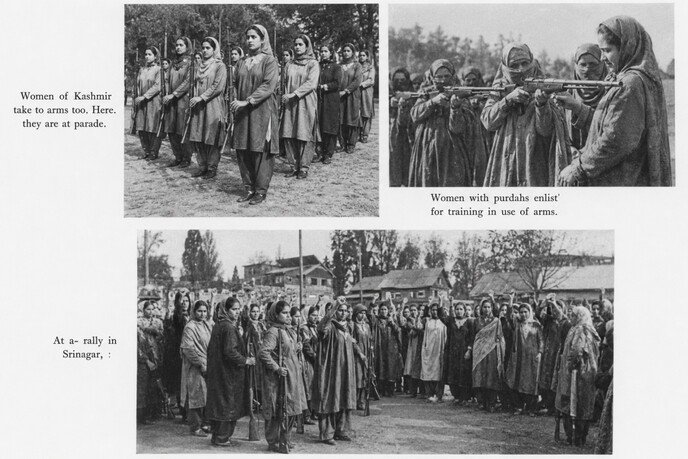
The success of the training programme became evident in a series of shooting competitions organized to test the skills of the participants. One such competition, held at the initiative of Lieutenant General K. M. Cariappa, later Commander-in-Chief of the Indian Army, demonstrated the effectiveness of the Corps’ training methods. Shakti Bhatia emerged as the winner by scoring seventeen out of twenty marks and was awarded the Cariappa CupCariappa CupA prestigious shooting award presented to WSDC members, named after Lt. Gen. K. M. Cariappa.. Another prestigious award, the Lakhindar Singh Cup, was won by Sajda Begum. These achievements not only reflected individual excellence but also served as symbols of women’s growing participation in public and national service.
Beyond military preparation, the Women’s Self-Defence Corps played a significant role in political education. The leadership of the organization recognized that the defence of Kashmir required not only military preparedness but also political awareness and social unity. Regular meetings were organized in which members received instruction on contemporary political developments and the broader significance of the Kashmir struggle. Colonel Sher Jung delivered lectures on elementary military techniques, while prominent leaders of the National Conference addressed members on political issues confronting the state. Women participants themselves contributed to these discussions, speaking about the rights, responsibilities, and social position of Kashmiri women. Such activities encouraged greater political participation among women and fostered a sense of collective responsibility toward the future of the state. Patriotic songs formed another important aspect of the Corps’ activities. Many of these songs had been popularized during earlier political movements and were adapted to the circumstances of 1947. Through music, speeches, and public gatherings, members developed a shared sense of purpose that strengthened morale during a period of uncertainty and fear.
After the immediate emergency subsided, the activities of the Corps expanded into community outreach. Groups of women travelled from neighbourhood to neighbourhood within Srinagar, explaining the political significance of the struggle and emphasizing the values of unity, democracy, and communal harmony. In doing so, they helped disseminate the political message of the National Conference while simultaneously encouraging civic engagement among ordinary citizens. Equally important was the social welfare work undertaken by the Corps. The humanitarian crisis created by the conflict generated urgent needs among soldiers, refugees, and civilians alike. Women volunteers responded by organizing relief activities that complemented their military and political responsibilities. Members regularly visited hospitals where they distributed fruits, sweets, eggs, and other essential items to wounded soldiers and patients. They also delivered messages of encouragement to those recovering from injuries sustained in the defence of Kashmir.
These visits served purposes that extended beyond material assistance. They symbolized the close relationship between the civilian population and those engaged in the defence effort. The presence of women volunteers in hospitals provided emotional support to patients and reinforced a sense of collective solidarity during a difficult period. The Corps also extended its services to civilian hospitals, where poor men and women received assistance and care. For many ordinary Kashmiris, these activities represented a visible manifestation of the social and political changes occurring within the state. The welfare work undertaken by the Corps reflected broader ideals of social justice and public service that were central to the political programme of the National Conference. Several women played particularly prominent roles in these humanitarian efforts. Among them were Mrs. Atri, Mrs. Lakhwara, and Sajda Begum, whose contributions were widely recognized. Their work demonstrated that the significance of the Women’s Self-Defence Corps extended far beyond military training. The organization functioned simultaneously as a defence body, a political institution, and a social welfare organization.
The experience of the Women’s Self-Defence Corps represents an important chapter in the history of Kashmir. It highlights the capacity of women to respond actively and effectively to moments of crisis and challenges traditional narratives that portray them merely as victims of conflict. The Corps provided women with opportunities for leadership, public participation, and political engagement that had previously been limited. At the same time, it contributed directly to the defence, morale, and social welfare of the Valley during one of the most difficult periods in its history.
The tribal invasion of 1947 undoubtedly transformed the political and military landscape of Jammu and Kashmir. Yet it also produced new forms of civic participation and social mobilization. The Women’s Self-Defence Corps emerged as one of the most remarkable outcomes of this period, demonstrating how ordinary women responded to extraordinary circumstances with courage, discipline, and determination. Their contribution remains a significant, though often overlooked, aspect of Kashmir’s history and deserves greater recognition within broader studies of conflict, gender, and resistance in South Asia.
Disclaimer:The views and opinions expressed in this article are those of the author(s) and do not necessarily reflect the official policy or position of The Rift.