Opening The Rift
therift
© 2026 The Rift. All Rights Reserved.
When Judiciary Delays, Executive Wins by Default in India
As of now, seemingly, the executive’s legislative, administrative and punitive actions do not need to survive judicial scrutiny if they can operate long enough to make the judicial scrutiny irrelevant.

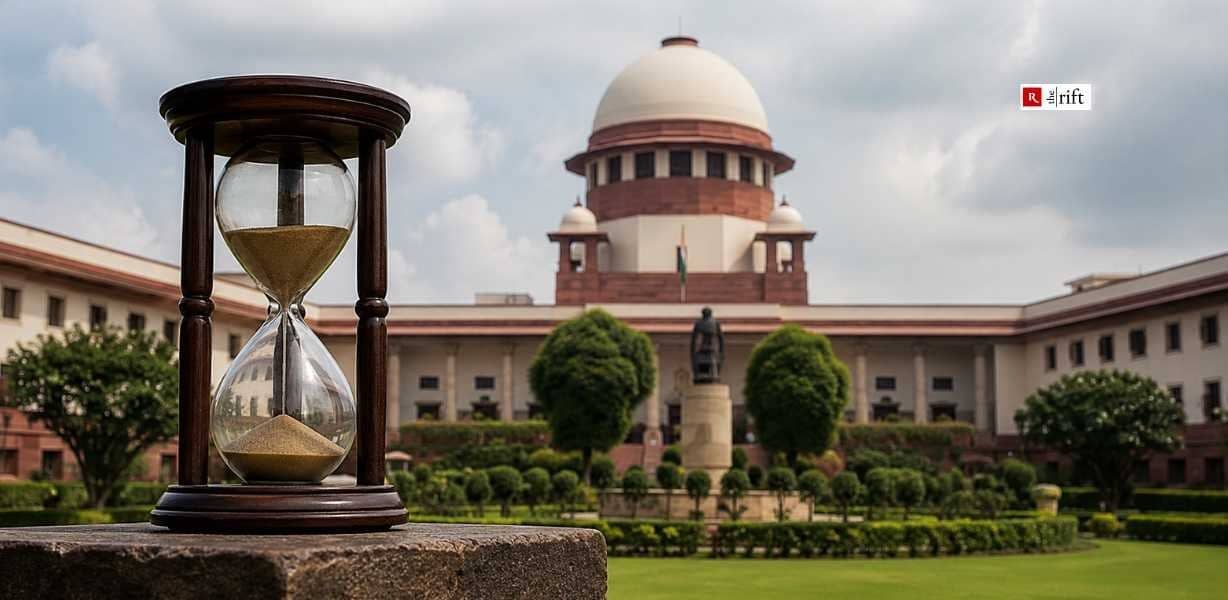
Image | Representative Only
Key Takeaways
1 of 3
Automatically generated. Read full article for complete context.
Constitutional challenges in recent years in India follow a pattern that has become grimly predictable. A sweeping executive action is announced followed by petitions by the aggrieved parties prompting the apex court to issue notices. Then begin the procedural delays for months and years with executive actions already becoming an irreversible ground reality. By the time the court finally decides on the matters, the executive actions have already caused or achieved its intended objectives with a near impossibility of reversal. This has led to a situation where the executive does not need to win the argument in the court anymore, it needs only to outlast the actionable period to ensure that the judgment is only a formality with the Special Intensive Revision (SIR)Special Intensive RevisionAn exercise conducted by the Election Commission to update and purify the electoral rolls by adding new voters and deleting dead or shifted voters. being the latest such case.
This pattern is not about every case being filed in the court, it is about only those specific cases that challenge the constitutional limit of the executive actions where the delay in its adjudication carries consequences that cannot be undone easily later.
Important Cases (2017-2024)
SEPT 2017 – FEB 2024
Electoral Bonds Scheme
Scheme allowed to run for 6 years and 5 months before being struck down. By then, ₹16,518 crore had funded multiple elections.
AUG 2019 – DEC 2023
Abrogation of Article 370
Court let 4 years and 4 months pass before final verdict. State’s administration, land rules, and constituencies were already fully restructured.
DEC 2019 – ONGOING
Citizenship (Amendment) Act
Pending for over 6 years. Government notified rules just before 2024 elections; SC declined to stay. Citizenship is actively being granted.
SEPT 2020 – ONGOING
Umar Khalid’s UAPA Arrest
Incarcerated for nearly 6 years without trial. Bail pleas faced repeated adjournments, bench reconstitutions, and judicial recusals.
EARLY 2026 – MAY 2026
West Bengal SIR Purge
27 lakh voters barred from election. Supreme Court upheld the revision only after every ballot was cast and new government formed.
VISUALS BY THE RIFT
Electoral Bond Scheme
For instance, the Electoral Bonds Scheme was introduced in the 2017 Union Budget which was challenged by September 2017 itself by the Association for Democratic ReformsAssociation for Democratic Reforms (ADR)An Indian non-partisan, non-governmental organization working on electoral and political reforms. and other Parties with a straightforward argument that citizens have a right to know who finances the political parties seeking their mandate. The scheme had allowed unlimited, anonymous corporate donations to political parties with no disclosure.
For over six years, the Supreme Court let the scheme run with procedural delays. The 2019 general election and multiple state polls were held in this interim period despite the stay being sought before these elections. Over 30 tranches between 2018 and January 2024 totalling approximately ₹16,518 crore were funnelled through the electoral bond scheme. The party in power at the centre cashed nearly half of that amount, roughly over ₹6,986 crore.
Electoral Bonds Sold (2018-2024)
Total Electoral Bonds Sold
₹16,518 Cr
(2018 – Jan 2024)
Ruling Party Share (BJP)
~₹6,986 Cr
Nearly 50% of total funds
VISUALS BY THE RIFT
A five-judge Constitution Bench finally struck down the electoral bonds scheme in February 2024, celebrating the ruling with a landmark defence of the Right to information. But, by then the damage was already done. A huge amount of money had already changed hands in an opaque manner funding the political parties.
Elections held during that period including the 2019 and 2024 general elections (2024 general election was held just a few months after the electoral bond judgment) shaped by that money had already been won or lost. The court delivered a constitutional victory but the executive had already pocketed the political one.
This six-year and seven-month period before the final judgment arrived could not be simply described as a procedural delay. This delay allowed the BJP to encash the largest amount of money out of that scheme in legally mandated opaque transactions without accountability and with no knowledge of what favours the party in power might have extended to those who donated. This delay in effect placed the ruling party in a structural advantage over the opposition, an advantage which the final judgment could possibly never undo.
This pattern is visible in all the important cases challenging the executive actions particularly of the Union government.
Abrogation of Article 370
For instance, petitions landed on the Supreme Court docket within weeks after the Union government abrogated Article 370 in August 2019, bifurcating the state of Jammu and Kashmir into two Union Territories. The Attorney General on behalf of the Union government explicitly told the court that the abrogation has already become a fait accompliFait AccompliA thing that has already happened or been decided before those affected hear about it, leaving them with no option but to accept it., thus should be accepted as a fact by everyone.
The court did not reject that framing and let the days pass by. When the final, unanimous verdict upholding the abrogation arrived in December 2023, more than four years later after the executive action, the entire bureaucratic and political administration of the region had already been restructured with new domicile laws, land ownership rules and delimitation of constituencies. Imagine, even if the court had found the abrogation constitutionally illegal and flawed, reversing the administrative machinery of an entire former state after four years of federal control would have been an exercise in fiction. The delay did not just benefit the government’s position. It became the government’s position.
The SIR Case
The most recent iteration of this pattern is the Special Intensive Revision of electoral rolls in several states. In the particular case of West Bengal, in the months before the April 2026 Assembly election in Bengal, the Election Commission conducted an SIR resulting in the deletion of roughly 91 lakh names from the state’s voter rolls. This deletion amounts to approximately purging 12 per cent of the total electorate. Of these, around 27 lakh voters were categorised as “under adjudication” for alleged documentary discrepancies. Just before days of election, on the order of the apex court, few of the total 27 lakh were heard and allowed to include their names in the electoral rolls. Remaining, 27 lakh voters simply could not even get the chance to appeal and thus were barred from voting in the election.
West Bengal Voter Roll Deletions (2026)
91 Lakh
Names Deleted from Rolls
12%
Of Total Electorate Purged
27 Lakh
Placed “Under Adjudication”
VISUALS BY THE RIFT
On May 27,2026 a bench led by Chief Justice Surya Kant upheld the SIR’s constitutional validity. The judgment came after every ballot was cast and every seat decided with new governments already in place. The court found that the “data placed on record does not disclose a level of disenfranchisement so widespread or systemic as to indicate a constitutional infirmity in the design of the exercise.”
For the voters who were struck off the rolls and watched the election pass without them, the distinction between a constitutional process and an unconstitutional one was merely a jumlaJumlaA Hindi/Urdu term popularized in Indian politics referring to a false promise or a rhetorical gimmick used to win elections.. The election was over. The seats were filled. The new government was already formed. Now the opposition parties will have to live with this new reality. Even if they had won the case in the eyes of the law, they have lost the election. So, this delay in the judicial process is a benefit for the ruling party and a loss for the opposition parties even if they had won the case in the court.
Citizenship Without a Court (CAA)
The same logic is playing out with the Citizenship (Amendment) Act. Passed way back in December 2019 amidst nationwide protests, the CAA was challenged by over 200 petitions. The Union government asked for six months to frame the rules for implementing the law. After this six-month period the final hearings of the cases were repeatedly deferred. When the Union government notified the CAA rules in March 2024, weeks before the general elections, petitioners sought an urgent stay. They argued that granting citizenship under a potentially unconstitutional law is an irreversible act and it cannot be revoked once conferred.
A bench led by Chief Justice D.Y. Chandrachud declined to stay the rules. The final hearing was scheduled in May 2026 with no indication of when it will conclude. Now, every month of this delay is a month during which citizenship can be granted, administrative records can be altered making the reversal of the decision difficult and costly. Even if the court rules the law unconstitutional, it has already given a de-facto legal sanctity to the law.
Consider the farm laws with a different flavour of the same problem. The Supreme Court stayed the three farm laws in January 2021 and appointed an expert committee. The committee submitted its report in March 2021. After this The court then went into a slumber. No hearings were scheduled and no constitutional questions were addressed. The government then in November 2021 repealed these farm laws on its own rendering the legal challenge moot. The apex court never told India whether those laws violated the Constitution. The question was simply erased.
The Delay as Punishment (UAPA)
This pacing logic exacts its most devastating toll on individual liberty. Although the court has granted bail to several UAPA accused recently with hopeful observations with the notable exceptions of Umar Khalid (Khalid has been granted 3 day fleeting bail to see his ailing mother) and Sharjeel Imam (previously Imam has been granted 10 days bail to attend his brother’s wedding in the month of march), the basic problem of delayed justice continues.
Section 43D(5) of the Unlawful Activities (Prevention) Act, 1967UAPAIndia’s primary anti-terrorism law that allows for prolonged detention without trial and makes getting bail extremely difficult., strikes at the heart of this process. Though the court in its previous judgment of Union of India vs K.A Najeeb unequivocally said that statutory restriction can not eclipse the rights under Article 21Article 21A fundamental right in the Indian Constitution that guarantees protection of life and personal liberty. of the Indian Constitution. Yet, five years later, the court does not seem to follow its own ruling with consistency. Apparently, the current jurisprudence, entirely depends on which bench is hearing the petition.
According to reports, between 2019 and 2023, the government made over 10000 arrests under the UAPA, with securing only 335 convictions. A conviction rate of roughly 3.2 per cent. The delay here is not procedural or incidental to the punishment, the delay is the punishment.
UAPA Arrests and Convictions (2019-2023)
Conviction Rate
3.2%
Total Arrests
10,000+
Convictions
335
VISUALS BY THE RIFT
The case of Umar Khalid is particularly concerning. He was arrested in September 2020 and has spent over five years in Jail. His bail pleas were consistently faced with repeated adjournments, bench reconstitutions and a judge recusal. In February 2024, he withdrew the plea to try his luck in the trial court. In January 2026, the apex court denied him bail again.
In May 2026 a different bench expressed ‘serious reservations’ over his continued incarceration and denial of bail. The Court has now referred the broader constitutional question, whether prolonged incarceration under the UAPA violates Article 21, to a larger bench. Whatever the outcome of this case may be, Umar Khalid remains in Jail after spending three days on fleeting bail in June to see his ailing mother. With this slow justice system, the government is being granted consistent forever temporal impunity to target whoever it wants to.
The apex court delaying the important constitutional cases consistently, only grants the executive a form of impunity that no law provides. As of now, seemingly, the executive’s legislative, administrative and punitive actions do not need to survive judicial scrutiny if they can operate long enough to make the judicial scrutiny irrelevant.
With Electoral bond scheme running over for six years before being declared as unconstitutional, Citizenship (Amendment) Rules 2024 notified just weeks before the 2024 Lok Sabha elections despite ongoing legal challenges, Article 370 abrogation transforming into a hardened administrative and political reality over 52 months, the farm laws being repealed even before the court could decide its constitutionality, the SIR case judgement after the elections are over with millions deprived to vote and thousands of individuals already spent years in jails under UAPA without any trials, the court is only trying to catch up with the time and circumstances that has already passed with far reaching consequences.
The judicial calendar, on the face of it, is no longer a neutral instrument. It seems to have become the executive’s unwitting ally in making its most contested decisions fait accompli
Until the Supreme Court devises an enforceable mechanism for time-bound disposal of cases challenging the structural limits of the Indian democracy, delay will remain the most reliable strategy by the executive and the Court’s most consequential abdication to deliver justice while millions of Indian citizens suffer.
This article first appeared on Countercurrents.
Disclaimer:The views and opinions expressed in this article are those of the author(s) and do not necessarily reflect the official policy or position of The Rift.