Opening The Rift
therift
© 2026 The Rift. All Rights Reserved.
Once a Writer, Always a Witness: Five Decades of Reporting from the Margins
My over five decades of experience as an independent writer can be useful for young people who have similar aspirations.

Key Takeaways
1 of 3
Automatically generated. Read full article for complete context.
As a teenager I took a rather strange decision—that I would spend my entire life as an independent writer and will not even look for a regular job.
In college I had started writing freelance and fortunately one of my articles was published as the lead article in the top newspaper of India. Another one was reprinted in the USA bringing what then appeared to be a princely earning.
This may have contributed to my decision, but the bigger and less encouraging reality was that I had no financial base to support the luxury of rejecting the option of full time jobs. It was highly unlikely that just my love for writing in a very independent way would help me to meet my essential expenses and family responsibilities. So there was at least some temptation when I got a job offer from a top publication in my very first year as a full-time independent writer, but somehow I could bring myself to say no—very politely yet firmly.
The next big question for me was—having decided to devote all my working time to independent writing, what exactly my priorities should be.
Bharat Dogra
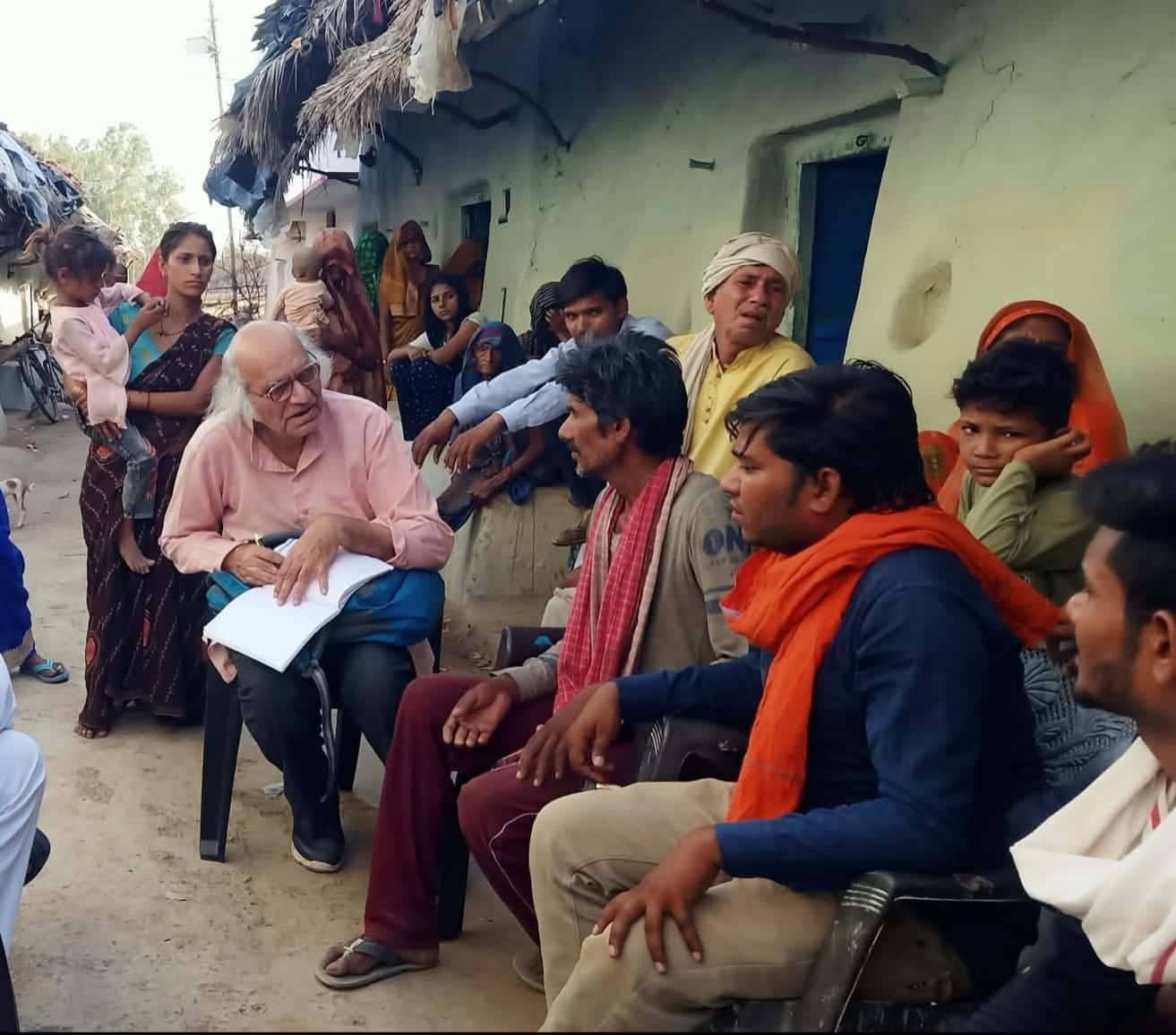
In the mid and late 1970s in India, the issues of poverty and meeting the basic needs of all people, with all the accompanying concerns of justice and equality, appeared to be the most important. So I made this my first priority and started visiting remote villages for such reporting. This was not easy for me as I had spent all my student years in India’s capital city of Delhi. However it was also something exciting even with all its difficulties, in fact, at times, I felt it was because of its difficulties!
Soon enough, in about five years or so, my identity as someone reporting and writing on grassroots realities was well-established, a far cry from my writing in my college days when I had specialized in cinema!
In fact some of my early success with such writing that was published in leading newspapers of India surprised even me. A number of journalism awards followed, bringing perhaps even more happiness to my ageing parents than to me. Again to my surprise, this success was repeated when I started writing in Hindi language as well and here I received some top awards not just from professional organizations but from the government as well.
Meanwhile romance bells were ringing too and marriage at a rather early age brought more happiness. Madhu accepted all the peculiarities of my life—frequent travels, irregular work hours, unstable income—as an independent writer without voicing any problems and helped in many significant and affectionate ways. Soon our small home was receiving more than its share of visiting activists and writers, several of whom became family friends. Prominent British writer Jeremy Seabrook, who used to travel a lot during those days, became a regular visitor to our modest flat and said that he gets the best welcome here.
Life cannot continue to be so happy for too long and soon I had my share of problems, sometimes more than my share.
A difficult call came. In a remote forested area women living in secluded hamlets were being molested by dacoits. “Can I come to report on this?” asked a social activist working among these communities?
On the face of it this appeared to involve high risks. Our daughter whom Madhu named Bharti had just been born and frankly I was in no mood then to tear myself away from newly found parental bliss. However, the call of duty beckoned and so I went by the next night’s train.
Bharat Dogra
As we were noting testimonies of several victims in remote forest hamlets, a message came that a dacoit gang was nearby and had summoned us. We had no choice but to go. As we walked, following the messenger, the dense leaves of what outwardly appeared to be a row of trees parted to reveal dacoits with firearms and bullets.
Fortunately, the dacoits were polite. Their leader said he wanted us to know that his particular gang was in no way involved in the molestation of women as it had its own ethical code. This was the work of some upstarts and he would like to curb their wrong activities, he said.
The more difficult part came when the dacoit leader subjected us and particularly me to some tough scrutiny to ensure that we would not harm his interests in any way. I felt fortunate to get away unharmed.
I was not so fortunate while covering a village where some persons had died after consuming contaminated water. While returning pillion riding on a motorcycle on a steep hill, the vehicle tumbled and I was badly injured. My teeth suffered permanent damage and lips were swollen beyond recognition. On top of this I had to undertake an 18-hour bus journey in this condition from Udaipur to Delhi. However I can add with some pride that my report on contaminated water-related deaths was still published prominently in a leading newspaper.
In one of my field trips I met prominent environment activists Sunderlal Bahuguna and Vimla Bahuguna. Extended talks with them and younger activists of the chipko (hug the trees) movement, like Kunwar Prasun in the Himalayan region helped to greatly increase my understanding of environmental issues.
One day Sunderlal Bahuguna came to our home and said that I must accompany him to a village in Kotdwar district in the Himalayan foothills to expose a serious case of land being grabbed by a powerful person from those landless and poorest households who had received plots of farmland under the bhoodan or gift of land movement.
As this was a new area for both of us, we lost our way and finally reached what appeared to us to be our destination when night had set in the peak of cold weather conditions. However, as we soon learned from the villagers who had sheltered us, this was actually not the village of the victims but instead that of the ruthless land grabber. When they learnt about our objectives, the scared villagers said that they would not be able to protect us if the land-grabber and his goons came to know about our presence in the village and we must leave this place very early in the morning. Instead, they woke us soon after midnight saying that somehow news about our presence had reached the land grabber and we must leave immediately. So we left in a bullock cart in the bitingly cold weather in the late night.
However, all the hard work appeared to be amply rewarded when a senior local official later sent me a message through a common friend that he had used my report as a base for ordering a detailed inquiry into the land grab and this in turn led to strong action being taken against the land grabber and for restoring the land to those tribal households to whom it rightfully belonged.
It is easy to lose track when visiting remote areas for the first time. So it happened again in the Chambal region of Central India: when walking a long distance on a hot afternoon, my nose started bleeding profusely, and I headed for the nearest village in search of medical help and cold water. It so happened that the nearest house—in fact, quite a mansion—turned out to belong to the same big landlord against whom I had been collecting evidence of several kinds of wrongdoing. I was lucky to get away with some first aid, without my identity being revealed.
Here in Chambal social activists inspired by Mahatma Gandhi had succeeded in obtaining the peaceful surrender of many once dreaded dacoits. The villages of Chambal, which had lived in terror of dacoits for long were now beginning to experience peace. In the course of several visits I reported on this inspiring change and interviewed several dacoits who had surrendered and were now leading a peaceful life. This brought me face-to-face with the importance of nonviolence in our increasingly troubled world. Subsequently, I became increasingly involved with several social movements and efforts for bringing important justice-based changes and social reforms while following the path of nonviolent protests and struggles, something which has a rich tradition in India from the days of the freedom movement against the colonial rule led by Mahatma Gandhi— This also encouraged me to study India’s freedom movement in greater detail—the nonviolent struggles as well as revolutionary movements—resulting in two books and several booklets, apart from many articles, which were very well received by readers.
It is highly encouraging for a writer if his writing proves helpful for people in need. A column on weaker sections of society that I started for the leading Hindi newspaper in Delhi brought regular feedback of remedial actions being taken to sort out several problems of people to which the weekly column drew attention. Reports from drought- and flood-affected areas led to more relief supplies becoming available. In Gujarat, farmers displaced by pipelines were not getting proper compensation for lost land. A local activist invited me to report on the distressed farmers here, and my report was published in a leading newspaper. The activist told me later that this had helped their campaign to get significant compensation for the farmers.
For achieving even better results, I evolved a new strategy particularly when reporting from disaster zones or special problem areas. After finishing my fieldwork, I started addressing local press conferences before returning to Delhi. Thus, even before I started my own writing in greater detail, several short news reports on my findings in different villages were already published in local pages of several newspapers, resulting in some immediate impact as local officials were sure to read these short news reports.
Such successes encouraged me to work on longer term basis with several social movements including, apart from the Chipko movement mentioned earlier, the movement of iron ore miners and industrial workers in Chattisgarh, a national campaign of construction workers, a campaign for rights of homeless persons in Delhi, local and national campaigns for right to information and right to employment in rural areas and several movements for the reconsideration of major dam projects with safety and displacement concerns and various other ecologically disruptive projects.
Some of the important social campaigns in India have centered on the demand for protective laws relating to vulnerable and weaker sections of society. As a journalist, I could contribute at various stages of these campaigns: first, for making a strong case for these laws, and later after the laws had been passed, for their proper implementation in the right spirit. Sometimes, it was helpful to bring out pamphlets and booklets in which the case for the laws could be argued more strongly and in greater detail, compared to the limited space and other limitations of big newspapers. Some of the campaigners told me that my booklets had been quite useful for them. Similarly I tried to play a helpful role in the legislation relating to the right to employment in rural areas.
The campaign for the right to information became one of the most democratic campaigns in India. I was fortunate to be associated with it from an early stage when the demand for the right to information was being raised in the context of struggles of workers and peasants in Rajasthan. This ultimately became a big national-level movement. I wrote many newspaper articles in support of this campaign, apart from bringing out several booklets, two books, and even editing and publishing a journal in Hindi on the right to information for some time. Finally, when a national committee was formed to carry forward this campaign, I was selected to be the coordinator in the initial phase.
These and other campaigns involved work continuing for several years. As an independent writer, I could sustain this commitment, unlike some other journalists who could not help it if their assignment or ‘beat’ was changed. In the case of construction workers the law that was eventually passed made available huge amounts of budget for welfare of the workers. However, this had to be followed by a long effort to ensure proper implementation, and I found myself returning to this subject almost every year.
Another regular subject related to ensuring better facilities at various slums and trying to prevent slum demolitions. Here also, in order to draw immediate attention and in greater detail, sometimes it was more important to bring out pamphlets and booklets. A very sincere woman activist, Nirmala Sharma, was very active in Delhi on this front for several years and whenever possible I rushed to help by writing on preventing demolitions and taking up other issues raised by her. She and her colleagues were constantly trying to help women who had been victims of violence, and I tried to help by writing about several such cases.
One of the most courageous struggles in India was that of the iron ore miners of Dalli Rajhara, in Chattisgarh. This struggle was led by Shankar Guha Niyogi, a trade union leader who took a comprehensive view of the welfare and social concerns of workers while also integrating their struggles with the efforts of nearby villagers to resist injustice. I visited these struggle areas repeatedly for reporting from here, particularly when the struggles faced difficult times. The trade union said my work had been very helpful for them.
These efforts included visiting this area with a civil liberties team as one of its members at the time of the arrest of Niyogi. This opened up a new way of working in cooperation with others and subsequently I went as a member of such teams to several other areas to report on important issues of justice.
Some of the more difficult reporting involved travelling to villages where the poorest people had been attacked or hurt by the powerful ones. Often the car or jeep could not go up to the homes of the poorest people and one had to walk for a certain stretch. This was a difficult time as sometimes the more powerful persons tried to stop or worse still set ferocious dogs after me.
The efforts of Ekta Parishad and some other organizations to revive land reforms and make available at least some land to the landless rural people were highly relevant and I made continuing efforts to write on these efforts.
Bharat Dogra
Some of my writings on environmental movements related to the adverse impacts of indiscriminate mining and ecologically disruptive projects. Activists who went to Supreme Court to stop highly destructive mining told me that my pamphlets were very helpful for getting a favorable decision from court and the judge had in fact referred several times to this writing.
Another important part of this work was my extended campaign to plead for ecologically protective farming and natural farming. This necessarily involved preparing a strong critique of those dominant policies which emphasized using high doses of chemical fertilizers, pesticides and herbicides, or spreading seeds which facilitated these. In this and other aspects of development writing I had to struggle hard to present the perspective of sustainable and ecologically protective farming as big business interests favored other policies including spread of GM crops. My wider campaign also included efforts to retain and protect bullocks which were being discarded following the very large-scale spread of tractors and other farm machinery.
Some of these writings were also published abroad, particularly in the UK based prestigious journal The Ecologist and our family was delighted when its editor, renowned environmentalist Edward Goldsmith visited our home with his family.
In fact, one of the most rewarding aspects of working with several social movements was to have the friendship of some highly inspiring persons. There was so much to learn from persons like Vimla and Sunderlal Bahuguna and Shankar Guha Niyogi.
Bharat Dogra
Several editors who were regularly publishing my work also became good friends. The editorial offices of even some of the biggest newspapers used to be much friendlier and informal during my younger days. I was contributing regularly to the edit and oped pages of the Indian Express where we had such senior editors as Ajit Bhattacharjee, Balraj Mehta, Sumer Kaul, Ravindra Nath and Modhumita Mozumdar. They were all very friendly and in particularly several writers like me will not forget the gentle manners of Ravindra Nath who kept in touch even after going back to his home state of Kerala. As a young writer I could walk in even without appointment to briefly discuss pending and future articles or collect books for reviewing. I could say the same for The Hindustan Times, or for leading Hindi newspapers like Navbharat Times, Hindustan and Jansatta. Some of the most renowned editors of those days like Nikhil Chakravartty and Romesh Thapar were very welcoming, very encouraging even to a new writer like me. Sumit Chakravartty in fact became a close friend. Some editors based outside Delhi became friends just in the course of exchanging letters, Darryl D’Monte being the most memorable among them.
In the middle of all this my ideas were evolving so that it became increasingly clear to me that some of the more pressing problems facing the world can be resolved only if the world is based more firmly on a combination of justice and equality, nonviolence and peace, protection of environment and of all forms of life.
Such realizations led to increasing involvement in world affairs and international relations with a strong perspective of peace. My books on the Iraq war were an important opportunity for me to reflect more on the wider world issues. This also led to my realization that a combination of serious environmental problems (led by but not confined to climate change) and accumulation of weapons of mass destruction had led to the emergence of a survival crisis or an existential crisis on our planet. This realization combined with earlier work led me to taking a clear stand that while the resolution of this survival crisis must get the highest priority, this must be sought to be achieved within a framework of justice, democracy and peace.
As this realization became more and more important for my understanding of the world, I concentrated more on taking forward this work and wrote five books in English and Hindi on this issue. Apart from asserting the very high importance of resolving the survival crisis I raised a more specific demand that the next decade should be declared as the decade for saving earth at world level, finally turning this into a campaign.
Realizing the importance of giving more time for this work, I decided to give up the several honorary positions I had taken up on the request of several social movements and campaigns, including for tasks such as extending help to social activists and helping homeless persons in Delhi in various ways.
Bharat Dogra
I now became more conscious regarding the need for alternative paths of development, more specifically about what the policies and patterns of development should be in order to achieve the objective of resolving the survival crisis within a framework of justice and peace. When I visited villages for field work, even then I was thinking more along these lines. The questions in my mind were more and more like this—how can the sustainable livelihoods of small farmers be improved in such a way that increasing climate resilience is also achieved.
In addition, I was increasingly more concerned about peace in international affairs and nonviolence in daily life. A lot of my writing now is related to this. This includes a lifetime of work on the unity and harmony of people of different religions and faiths, which is of great importance in South Asia where we often refer to such work as the promotion and protection of communal harmony. My booklets on communal harmony were very widely used in these campaigns and had to be reprinted time and again.
I also realized that in my new framework of working in a campaign mode, and the campaign being entirely devoid of any funding, my earnings will be reduced further. Despite some early recognition of my work in the form of awards, the greater part of my decades of writing had been carried out in the middle of economic difficulties. This appeared set to increase now. So I looked around for how I could increase my earnings.
As we realized early on that not all that we want to say can be published in media, we had set up our own cottage scale publishing house called Social Change Papers. Madhu had helped a lot in this, and so had our daughter Reshma Bharti. Both of them contributed with writing as well as other help so that despite being short of resource we could participate several times in the World Book Fair in Delhi as well as in other book exhibitions and also could supply orders to several libraries. The helpful role of my office assistant Ishwar Singh was also of great value, as was that of the printer of most of our books Kuldeep Kulshrestha. Soon our books became well-known among social activists. Madhu helped also to combine these with other books to supply readymade sets of books to set up community libraries in many places. We tried to increase sales of our books. We also started a press clippings service. However these efforts declined during the Covid pandemic. Many payments due to us were never made. The book storage place we had been able to rent had to be vacated in a hurry, creating a crisis situation.
We gradually recovered, helped by the work I took up to document the many-sided achievements of several social organizations. While I continue to write regularly even now on daily basis at the age of 70, economic viability is getting increasingly difficult.
A remarkable aspect of my writing for over five decades is that I have never experienced a ‘burn-out’, never found it difficult to write and never was at a loss to decide about what more to write. In fact even in old age I am still full of ideas in the morning regarding what to write today. I am fortunate that my writings continue to be well-received even today, not just articles but also short stories and poems, as judged from the feedback I receive from several readers, including eminent scholars.
Myself and Madhu are devoted grandparents now, and happy to accept the responsibilities that come with this. However still I am as keen as ever to utilize whatever time I get for any writing that is of high social relevance. Very recently young friends told me these are times more of videos than of articles, and helped to start my YouTube channel. I am still in the early stage of learning how to take forward this channel (Bharat Dogra| Save Earth Campaign).
Looking back at the nearly 12,000 published articles, reports and features, several short stories, poems and novellas and about 400 books and booklets, their usefulness is of course entirely for others to judge and evaluate, but what I can assert with confidence is that it has always been my effort to contribute writings of high social relevance. More information about my books and booklets can be seen at my web-site (bharatdogra.in).
Bharat Dogra
Independent writers have an important role in media and democracy. My own experiences of over five decades have strengthened this belief with which this journey started. One hopes that the conditions in which independent and unbiased writers work can improve and some important initiatives can be taken in my country as well as at the world level for this. In particular in present conditions it is important to support writings related to justice-based peace and nonviolence.
My over five decades of experience as an independent writer can be useful for young people who have similar aspirations, and this is one reason for writing about this. Another reason is that this can hopefully inspire some efforts for providing more encouraging and conducive conditions for independent writers.
Despite difficulties, my efforts continue. Once a writer, always a writer.
Bharat Dogra
Disclaimer:The views and opinions expressed in this article are those of the author(s) and do not necessarily reflect the official policy or position of The Rift.
*Independent WritingCommunal HarmonyEnvironmentalismExclusiveGrassroots ReportingIndiaJournalismNonviolenceSocial Activism